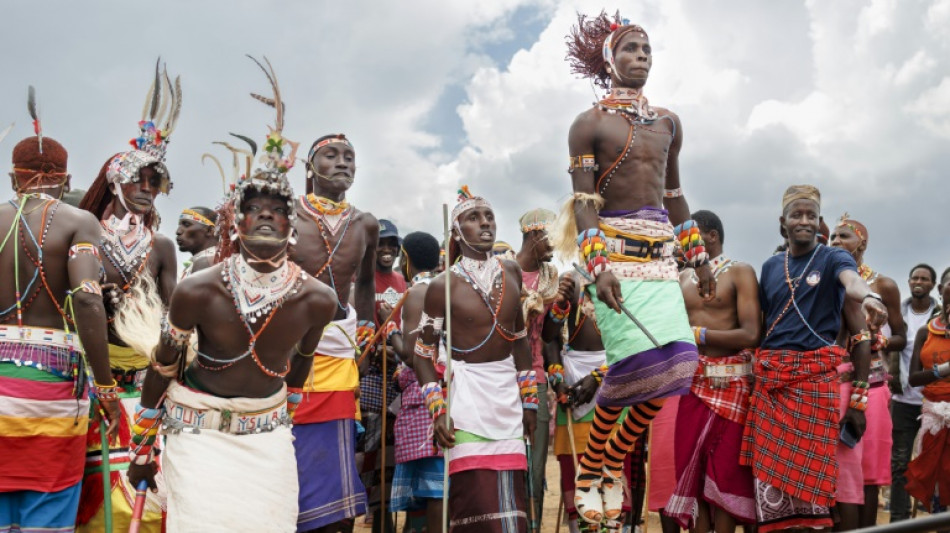
Resilient but threatened, Kenya celebrates Maa culture / Photo: Tony KARUMBA - AFP/File

 Thai, Myanmar military chiefs meet as post-coup thaw progresses
 Asian stocks rally as US Treasury steps in to ease bond fears

 Verstappen signs new Red Bull contract until 2030: team

 What property giant Evergrande's sentence means for China's economy

 Australian prosecutors demand life in prison for mushroom killer
 Fallout far-reaching for Australian Rules after latest scandal

 Rafts on Rome's Tiber River cool down overheated tourists
 Top seeds Sabalenka, Zverev stunned in Cincinnati fourth round

 Australia says relations with Israel 'difficult' after aid worker death

 PSG start Ligue 1 defence with eye on Champions League hat-trick

 Arsenal can become world's best club: Arteta
 Japan's King Kazu, 59, scores twice from spot to make cup history

 Kyiv's desperate vendors persevere outside obliterated flea market
 Australia races to shield little penguins from H5N1 bird flu

 Messi scores first goal since father's death

 US national debt exceeds $40 trillion for first time
 Brazilian narco violence spills over into tranquil Bolivia

 Trump's devoted 'human printer' in media glare

 Top seed Zverev bundled out by Paul in rain-hit Cincinnati upset

 WADA pledges vigilance on Russian athletes ahead of 2028 Olympics

 NASA satellite rescue mission fails

 Cobolli halts Jodar to reach Cincinnati quarter-finals

 As election looms, Netanyahu puts Turkey in Israel's crosshairs

 McIlroy questions LIV stars 'value' as talk of PGA return builds
 'Breakthrough' mRNA cancer drug curbs melanoma in large trial

The Maa Festival celebrates one of the best-known parts of Kenya's culture, which has been remarkably resilient even as it is strained by modernisation and climate change.
At this week's festival, which brought members of Maa tribes from across Kenya to the Samburu national reserve in the north of the country, modern technology sits comfortably alongside ancient culture.
In a straw-topped dung-walled hut, a group of women pass around smartphones and a tablet to share pictures of members of other sub-tribes they have met.
On a main stage, groups combine contemporary beats with the hypnotic guttural throb of Maa chants, while elsewhere people in dazzling beads and headdresses leap and dance in circles that speak of much older traditions.
Kenya has dozens of tribes, but it is the pastoralist Maa communities -- named after the language they share -- that have held on to ancient dress and customs the longest, becoming beloved symbols of the country as a result.
- 'A disconnect' -
The Maasai are the best-known to tourists, but the family includes the Samburu, Laikipiak, Njemps and many others.
"The Maa lived very communally," said Stella Napanu of the Northern Rangelands Trust, a conservation group run by local indigenous communities.
"That strengthened them and helped protect their culture from outside influences."
Climate change is a threat to the Maa, however.
Dwindling water resources have forced herders to travel further from their families, straining community ties.
"There's a disconnect between elders and young people because of this and it has weakened our government structures," said Napanu.
Other changes have been more positive.
Maa musicians have new outlets like YouTube to foster pride in their culture. Some travel as far as France and Australia to perform.
"God has given us this culture, so we must preserve it for our children," said a woman who recently travelled to Germany to show off her beadwork.
But communal living is unlikely to survive the lure of the city.
"Some parts of our culture will not last much longer," said Nasieku Letipila, 42, who runs Samburu county's culture department.
"For the Maa, if I have 10 cows and my neighbour has none, I have to share -- I cannot eat if they cannot eat -- that is the most beautiful part of our culture," she said.
"It sustained us, but it is the most difficult part to maintain. Now I live in a city in a gated community and I don't know my neighbours."
The Maa festival, which is becoming an annual affair since its launch last year, is a chance to reconnect with that older way of being.
"I always have to go back to the village and live like that for a while," said Letipila.
"Our culture is the strongest in Kenya. It's a religion to us, we cannot live without it."
M.Gameiro--PC