For profit or for all? Argentine football clubs red-card Milei reforms / Photo: Luis Robayo - AFP

 PSG start Ligue 1 defence with eye on Champions League hat-trick
 Arsenal can become world's best club: Arteta
 Japan's King Kazu, 59, scores twice from spot to make cup history

 Kyiv's desperate vendors persevere outside obliterated flea market
 Australia races to shield little penguins from H5N1 bird flu
 Messi scores first goal since father's death
 US national debt exceeds $40 trillion for first time
 Brazilian narco violence spills over into tranquil Bolivia
 Trump's devoted 'human printer' in media glare

 Top seed Zverev bundled out by Paul in rain-hit Cincinnati upset
 WADA pledges vigilance on Russian athletes ahead of 2028 Olympics

 NASA satellite rescue mission fails
 Cobolli halts Jodar to reach Cincinnati quarter-finals
 As election looms, Netanyahu puts Turkey in Israel's crosshairs
 McIlroy questions LIV stars 'value' as talk of PGA return builds
 'Breakthrough' mRNA cancer drug curbs melanoma in large trial
 Many US Fed policymakers back interest rate hikes if inflation stays high
 Robinson and Tongue star as Pakistan collapse in England opener

 All Blacks must get 'everything right' to beat Springboks, says legend Fitzpatrick
 Robinson and Tongue star as Pakistan all out for 171 in England opener
 Lake Zurich sees water level hit record low amid drought
 Merck and Moderna's tailored cancer drug curbs melanoma recurrence in trial
 Referees chief Webb wants clamp-down on Premier League set-piece grappling
 Robinson makes history as Pakistan collapse against England

 Alvarez can win back Atletico fans in two games: club chief
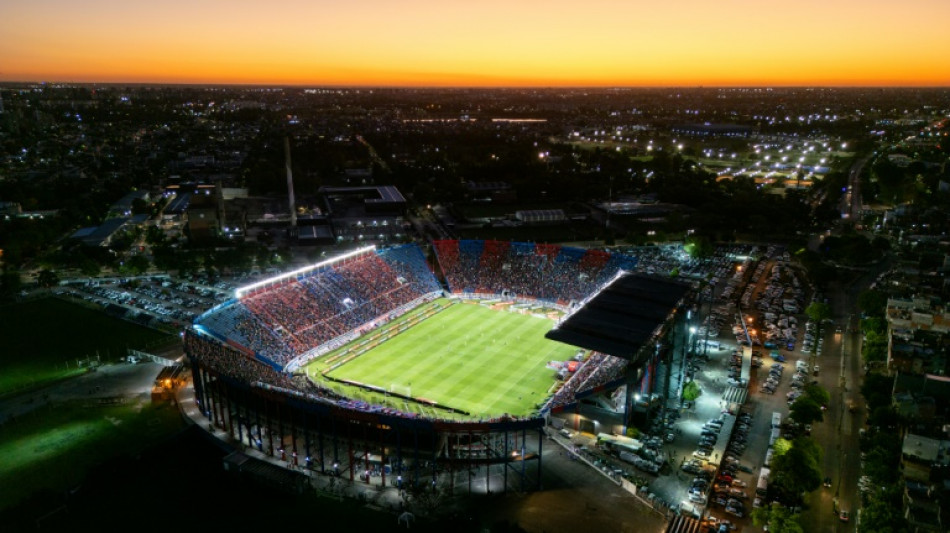
A debate over the soul of football is raging in World Cup holders Argentina, pitting defenders of the social role of the beautiful game against the government of libertarian President Javier Milei, who wants to turn clubs into for-profit companies.
Argentina, which gave the world Diego Maradona and Lionel Messi, is home to some of the world's most devoted football fans -- a fact attributed by supporters like Gabriel Nicosia to the clubs' community outreach.
Nicosia is a lifelong supporter of San Lorenzo, a more-than-century-old first division club based in the working-class Buenos Aires neighborhood of Boedo where he grew up.
Several times a week he crosses town to have a coffee or work out in the club of which Argentina-born Pope Francis is a fan.
"When I come here I meet my childhood friends. It's a fundamental pillar of everyday life," says the 50-year-old accountant, one of 80,000 members of a club whose stadium can only seat 48,000.
Membership can be acquired for a modest 22,000 pesos ($21) a month and comes with a vote on the club's management and tickets to local games.
The club's role as the glue that binds the community is underscored by the 300 scholarships it awards each year to young people from a nearby shantytown.
The recipients get to indulge their own dreams of fame and fortune by hanging out close to the training grounds of millionaire players.
Advocates of the not-for-profit model fear that this outreach could become a thing of the past if Milei manages to impose his free-marketeer vision on the clubs.
The president, an ardent defender of deregulation in all spheres of society, wants to change the statutes of the country's several thousand football clubs to allow them to become privately-owned for-profit companies.
- 'No-one cares' about owners -
During campaigning for president last year, Milei cited Buenos Aires' famous Boca Juniors, of which he is a fan, in arguing: "No-one cares who the owner is if you beat (arch-rivals) River Plate 5-0 and you win the Club World Cup."
The alternative, he said, was to "live with the misery that is Argentine football, which is deteriorating by the day."
He has pointed to Europe's top clubs, several of which are owned by Gulf states or, were previously, by Russian oligarchs as a model for his country.
But many Argentine clubs are firmly opposed to any change of ownership.
- Court setback for Milei -
"Our club belongs to its people, its members and its partners who make it greater each day," was Boca Juniors' rejoinder.
Argentine Football Association (AFA) president Claudio Tapia, who has one World Cup (2022) and two Copa America (2021, 2024) titles under his belt, has also made no secret of his opposition to the reforms.
It's "not our football model," Tapia, whose re-election to another four-year term in October was seen as a rebuke to Milei's reform, told an AFA assembly in August.
The president, a self-described "anarcho-capitalist", has forged ahead regardless.
In August, his government ordered the AFA to amend its statutes to allow for-profit clubs to join.
The decree was suspended by a court in September pending the outcome of a legal challenge by the AFA.
- Following Brazil's lead -
In Latin America, the pressure on clubs to open up to private investors is not unique to Argentina.
In 2021, Brazil changed its laws to allow for-profit clubs and Argentina's neighbour Uruguay has also adopted the model.
Some clubs see outside investment as a way to grow, attract new talent and ensure their funding into the future.
Membership fees "are not enough" to cover a club's costs, San Lorenzo director Martin Cigna said, adding that without TV rights and transfer fees his club would be running "a million-dollar deficit."
Former Argentina international Juan Sebastian Veron, who is president of another venerable club, Estudiantes, said they were preparing for a change to a "hybrid" model that would combine a "social" role with private funding.
Sports sociologist Veronica Moreira warned that a for-profit model would jeopardize club's non-commercial activities, with investors likely to "close anything that does not make a profit."
The ball is still up in the air but tensions are rising between the AFA and Milei.
The president has vowed to investigate "irregularities" at the AFA, whose leadership he has compared to that of authoritarian Venezuelan President Nicolas Maduro.
But for the moment, football fans are on the AFA's side.
A poll carried out by the sports think tank Tactica showed 60.2 percent of Argentines interested in the sport opposed a change in the clubs' ownership.
P.Sousa--PC