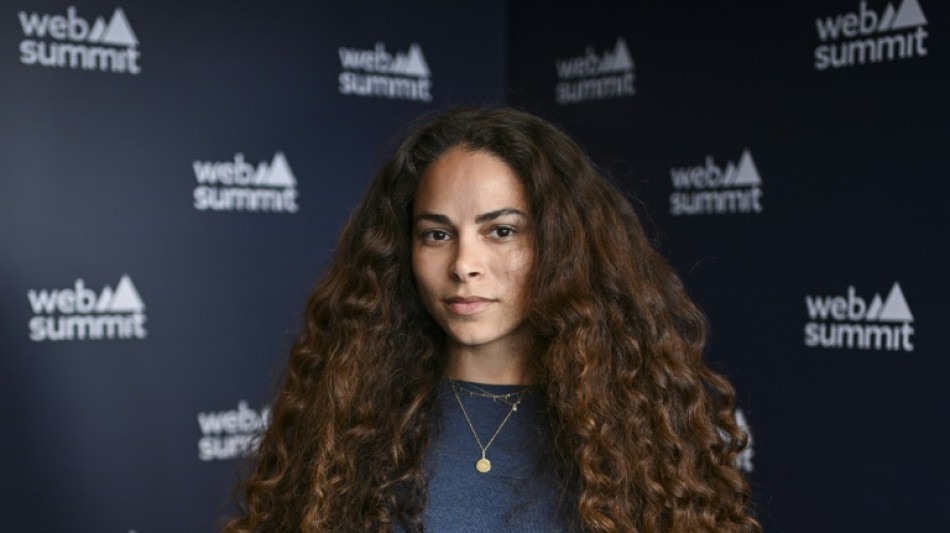
'Terrible' AI has given tech an existential headache: activist / Photo: Patricia DE MELO MOREIRA - AFP

 PSG start Ligue 1 defence with eye on Champions League hat-trick

 Arsenal can become world's best club: Arteta

 Japan's King Kazu, 59, scores twice from spot to make cup history

 Kyiv's desperate vendors persevere outside obliterated flea market

 Australia races to shield little penguins from H5N1 bird flu

 Messi scores first goal since father's death

 US national debt exceeds $40 trillion for first time

 Brazilian narco violence spills over into tranquil Bolivia

 Trump's devoted 'human printer' in media glare

 Top seed Zverev bundled out by Paul in rain-hit Cincinnati upset

 WADA pledges vigilance on Russian athletes ahead of 2028 Olympics

 NASA satellite rescue mission fails

 Cobolli halts Jodar to reach Cincinnati quarter-finals

 As election looms, Netanyahu puts Turkey in Israel's crosshairs

 McIlroy questions LIV stars 'value' as talk of PGA return builds

 'Breakthrough' mRNA cancer drug curbs melanoma in large trial
 Many US Fed policymakers back interest rate hikes if inflation stays high

 Robinson and Tongue star as Pakistan collapse in England opener

 All Blacks must get 'everything right' to beat Springboks, says legend Fitzpatrick

 Robinson and Tongue star as Pakistan all out for 171 in England opener

 Lake Zurich sees water level hit record low amid drought

 Merck and Moderna's tailored cancer drug curbs melanoma recurrence in trial

 Referees chief Webb wants clamp-down on Premier League set-piece grappling

 Robinson makes history as Pakistan collapse against England

 Alvarez can win back Atletico fans in two games: club chief

Technology firms are ceaselessly promoting new AI products, but climate activist Sage Lenier says AI is useless, unsustainable and has given the industry an existential problem.
"AI has no benefit to society," she told AFP on the sidelines of the Web Summit tech conference in Lisbon.
The CEOs who have become enraptured by a "useless" product class have smashed the idea of tech as an essential utility.
"And now they have an existential problem," she said.
Lenier first garnered attention as a 19-year-old student in 2018 when she founded and led a course at the University of California, Berkeley, titled "Solutions for a Sustainable & Just Future".
She has said students like her were sick of the kind of climate education that offered no hope -- she wanted to focus on the solutions not just the problems.
Hundreds joined the course at Berkeley over the years and eventually hundreds more online, and Lenier has since built a nonprofit around it and now hopes to launch a documentary series.
The California native, who now lives in New York, said she was largely positive about tech.
But her climate focus makes her an outsider at the Web Summit -- "I'll keep coming if they want me to shout at them," she said.
Last year, she told the crowd: "Some of you could be considered directly responsible for architecting the ecological crisis."
She implored tech bosses to embrace the circular economy, which relies on reusing and recycling rather than creating products that end up being junked.
But one year on, Microsoft, Google and others have unleashed an endless stream of energy-gobbling AI products.
They have rushed to reopen nuclear plants, pledged to build many more data centres -- and crashed through their climate targets.
- 'Waste of emissions' -
Yet AI, Lenier said, "has a million negatives".
"It is terrible for the planet. It's terrible for every community that you're running data centres in. And it's useless. I think it's just a waste of emissions," she said.
She points out that it was not always this way in the tech sector.
"It was the only industry, at least in America, where for years and years they tried to portray themselves as clean, green and pro-future," she said.
"Bill Gates has written multiple books on climate change."
The CEOs really want the image, and succeeded in dodging the kind of scrutiny put on the fashion and automotive industries.
"Then the moment they got an opportunity, with AI, to increase shareholder returns... every single one of them slammed the red button," she said.
- 'So bad so fast' -
Although Lenier came to prominence by focusing attention on the solutions to the climate crisis, she sees a bleak future coming within a generation.
"Shit is going to get so bad so fast. The food chain is going to break. We will see mass malnourishment if not mass starvation," she said.
The power grid, too, will break down.
Against this background, products like cars and new clothes are superfluous.
"You can't have cars in the long term. It doesn't matter if they're electric or not. They're unsustainable," she said.
"We can't be producing 80 billion garments of clothing a year in a low carbon future."
A year ago, she said she might have argued that tech was something different.
"It's a piece of our infrastructure, we built our societies around it," she said.
But with AI, "they've given themselves their own little fast fashion".
M.A.Vaz--PC