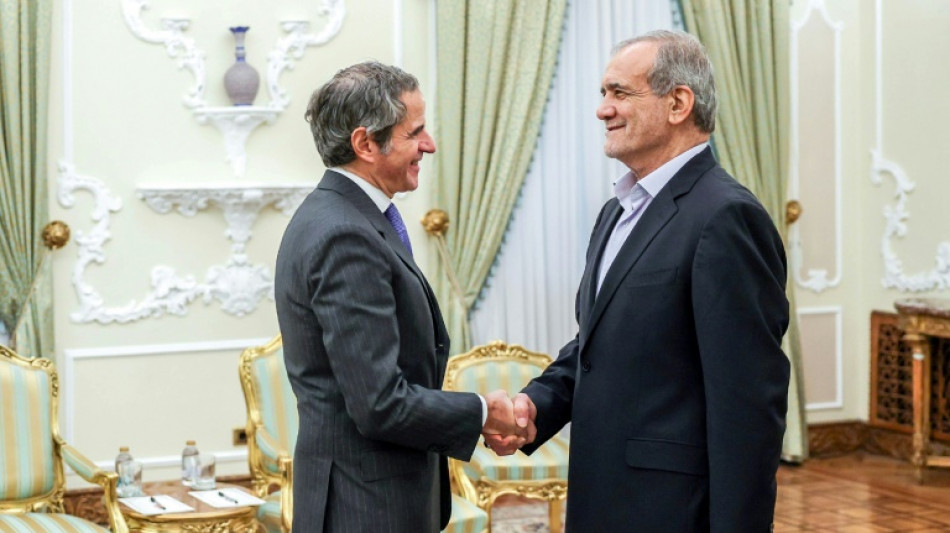
Iran tells UN nuclear chief willing to resolve 'ambiguities' / Photo: - - Iranian Presidency/AFP

 PSG start Ligue 1 defence with eye on Champions League hat-trick
 Arsenal can become world's best club: Arteta
 Japan's King Kazu, 59, scores twice from spot to make cup history
 Kyiv's desperate vendors persevere outside obliterated flea market
 Australia races to shield little penguins from H5N1 bird flu
 Messi scores first goal since father's death
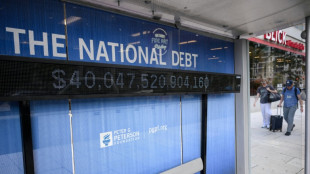 US national debt exceeds $40 trillion for first time
 Brazilian narco violence spills over into tranquil Bolivia
 Trump's devoted 'human printer' in media glare
 Top seed Zverev bundled out by Paul in rain-hit Cincinnati upset
 WADA pledges vigilance on Russian athletes ahead of 2028 Olympics
 NASA satellite rescue mission fails
 Cobolli halts Jodar to reach Cincinnati quarter-finals

 As election looms, Netanyahu puts Turkey in Israel's crosshairs
 McIlroy questions LIV stars 'value' as talk of PGA return builds
 'Breakthrough' mRNA cancer drug curbs melanoma in large trial
 Many US Fed policymakers back interest rate hikes if inflation stays high
 Robinson and Tongue star as Pakistan collapse in England opener
 All Blacks must get 'everything right' to beat Springboks, says legend Fitzpatrick
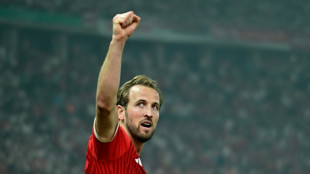
 Robinson and Tongue star as Pakistan all out for 171 in England opener
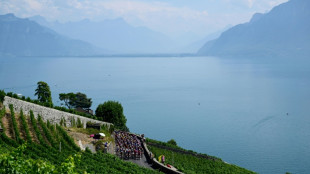 Lake Zurich sees water level hit record low amid drought
 Merck and Moderna's tailored cancer drug curbs melanoma recurrence in trial
 Referees chief Webb wants clamp-down on Premier League set-piece grappling
 Robinson makes history as Pakistan collapse against England
 Alvarez can win back Atletico fans in two games: club chief
Iranian President Masoud Pezeshkian told the visiting head of the UN nuclear watchdog on Thursday that his government was willing to resolve doubts about its atomic programme, ahead of US President-elect Donald Trump's arrival in office.
International Atomic Energy Agency chief Rafael Grossi said achieving "results" in nuclear talks with Iran was vital to avoid a new conflict in the region already inflamed by Israel's war against Hamas in Gaza and Hezbollah in Lebanon.
His visit comes just days after Israeli Defence Minister Israel Katz said Iran was "more exposed than ever to strikes on its nuclear facilities" giving Israel "the opportunity to achieve our most important goal".
"As we have repeatedly proven our goodwill, we announce our readiness to cooperate and converge with this international organisation to resolve the alleged ambiguities and doubts about the peaceful nuclear activity of our country," Pezeshkian told Grossi.
Trump, a hawk on Iran, is expected to give Israel a far freer rein after he takes office in January.
In Tehran, Grossi said Iranian nuclear installations "should not be attacked".
Foreign Minister Abbas Araghchi, who also met with Grossi, said Iran was "willing to negotiate" based on the "national interest" and "inalienable rights," but was not "ready to negotiate under pressure and intimidation".
Araghchi was Iran's chief negotiator in talks that led to a landmark 2015 nuclear deal with major powers, abandoned three years later by Trump.
- 'Immediate countermeasures' -
Grossi also met the head of Iran's atomic energy organisation, Mohammad Eslami.
Eslami told a joint news conference that Iran would take "immediate countermeasures" against any sanctions from the IAEA's board of governors.
"Any interventionist resolution in the nuclear affairs of the Islamic Republic of Iran will definitely be met with immediate countermeasures," Eslami said.
Grossi's visit is his second to Tehran this year but his first since Trump's re-election.
During his first term in the White House from 2017 to 2021, Trump adopted a policy called "maximum pressure" which reimposed sweeping US economic sanctions that had been lifted under the 2015 deal.
- Search for solutions -
In response, Iran started to gradually roll back its commitments under the deal, which barred it from enriching uranium to above 3.65 percent.
The IAEA says Iran has significantly expanded its stocks of uranium enriched to 60 percent, a level that has triggered international alarm as it is much closer to the 90 percent level needed for a nuclear warhead.
Iran has blamed the incoming US president for the standoff.
"The one who left the agreement was not Iran, it was America," government spokeswoman Fatemeh Mohajerani said on Wednesday.
"Mr. Trump once tried the path of maximum pressure and saw that this path did not work."
Trump's looming return to the White House in January has only added to international fears of all-out conflict between Israel and Iran after the archfoes exchanged unprecedented direct attacks earlier this year.
"The margins for manoeuvre are beginning to shrink," Grossi warned in an interview with AFP on Tuesday, adding that "it is imperative to find ways to reach diplomatic solutions".
- Religious decree -
Grossi has said that while Iran does not currently have a nuclear weapon, it does have plenty of enriched uranium that could eventually be used to make one.
Pezeshkian won election in July on a platform to improve ties with the West and revive the 2015 deal.
But all efforts to get the nuclear agreement off life support have failed.
In recent years, Tehran has switched off surveillance devices used to monitor its nuclear programme and effectively barred IAEA inspectors.
Grossi said he would visit uranium enrichment plants at Fordo and Natanz on Friday to get a "full picture" of Iran's nuclear programme.
The foundations of the programme date back to the late 1950s, when the United States signed a civil cooperation agreement with the Western-backed shah, Mohammad Reza Pahlavi.
In 1970, Iran ratified the Treaty on the Non-Proliferation of Nuclear Weapons, which requires signatory states to declare and place their nuclear materials under IAEA control.
But with Iran threatening to hit back at Israel for its latest missile strikes, some lawmakers have called on the government to revise its nuclear doctrine to develop an atomic bomb.
They called on supreme leader Ayatollah Ali Khamenei, who wields ultimate authority in Iran, to reconsider his longstanding religious edict or fatwa banning nuclear weapons.
P.Sousa--PC