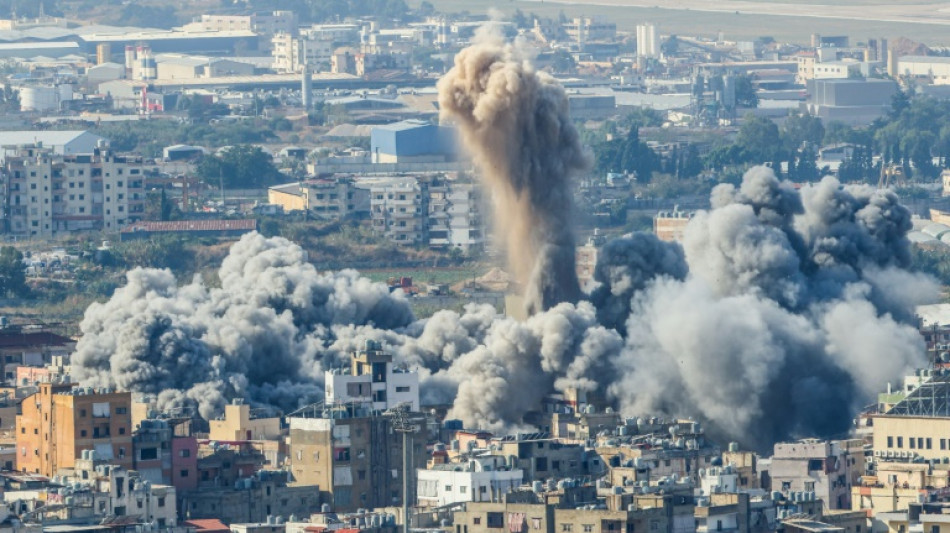
Lebanon economic losses top $5 billion in year of clashes: World Bank / Photo: Anwar AMRO - AFP

 PSG start Ligue 1 defence with eye on Champions League hat-trick
 Arsenal can become world's best club: Arteta
 Japan's King Kazu, 59, scores twice from spot to make cup history
 Kyiv's desperate vendors persevere outside obliterated flea market
 Australia races to shield little penguins from H5N1 bird flu
 Messi scores first goal since father's death
 US national debt exceeds $40 trillion for first time
 Brazilian narco violence spills over into tranquil Bolivia
 Trump's devoted 'human printer' in media glare
 Top seed Zverev bundled out by Paul in rain-hit Cincinnati upset

 WADA pledges vigilance on Russian athletes ahead of 2028 Olympics

 NASA satellite rescue mission fails
 Cobolli halts Jodar to reach Cincinnati quarter-finals

 As election looms, Netanyahu puts Turkey in Israel's crosshairs

 McIlroy questions LIV stars 'value' as talk of PGA return builds
 'Breakthrough' mRNA cancer drug curbs melanoma in large trial
 Many US Fed policymakers back interest rate hikes if inflation stays high
 Robinson and Tongue star as Pakistan collapse in England opener
 All Blacks must get 'everything right' to beat Springboks, says legend Fitzpatrick
 Robinson and Tongue star as Pakistan all out for 171 in England opener

 Lake Zurich sees water level hit record low amid drought
 Merck and Moderna's tailored cancer drug curbs melanoma recurrence in trial
 Referees chief Webb wants clamp-down on Premier League set-piece grappling
 Robinson makes history as Pakistan collapse against England
 Alvarez can win back Atletico fans in two games: club chief
More than a year of clashes that recently escalated into war have cost Lebanon more than $5 billion in economic losses, with actual structural damage amounting to billions more, the World Bank said on Thursday.
Since September 23, Israel has ramped up its air campaign in Lebanon, later sending in ground troops following almost a year of limited, cross-border exchanges initiated by Hezbollah over the Gaza war.
Lebanon's health ministry on Thursday said 33 people had been killed in Israeli strikes on the south and east, with a civil defence official saying an Israeli raid killed at least five rescuers in the Baalbek area.
Intensified Israeli strikes also hit in and around Damascus, where the Syrian Observatory for Human Rights war monitor reported 20 people killed including Palestinian Islamic Jihad militants and Iran-backed fighters.
In its Lebanon report, the World Bank provided estimates for damage between October 8, 2023 and October 27, 2024, saying "the conflict has caused $5.1 billion in economic losses", with damage to physical structures amounting to "at least $3.4 billion" on top of that.
The losses are "largely concentrated in the commerce and tourism and hospitality sectors... as well as in the agriculture sector", the report said.
- 'Absolutely central' -
The conflict has also "damaged an estimated 99,209 housing units" -- mainly in Lebanon's war-torn south near the border with Israel -- totalling $2.8 billion in damages, it said.
Eighty-one percent of damaged and destroyed houses are located in the Tyre, Nabatiyeh, Saida, Bint Jbeil and Marjayoun districts.
"The final cost of damage and losses for Lebanon associated with the conflict is expected to significantly exceed" the combined $8.5 billion estimated in the report, the bank said.
The World Bank estimates that the conflict cut Lebanon's real GDP growth for 2024 by at least 6.6 percent.
Lebanon had already been reeling since 2019 from an intense economic crisis that pushed most of the population into poverty.
"This compounds five years of sustained sharp economic contraction in Lebanon that has exceeded 34 percent of real GDP, losing the equivalent of 15 years of economic growth," the World Bank said.
The UN peacekeeping chief whose force monitors Lebanon's south said redeploying Lebanese troops there is crucial for any solution to more than a year of Hezbollah-Israel clashes that escalated into war in September.
"The redeployment of the Lebanese armed forces is an absolutely central element to any durable settlement," Under Secretary-General for Peace Operations Jean-Pierre Lacroix told reporters during a briefing in the Beirut area, at the end of a three-day visit.
In an interview last month, Lebanese Prime Minister Najib Mikati told AFP his country was ready to bolster the army's presence in the south from about 4,500 to at least 11,500 troops following a ceasefire.
- South Beirut strikes -
This week, Israel ramped up its raids on south Beirut, hitting the Hezbollah bastion with three waves of air strikes on Thursday alone.
The strikes were preceded by Israeli evacuation warnings telling residents to leave immediately.
Repeated strikes have led to a mass exodus of civilians from the once densely packed residential area, although some return during the day to check on their homes and businesses.
More than 3,400 people have been killed in Lebanon since the clashes began last year, according to the health ministry, the majority of them since late September.
Israeli strikes on Syria, meanwhile, have also intensified recently, including in areas near the border with Lebanon, where Israel says it is targeting sites belonging to Iran-backed Hezbollah.
Thursday's strikes hit residential buildings on the outskirts of the capital, as well as in the Mazzeh neighbourhood, home to embassies, United Nations offices and security headquarters.
Israeli authorities rarely comment on individual strikes in Syria but have repeatedly said they will not allow arch-enemy Iran to expand its presence there.
E.Borba--PC