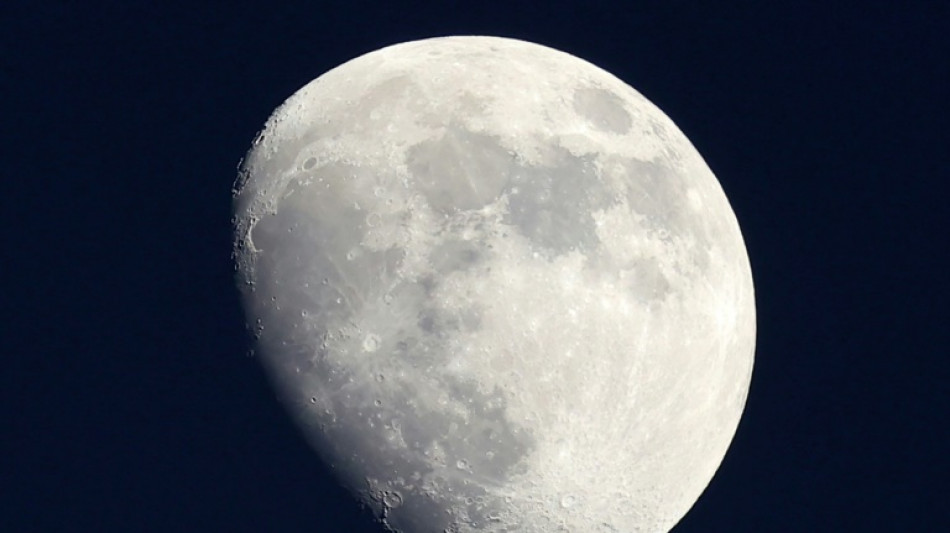
China tests building Moon base with lunar soil bricks / Photo: KARIM JAAFAR - AFP

 PSG start Ligue 1 defence with eye on Champions League hat-trick

 Arsenal can become world's best club: Arteta

 Japan's King Kazu, 59, scores twice from spot to make cup history

 Kyiv's desperate vendors persevere outside obliterated flea market

 Australia races to shield little penguins from H5N1 bird flu

 Messi scores first goal since father's death

 US national debt exceeds $40 trillion for first time

 Brazilian narco violence spills over into tranquil Bolivia

 Trump's devoted 'human printer' in media glare

 Top seed Zverev bundled out by Paul in rain-hit Cincinnati upset

 WADA pledges vigilance on Russian athletes ahead of 2028 Olympics

 NASA satellite rescue mission fails

 Cobolli halts Jodar to reach Cincinnati quarter-finals

 As election looms, Netanyahu puts Turkey in Israel's crosshairs

 McIlroy questions LIV stars 'value' as talk of PGA return builds
 'Breakthrough' mRNA cancer drug curbs melanoma in large trial

 Many US Fed policymakers back interest rate hikes if inflation stays high

 Robinson and Tongue star as Pakistan collapse in England opener
 All Blacks must get 'everything right' to beat Springboks, says legend Fitzpatrick

 Robinson and Tongue star as Pakistan all out for 171 in England opener

 Lake Zurich sees water level hit record low amid drought

 Merck and Moderna's tailored cancer drug curbs melanoma recurrence in trial

 Referees chief Webb wants clamp-down on Premier League set-piece grappling

 Robinson makes history as Pakistan collapse against England

 Alvarez can win back Atletico fans in two games: club chief

China is expected to push forward in its quest to build the first lunar base on Friday, launching an in-space experiment to test whether the station's bricks could be made from the Moon's own soil.
Brick samples will blast off aboard a cargo rocket heading for China's Tiangong space station, part of Beijing's mission to put humans on the Moon by 2030 and build a permanent base there by 2035.
It is a daunting task: any structure has to withstand huge amounts of cosmic radiation, extreme temperature variations and moonquakes, and getting building materials there in the first place is a costly procedure.
Constructing the base out of the Moon itself could be a solution to those problems, scientists from a university in central Wuhan province hope.
They have created a series of prototype bricks made of various compositions of materials found on earth, such as basalt, which mimic the properties of lunar soil.
Slivers of those test bricks will be subjected to a series of stringent tests once they reach the Tiangong space station.
"It's mainly exposure," said Zhou Cheng, a professor at Wuhan's Huazhong University of Science and Technology.
"To put it simply, we put (the material) in space and let it sit there... to see whether its durability, its performance will degrade under the extreme environment."
The temperature on the Moon can vary drastically between 180 and -190 degrees Celsius (356 to -310 degrees Fahrenheit).
Its lack of an atmosphere means it is subjected to large quantities of cosmic radiation as well as micrometeorites, while moonquakes can weaken any structure on its surface.
The exposure experiment will last three years, with samples sent back for testing every year.
- 'Good chance of success' -
Zhou's team developed their prototype bricks after analysing soil brought back by China's Chang'e-5 probe, the world's first mission in four decades to collect Moon samples.
The resulting black bricks are three times stronger than standard bricks, he said, and interlock together without a binding agent.
The team has also worked on the "Lunar Spider", a 3D printing robot to build structures in space, some of which are conical in shape.
"In the future, our plan is definitely to use resources on-site, that is, make bricks directly from the lunar soil, and then do various construction scenarios, so we won't be bringing the materials from Earth," said Zhou.
It's "an obvious thing to try" because using materials already on the Moon would be much cheaper, said Jacco van Loon, an astrophysicist at Keele University in Britain.
"The experiments have a good chance of success, and the results will pave the way to building moonbases," he told AFP.
- Lego bricks -
Beijing is far from alone in looking to build the first lunar base.
China's planned outpost on the Moon, known as the International Lunar Research Station (ILRS), is a joint project with Russia.
A dozen countries -- including Thailand, Pakistan, Venezuela and Senegal -- are partners in the initiative, as well as around 40 foreign organisations, according to Chinese state media.
The United States is aiming to put humans back on the Moon in 2026 and subsequently set up a station there, though its Artemis programme has already seen various delays.
As part of the US preparations, researchers at the University of Central Florida are testing potential building bricks of their own, made using 3D printers.
The European Space Agency, meanwhile, has carried out studies on how to assemble bricks based on the structure of Lego.
J.Oliveira--PC