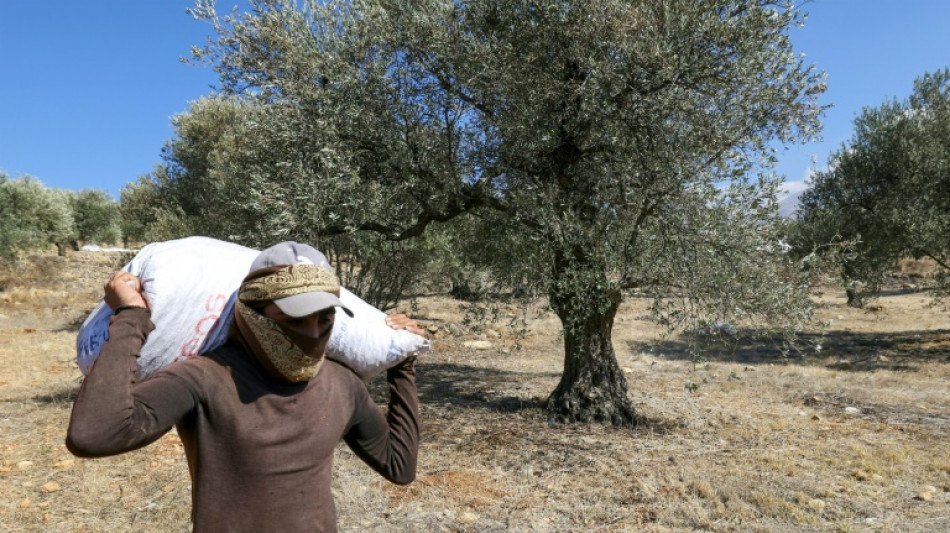
Defiant Lebanese harvest olives in the shadow of war / Photo: Anwar AMRO - AFP

 'More confrontational': Iran's new hardline security leadership
 UK summons Israeli envoy over West Bank settlement project

 Trump vows 'tremendous' economic costs on Iran partners

 Germany, France, UN condemn far-right Israeli minister's 'inhumane' Gaza remarks

 Prince Harry and Meghan moving back to UK: British press
 Lee, Baena guide Atletico to opening Liga win over Malaga
 Ecuador intel chief, five Americans killed in Kenya helicopter crash

 Robinson and Tongue share match ball after dismissing Pakistan
 Israel army admits firing on car in death of five-year-old Hind Rajab
 Honduras places 80% of country on El Nino drought alert

 Some of Meta's safety tools were 'designed to fail': witness
 PSG Ligue 1 opener moved over state of Parc des Princes pitch

 UK PM launches bid to help homeless, donating part of his wages

 Golden Shoe winner Kane hopes for Ballon d'Or after 'best season ever'

 Kyiv's ex-defence chief makes risky bet by venturing into electoral grounds
 Coventry have survival inspiration says Lampard

 Reijnders leaves Man City for Saudi's Al Qadsiah
 Trump says will meet North Korea's Kim later this year

 Stocks waver, dollar drops as US Treasury moves to lower bond yields

 France recalls rare disease drug Tavneos after deaths
 Arsenal agree to sign Villa defender Konsa: reports
 Evacuation orders lifted in Belgian wildfire zone

 UK media skewered for 'hounding' black academic
 More than 7,300 excess deaths in France's historically hot summer so far
 US socialists score shock Florida win as Trump picks stumble

On a mountain slope in south Lebanon, agricultural worker Assaad al-Taqi is busy picking olives, undeterred by the roar of Israeli warplanes overhead.
This year, he is collecting the harvest against the backdrop of the raging Israel-Hezbollah war.
He works in the village of Kfeir, just a few kilometres (miles) from where Israeli bombardment has devastated much of south Lebanon since Israel escalated its campaign against Iran-backed Hezbollah in September.
"But I'm not afraid of the shelling," Taqi said, as he and other workers hit the tree branches with sticks, sending showers of olives tumbling down into jute bags.
"Our presence here is an act of defiance," the 51-year-old said, but also noting that the olive "is the tree of peace".
Kfeir is nine kilometres (six miles) from the Israeli-occupied Golan Heights, in the mixed Christian and Druze district of Hasbaya, which has largely been spared the violence that has wracked nearby Hezbollah strongholds.
But even Hasbaya's relative tranquillity was shattered last month when three journalists were killed in an Israeli strike on a complex where they were sleeping.
Israel and Hezbollah had previously exchanged cross-border fire for almost a year over the Gaza conflict.
- $58 mln in losses -
The workers in Kfeir rest in the shade of the olive trees, some 900 metres (3,000 feet) above sea level on the slopes of Mount Hermon, which overlooks an area where Lebanese, Syrian and Israeli-held territory meet.
They have been toiling in relative peace since dawn, interrupted only by sonic booms from Israeli jets breaking the sound barrier and the sight of smoke rising on the horizon from strikes on a south Lebanon border village.
Hassna Hammad, 48, who was among those picking olives, said the agricultural work was her livelihood.
"We aren't afraid, we're used to it," she said of the war.
But "we are afraid for our brothers impacted by the conflict", she added, referring to the hundreds of thousands of Lebanese displaced by the fighting.
Elsewhere in south Lebanon, olive trees are bulging with fruit that nobody will pick, after villagers fled Israeli bombardment and the subsequent ground operation that began on September 30.
A World Bank report this month said that "the disruption of the olive harvest caused by bombing and displacement is expected to lead to $58 million in losses" in Lebanon.
It said 12 percent of olive groves in the conflict-affected areas it assessed had been destroyed.
Normally, the olive-picking season is highly anticipated in Lebanon, and some people return each year to their native villages and fields just for the harvest.
"Not everyone has the courage to come" this time, said Salim Kassab, who owns a traditional press where villagers bring their olives to extract the oil.
"Many people are absent... They sent workers to replace them," said Kassab, 50.
- 'Love the olive month' -
"There is fear of the war of course," he said, adding that he had come alone this year, without his wife and children.
Kassab said that before the conflict, he used to travel to the southern cities of Nabatiyeh and Sidon if he needed to fix his machines, but such trips are near impossible now because of the danger.
The World Bank report estimated that 12 months of agriculture sector losses have cost Lebanon $1.1 billion, in a country already going through a gruelling five-year economic crisis before the fighting erupted.
Areas near the southern border have sustained "the most significant damage and losses", the report said.
It cited "the burning and abandonment of large areas of agricultural land" in both south and east Lebanon, "along with lost harvests due to the displacement of farmers".
Elsewhere in Kfeir, Inaam Abu Rizk, 77, and her husband were busy washing olives they plan to either press for oil or jar to be served throughout the winter.
Abu Rizk has taken part in the olive harvest for decades, part of a tradition handed down the generations, and said that despite the war, this year was no different.
"Of course we're afraid... there is the sound of planes and bombing," she said.
But "we love the olive month -- we are farmers and the land is our work".
T.Batista--PC