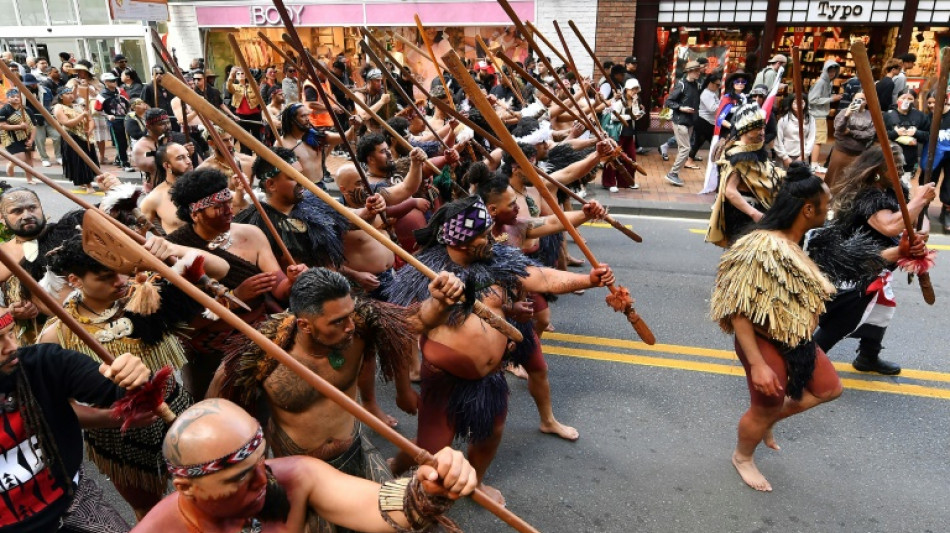
Tens of thousands march in New Zealand Maori rights protest / Photo: Sanka Vidanagama - AFP

 'More confrontational': Iran's new hardline security leadership

 UK summons Israeli envoy over West Bank settlement project

 Trump vows 'tremendous' economic costs on Iran partners

 Germany, France, UN condemn far-right Israeli minister's 'inhumane' Gaza remarks

 Prince Harry and Meghan moving back to UK: British press

 Lee, Baena guide Atletico to opening Liga win over Malaga

 Ecuador intel chief, five Americans killed in Kenya helicopter crash

 Robinson and Tongue share match ball after dismissing Pakistan

 Israel army admits firing on car in death of five-year-old Hind Rajab

 Honduras places 80% of country on El Nino drought alert

 Some of Meta's safety tools were 'designed to fail': witness
 PSG Ligue 1 opener moved over state of Parc des Princes pitch

 UK PM launches bid to help homeless, donating part of his wages

 Golden Shoe winner Kane hopes for Ballon d'Or after 'best season ever'

 Kyiv's ex-defence chief makes risky bet by venturing into electoral grounds
 Coventry have survival inspiration says Lampard

 Reijnders leaves Man City for Saudi's Al Qadsiah

 Trump says will meet North Korea's Kim later this year

 Stocks waver, dollar drops as US Treasury moves to lower bond yields

 France recalls rare disease drug Tavneos after deaths
 Arsenal agree to sign Villa defender Konsa: reports

 Evacuation orders lifted in Belgian wildfire zone

 UK media skewered for 'hounding' black academic

 More than 7,300 excess deaths in France's historically hot summer so far

 US socialists score shock Florida win as Trump picks stumble

Booming Indigenous Maori "haka" chants rang out across New Zealand's capital on Tuesday, as tens of thousands rallied against a conservative push to redefine the nation's founding treaty.
More than 35,000 demonstrators poured into the harbourside city of Wellington, police said, shutting down busy streets as their spirited procession inched its way towards parliament.
Bare-chested men draped in traditional feather cloaks were joined by horse riders waving the red, white and black Maori flag.
Children marched alongside adults bearing distinctive full-face Maori "moko" tattoos and clutching ceremonial wooden weapons.
"The vibe is beautiful. People of all walks are here to support. It is peaceful and respectful," participant Nick Stewart told AFP.
Protests have been swelling throughout New Zealand after a minor party in the conservative coalition government drafted a bill to redefine the 1840 Treaty of Waitangi.
Although the bill has almost no chance of passing, its mere introduction has triggered one of New Zealand's largest protests in decades.
Many critics -- including some of New Zealand's most respected lawyers -- see it as an attempt to strip long-agreed rights from the country's 900,000 strong Maori population.
"We stand here gathered in our tens of thousands on the steps of parliament to protest this bill for our mokopuna," said Stewart, using a Maori word for future generations.
Crowds gathered on the lawns outside New Zealand's beehive-shaped parliament building, playing reggae music and giving speeches that urged the government to come out and face them.
"It's not the best way to have a conversation. We will not accept unilateral change to a treaty that involves two parties," said Ngira Simmonds, a key advisor to New Zealand's Maori queen.
"There is a better way," he told AFP from Wellington.
Many demonstrators arrived in Wellington after a nine-day "hikoi" -- or protest march -- that began hundreds of kilometres away at New Zealand's northern tip.
- A country divided -
At the centre of the outcry is government minister David Seymour, the outspoken leader of the libertarian ACT Party -- a minor partner in the governing coalition.
Seymour has long railed against affirmative action policies designed to help Maori, who remain far more likely to die early, live in poverty, or wind up in prison.
His bill would look to wind back these so-called "special rights".
Incumbent Prime Minister Christopher Luxon has voiced his opposition to Seymour's bill, meaning it is all but doomed to fail when it comes to a parliamentary vote.
But former conservative prime minister Jenny Shipley said just putting it forward threatened to "divide New Zealand in a way that I haven't lived through in my adult life".
The bill was introduced to parliament for preliminary debate last week.
Proceedings were derailed when 22-year-old Maori Party MP Hana-Rawhiti Maipi-Clarke took to her feet in the chamber, ripped the bill in half, and launched into a haka.
Seen as the country's founding document, the Treaty of Waitangi was signed in 1840 to bring peace between 540 Maori chiefs and colonising British forces.
Its principles today underpin efforts to foster partnership between Indigenous and non-Indigenous New Zealanders and protect the interests of the Maori community.
The anniversary of the treaty's signing remains a national holiday.
O.Salvador--PC