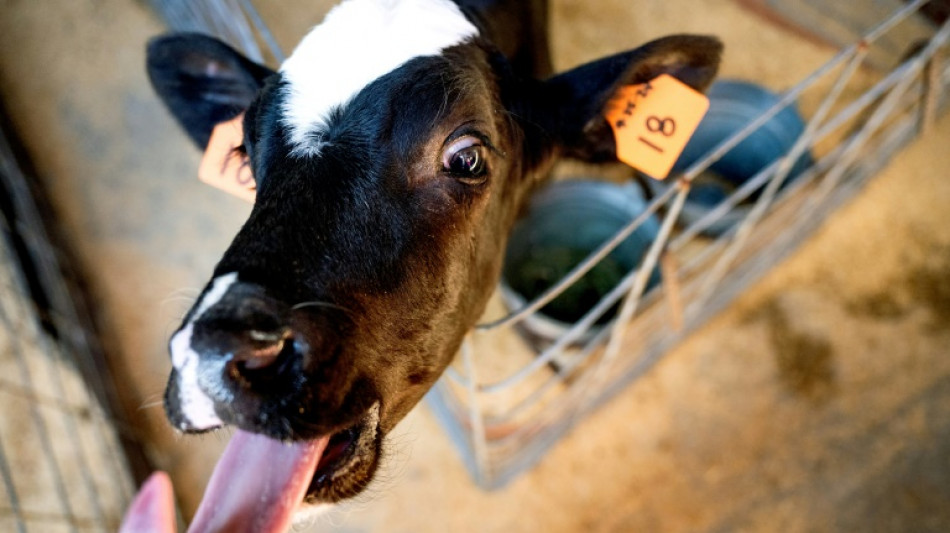
Scientists seek miracle pill to stop methane cow burps / Photo: NOAH BERGER - AFP

 WADA pledges vigilance on Russian athletes ahead of 2028 Olympics

 NASA satellite rescue mission fails

 Cobolli halts Jodar to reach Cincinnati quarter-finals

 As election looms, Netanyahu puts Turkey in Israel's crosshairs

 McIlroy questions LIV stars 'value' as talk of PGA return builds
 'Breakthrough' mRNA cancer drug curbs melanoma in large trial

 Many US Fed policymakers back interest rate hikes if inflation stays high

 Robinson and Tongue star as Pakistan collapse in England opener
 All Blacks must get 'everything right' to beat Springboks, says legend Fitzpatrick

 Robinson and Tongue star as Pakistan all out for 171 in England opener

 Lake Zurich sees water level hit record low amid drought

 Merck and Moderna's tailored cancer drug curbs melanoma recurrence in trial

 Referees chief Webb wants clamp-down on Premier League set-piece grappling

 Robinson makes history as Pakistan collapse against England

 Alvarez can win back Atletico fans in two games: club chief

 Oldest human brain cells grown in lab 'recorded passage of time'

 7,300 excess deaths and counting in France's historically hot summer
 Ukraine MPs approve new defence minister after divisive reshuffle

 North Korea leader's sister says 'unaware' of reported Kim-Trump communication

 Russia, Ukraine exchange 103 captured soldiers each

 Sainz signs new contract with F1 team Williams

 Playing at Real Madrid 'not for everyone': Bernardo Silva
 As election nears, Israelis fear polarisation could spark violence

 Bayern's Hoeness 'speechless' after second Musiala collapse

 Reijnders leaves Man City for Saudi's Al Qadsiah: source

A scientist guides a long tube into the mouth and down to the stomach of Thing 1, a two-month-old calf that is part of a research project aiming to prevent cows from burping methane, a potent greenhouse gas.
Paulo de Meo Filho, a postdoctoral researcher at University of California, Davis, is part of an ambitious experiment aiming to develop a pill to transform cow gut bacteria so it emits less or no methane.
While the fossil fuel industry and some natural sources emit methane, cattle farming has become a major climate concern due to the sheer volume of the cows' emissions.
"Almost half of the increase in (global) temperature that we've had so far, it's been because of methane," said Ermias Kebreab, an animal science professor at UC Davis.
Methane, the second largest contributor to climate change after carbon dioxide, breaks down faster than CO2 but is more potent.
"Methane lives in the atmosphere for about 12 years" unlike carbon dioxide which persists for centuries, Kebreab said.
"If you start reducing methane now, we can actually see the effect on the temperature very quickly."
Filho uses the tube to extract liquid from Thing 1's rumen -- the first stomach compartment containing partially digested food.
Using the rumen liquid samples, the scientists are studying the microbes that convert hydrogen into methane, which is not digested by the cow but instead burped out.
A single cow will burp roughly 220 pounds (100 kilograms) of the gas annually.
- 'Social critters' -
Thing 1 and other calves receive a seaweed-supplemented diet to reduce methane production.
Scientists hope to achieve similar results by introducing genetically modified microbes that soak up hydrogen, starving methane-producing bacteria at the source.
However, the team proceeds cautiously.
"We can't just simply cut down methane production by removing" methane-making bacteria, as hydrogen could accumulate to the point of harming the animal, warned Matthias Hess, who runs the UC Davis lab.
"Microbes are kind of social critters. They really like to live together," he said.
"The way they interact and affect each other impacts the overall function of the ecosystem."
Hess's students test different formulas in bioreactors, vessels that reproduce microorganisms' living conditions in a stomach from movements to temperature.
- More productive cows -
The project is being carried out at UC Davis as well as UC Berkeley's Innovative Genomics Institute (IGI).
IGI scientists are trying to identify the right microbe -- the one they hope to genetically alter to supplant methane-producing microbes.
The modified microorganisms will then be tested at UC Davis in the lab and in the animals.
"Not only are we trying to reduce methane emissions, but you also increase the feed efficiency," said Kebreab.
"Hydrogen and methane, they are both energy, and so if you reduce that energy and redirect it to something else... we have a better productivity and lower emissions at the same time."
The ultimate goal is a single-dose treatment administered early in life, since most cattle graze freely and can't receive daily supplements.
The three research teams have been given $70 million and seven years to achieve a breakthrough.
Kebreab has long studied sustainable livestock practices and pushes back against calls to reduce meat consumption to save the planet.
While acknowledging this might work for healthy adults in developed nations, he pointed to countries like Indonesia, where the government is seeking to increase meat and dairy production because 20 percent of children under five suffer from stunted growth.
"We can't tell them to not eat meat," he said.
J.Pereira--PC