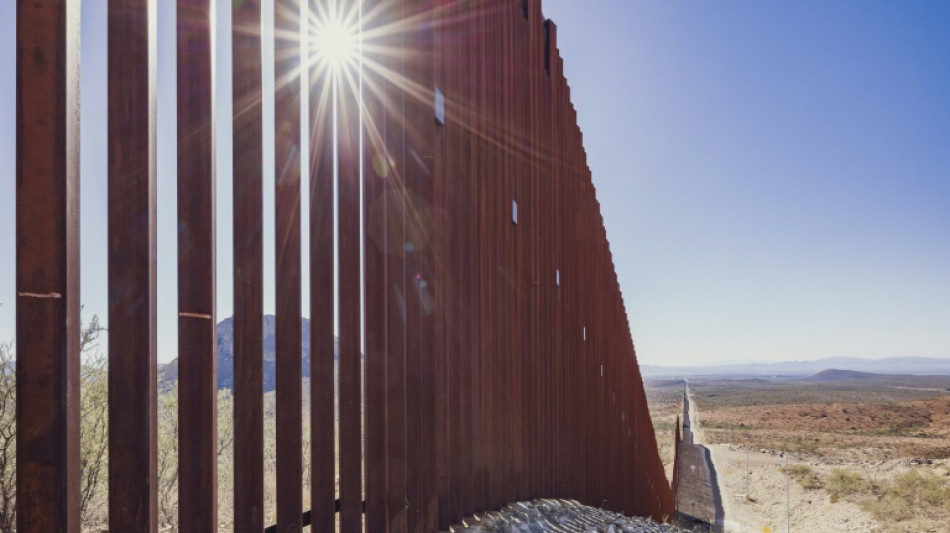
Trump's mass deportation plan could end up hurting economic growth / Photo: Olivier Touron - AFP

 WADA pledges vigilance on Russian athletes ahead of 2028 Olympics

 NASA satellite rescue mission fails

 Cobolli halts Jodar to reach Cincinnati quarter-finals

 As election looms, Netanyahu puts Turkey in Israel's crosshairs

 McIlroy questions LIV stars 'value' as talk of PGA return builds
 'Breakthrough' mRNA cancer drug curbs melanoma in large trial

 Many US Fed policymakers back interest rate hikes if inflation stays high

 Robinson and Tongue star as Pakistan collapse in England opener

 All Blacks must get 'everything right' to beat Springboks, says legend Fitzpatrick

 Robinson and Tongue star as Pakistan all out for 171 in England opener

 Lake Zurich sees water level hit record low amid drought

 Merck and Moderna's tailored cancer drug curbs melanoma recurrence in trial

 Referees chief Webb wants clamp-down on Premier League set-piece grappling
 Robinson makes history as Pakistan collapse against England
 Alvarez can win back Atletico fans in two games: club chief

 Oldest human brain cells grown in lab 'recorded passage of time'

 7,300 excess deaths and counting in France's historically hot summer

 Ukraine MPs approve new defence minister after divisive reshuffle

 North Korea leader's sister says 'unaware' of reported Kim-Trump communication

 Russia, Ukraine exchange 103 captured soldiers each
 Sainz signs new contract with F1 team Williams

 Playing at Real Madrid 'not for everyone': Bernardo Silva

 As election nears, Israelis fear polarisation could spark violence

 Bayern's Hoeness 'speechless' after second Musiala collapse

 Reijnders leaves Man City for Saudi's Al Qadsiah: source

President-elect Donald Trump's hardline immigration proposals -- including a controversial mass deportation plan -- could prove economically damaging, analysts say, with US sectors that rely heavily on foreign workers like agriculture and construction especially hard hit.
US authorities estimate that there are around 11 million unauthorized people living in the United States, the vast majority of whom come from Mexico.
Around 8.3 million unauthorized people were in the labor force in 2022, according to a recent estimate from the Pew Research Center. That was equivalent to just under five percent of the overall workforce.
"Today our cities are flooded with illegal aliens," Trump said on the campaign trail earlier this year, adding: "Americans are being squeezed out of the labor force and their jobs are taken."
The reality, however, is more complex; many of the sectors that could be the hardest-hit have long struggled to attract US workers.
"The construction and agriculture industries would lose at least one in eight workers, while in hospitality, about one in 14 workers would be deported due to their undocumented status," the non-profit American Immigration Council (AIC) said in a recent report on Trump's deportation plans.
The deportations would also impact "more than 30 percent" of plasterers, roofers, and painters, along with a quarter of housekeeping cleaners, according to the report.
- Economic impact -
A recent joint study by the American Enterprise Institute (AEI), Brookings Institution, and the Niskanen Center estimated that Trump's immigration plans could curb US GDP growth in 2025 by as much as 0.4 percentage points.
The impact on growth would primarily come from the direct effect of having fewer foreign workers producing goods and services, with an additional, smaller decline in output coming from less consumer spending by those groups.
In such a scenario, the authors said, "legal immigration is slightly below where it was during the pre-pandemic Trump administration, while enforcement and deportation efforts reach levels not seen in recent decades."
A total of 3.2 million people would be deported during Trump's term under this projection, with net migration -- arrivals minus departures -- falling from 3.3 million in 2024 to negative 740,000 in 2025, boosted by a sharp rise in voluntary emigration.
In a more extreme scenario, which analysts say is highly unlikely, the impact on growth could be much more significant.
A recent Peterson Institute for International Economics report modelled the impact of expelling all 8.3 million unauthorized immigrant workers.
It predicted that economic growth by 2028 could be 7.4 percent beneath baseline estimates, "meaning no US net economic growth occurs over the second Trump term because of this policy alone."
At the same time, US inflation would be 3.5 percentage points higher by 2026 than it would otherwise be, as employers raised wages to attract American workers.
But even in a less significant scenario, mass deportations could push up prices, analysts say.
Trump's immigration plans "could lead to big price increases in certain sectors of the economy, but could also lead to inflation," Michael Strain, AEI's director of economic policy studies, told AFP.
But mass deportations' aggregate effect on inflation would likely be small, economists at Pantheon Macroeconomics wrote in an investor note, "with upward pressure in sectors like agriculture and construction partly offset by weaker demand in general and slower inflation in some other areas, such as housing."
- Obstacles -
Most analysts expect legal, logistical and financial challenges will blunt the most extreme proposals -- as they did during the first Trump administration -- with the end result being that net migration eases modestly next year compared to pre-pandemic levels.
"We expect tighter policy to lower net immigration to 750k per year, moderately below the pre-pandemic average of 1 (million) per year," economists at Goldman Sachs wrote in an investor note.
"We're sceptical that the kind of deportations proposed on the campaign could occur," Oxford Economics chief US economist Ryan Sweet wrote in a note to clients.
R.Veloso--PC