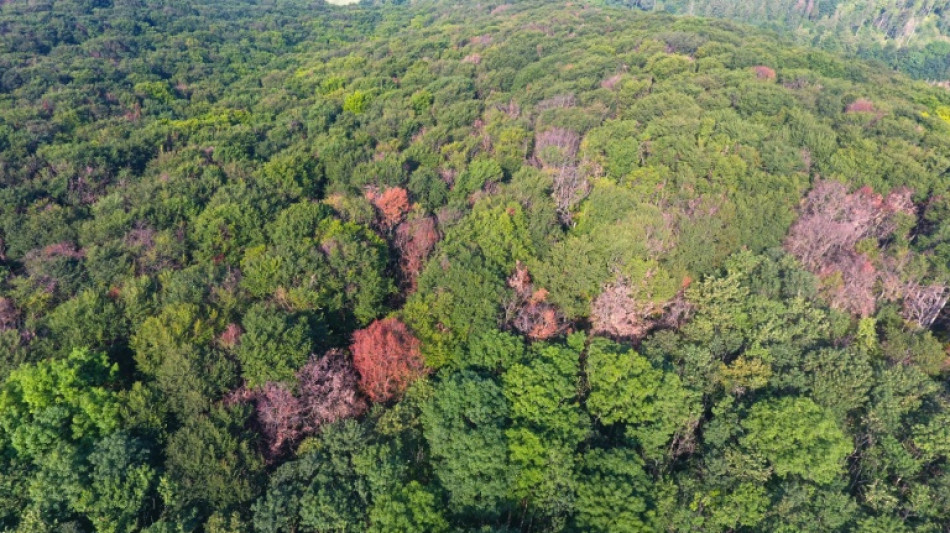
Beeches thrive in France's Verdun in flight from climate change / Photo: INA FASSBENDER - AFP/File

 WADA pledges vigilance on Russian athletes ahead of 2028 Olympics

 NASA satellite rescue mission fails

 Cobolli halts Jodar to reach Cincinnati quarter-finals

 As election looms, Netanyahu puts Turkey in Israel's crosshairs

 McIlroy questions LIV stars 'value' as talk of PGA return builds
 'Breakthrough' mRNA cancer drug curbs melanoma in large trial

 Many US Fed policymakers back interest rate hikes if inflation stays high

 Robinson and Tongue star as Pakistan collapse in England opener
 All Blacks must get 'everything right' to beat Springboks, says legend Fitzpatrick

 Robinson and Tongue star as Pakistan all out for 171 in England opener

 Lake Zurich sees water level hit record low amid drought

 Merck and Moderna's tailored cancer drug curbs melanoma recurrence in trial

 Referees chief Webb wants clamp-down on Premier League set-piece grappling

 Robinson makes history as Pakistan collapse against England

 Alvarez can win back Atletico fans in two games: club chief

 Oldest human brain cells grown in lab 'recorded passage of time'

 7,300 excess deaths and counting in France's historically hot summer
 Ukraine MPs approve new defence minister after divisive reshuffle

 North Korea leader's sister says 'unaware' of reported Kim-Trump communication

 Russia, Ukraine exchange 103 captured soldiers each

 Sainz signs new contract with F1 team Williams

 Playing at Real Madrid 'not for everyone': Bernardo Silva

 As election nears, Israelis fear polarisation could spark violence

 Bayern's Hoeness 'speechless' after second Musiala collapse

 Reijnders leaves Man City for Saudi's Al Qadsiah: source

An assisted migration of beech trees in need of protection from climate change is bearing its first fruits in France after 13 years, with saplings now gracing the former World War I battlefield of Verdun.
Some of the beeches, planted in 2013 after two years in the nursery, now stand three metres (10 feet) tall as they loom out of the fog in their reddish-brown autumn colours on what 100 years ago was a shell-blasted hellscape.
"What's crucial is the survival rate, which here we've got up to more than 90 percent" -- a big improvement on the 80 percent usually considered the marker of a successful plantation, said geneticist Brigitte Musch.
"We shouldn't get ahead of ourselves, they're only about 10 years old", she added -- a harsh frost or overgrowth with clematis is still capable of wiping out the young trees.
Experts from the French forestry authority (ONF) check up on the saplings regularly to ensure they are growing, healthy and holding up against local wildlife.
The plot of beeches less than one hectare (2.5 acres) in size is part of a scheme to "migrate the genes" of trees in danger of dying in France's south, where the climate is growing increasingly dry and unable to support them.
Musch, head of genetic resources at the ONF, remembers how the project emerged at a 2011 meeting from the idea of climate analogues.
Using UN climate experts' data and knowledge about where seeds can best grow, the method allows forestry experts to plot on a map which areas will have a hospitable climate in future for different types of trees.
The map of France for 2050 is alarming for lovers of the majestic beech, which can live for several centuries and spread their shady crowns as high as 40 metres.
Other traditionally widespread trees like oak are also in danger of disappearing from many French regions as the climate changes.
- Massive bombardment -
In Verdun, the beeches have made it through the first trials of their new home, taking root in chalky soil long ago packed hard and filled with metals and toxic substances by the intense bombardments of WWI.
"On average, six shells fell on every square metre (11 square feet) here. This was right on the front line in 1916. It was so rough that it had to be levelled with diggers just so we could get around," said Milene Mahut, a local ONF official.
After 1918, the forest was replanted with resinous trees like pines -- in part thanks to seeds sent as war reparations by Germany -- and later by deciduous trees, especially beech and sessile oak.
Now the new lines of beeches fleeing the south are arriving, outpacing the usual rate of tree migration.
The International Union for the Conservation of Nature (IUCN) estimates that oak and beech naturally migrate about 100 kilometres (60 miles) in 500 years.
That is around 10 times slower than the pace at which the climate is changing, according to the ONF -- highlighting the need to give the trees a helping hand.
Musch, who wrote her thesis on oak and beech recolonisation of Europe after the last ice age around 10,000 years ago, has dug into her research to mimic the natural process.
The beech fascinates her for its ability to "grow on rocks battered by the wind, bring in biodiversity, and even be invasive" as a species.
- 'Promise of rebirth' -
The ONF project has been baptised Giono after French author Jean Giono, whose book "L'Homme qui Plantait des Arbres" ("The Man who Planted Trees") tells the story of a shepherd bringing a mountain back to life with thousands of new trees.
Giono himself fought in the battle of Verdun, in which hundreds of thousands of men were killed and wounded on both the French and German sides over the course of 10 months.
Oak acorns and beechnuts from remarkable specimens have been collected in France's Provence, Sarthe, Allier and Deux-Sevres regions since 2011.
The Meuse region that is home to Verdun has been chosen for the new plantings for its less dry climate and relatively mild winters.
Climate change has also meant that some local species like spruce are suffering, including from attack by bark beetles.
"There's no single solution to climate change -- assisted migration is just one of them," Musch said.
Mahut, caring for the new beeches on their little plot, sees the growing trees as "a promise of rebirth" for the grievously mistreated land.
H.Portela--PC