Play on! Cuba's enduring love affair with radio soaps / Photo: ADALBERTO ROQUE - AFP

 Pant fastest to 100 sixes as India set Sri Lanka 372 to win first Test

 Russia rebukes Japan ambassador over disputed islands row
 Crude extends gains, most stocks drop as Mideast hopes dim

 Rift deepens as Asia football chief hits back at Qatar in Infantino saga

 India extend lead to 294 in first Sri Lanka Test

 Asian allies stress 'critical cooperation' as Trump slashes Korea drills

 Williams sisters fall at Cincinnati while Zverev advances

 Transylvania's fortified churches face fragile future

 China mourns former premier Zhu Rongji with flags lowered, funeral

 Philippine student killed in rare school shooting

 Arsenal primed for Premier League title defence as rivals face questions
 Zverev advances at Cincinnati while Williams sisters fall

 Copper powers profit rise at mining giant BHP

 Whales spark joy in New York but face threats from boat traffic

 Premier League's new bosses brace for battle

 Zambia's Hichilema: 'cattle boy' and two-time president

 Elderly far more at risk from rising heat than thought: study

 LiberNovo Previews Support Week 2026, Putting Better Ergonomic Support Within Reach
 Paramount demands $1.9 billion surety over states' merger lawsuit

 Latest developments in US-Iran war

 NBA has no evidence of Clippers salary cap cheating: report

 Boehly and Walter consider selling Chelsea stake to Clearlake Capital

 OpenAI to lease massive new AI data center in US, backed by Nvidia

 US stocks fall on spiking bond yields, higher oil prices

 LIV Golf cancels Michigan event, to decide team title at Indy

Forget Netflix and telenovelas. In communist Cuba, many people still turn to the humble radio for their daily drama fix.
Eighty years ago, a Cuban radio soap opera "El Derecho de Nacer" ("The right to be born") became an instant hit with its tale of a wealthy Havana patriarch trying to cover up the dishonor of his daughter falling pregnant out of wedlock.
The series, which wrung tears out of listeners across Latin America and was later turned into a movie, created the template for the region's hugely popular telenovelas.
But in Cuba, the love affair with radio plays, particularly period productions, has endured the advent of TV and streaming platforms.
These days, the must-listen-to soap is "Amores en Subasta" (Love for auction), which is broadcast at mid-morning every day on Radio Progreso, the self-described "happiness station" which has produced many of Cuba's best-loved series.
Set in Havana at the turn of the 20th century, the series revolves around the maid of a wealthy family who regales her employers every day with juicy gossip about Cuba's high society.
- 'Not all happy endings' -
Alexis Castillo, a congenitally blind 54-year-old listener, tunes in daily at his home in eastern Havana.
"It's as if I were living in that period," he told AFP, clutching his small transistor.
Across town, Milvia Lupe Levya, an 82-year-old pensioner, also listens transfixed to the stories of illicit affairs and other misadventures of Cuban nobility.
Her radio, which her son brought back from Mexico "about 20 years ago," hisses and crackles with age, but "the characters and performances captivate me," she said.
The soap, according to Levya, provides escapism from everyday life on the island.
"I feel like the queen of the world!" she said.
The radio soaps often touch on social themes.
A Black nanny comes to the rescue of the disgraced expectant mother in "El Derecho de Nacer," which gained a devoted following across Latin America, including in Brazil thanks to a Portuguese translation.
Social inequality and discrimination are also leitmotifs of "Amores en subasta," which delves into the intrigues of Havana's pre-revolutionary aristocracy.
Castillo dismissed the notion that such broadcasts were the entertainment of stay-at-home mums or people with little formal education.
"Radio soaps are not all melodramas with lots of sobbing and happy ending," he defended.
"Many of them are historical and biographical in nature and teach you things," he said, while admitting to a fondness for a "well-written" romance.
- Episodes shared on WhatsApp -
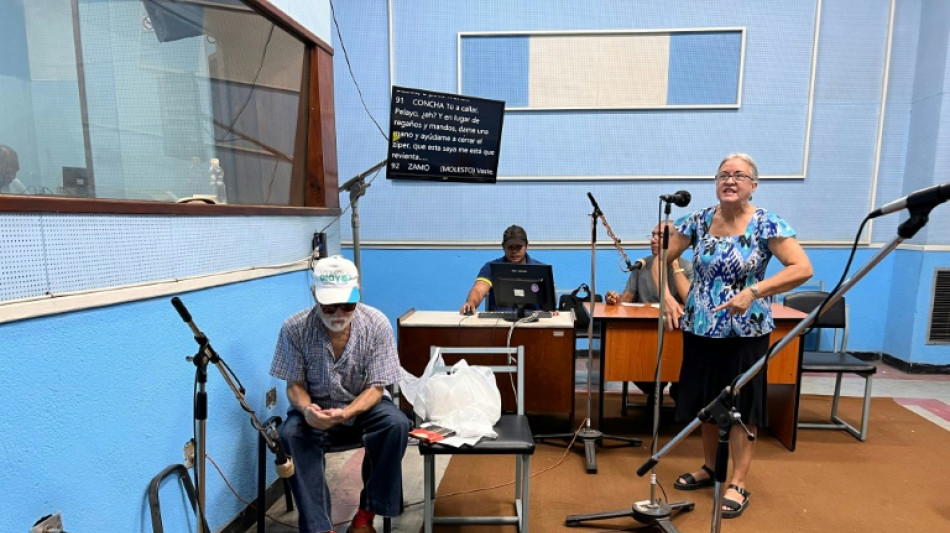
In Radio Progreso's recording studio, time seems to have stopped somewhere in the 1950s.
A group of actors stand in a circle, before a microphone, and bring their characters to life while reading scripts from a black screen.
Nilas Sanchez, an elegant white-haired 76-year-old, has half a century of studio acting under her belt.
She said that, despite the streaming revolution, she believed radio plays had many years of listenership remaining in Cuba.
"Cuba has a strong tradition of listening to the radio and radio dramas," Sanchez said.
The artistic director of "Amores en subasta", Yumary Cruz, swears by the recipe of the father of radio soaps, "El Derecho de Nacer" scriptwriter Felix B. Caignet.
"Tears, whispers and happiness forever delayed are still very effective," she said.
But even inside the padded walls of the studio, the country's present-day economic and energy crises are keenly felt.
To conserve energy in the face of repeated hours-long blackouts -- the Caribbean island has suffered three nationwide blackouts in two months -- air conditioning is forbidden in the studio, meaning the actors perform their lines drenched in sweat.
Cruz also laments the fact that many actors have left Cuba, which is experiencing its biggest outflow of citizens since its 1959 revolution.
Lovers of the genre, meanwhile, grumble at being deprived by the power cuts of their daily shot of drama.
In the absence of a web-based replay service the tech-savvy Castillo records each episode of "Amores en Subasta" and uploads it to a WhatsApp group so listeners across the country can tune in later.
He has also turned it into a podcast, uploading episodes to the cloud so fans both inside and outside Cuba -- including Cuban exiles in Florida -- can download it.
"It's a la carte radio," Cruz joked.
A.Santos--PC