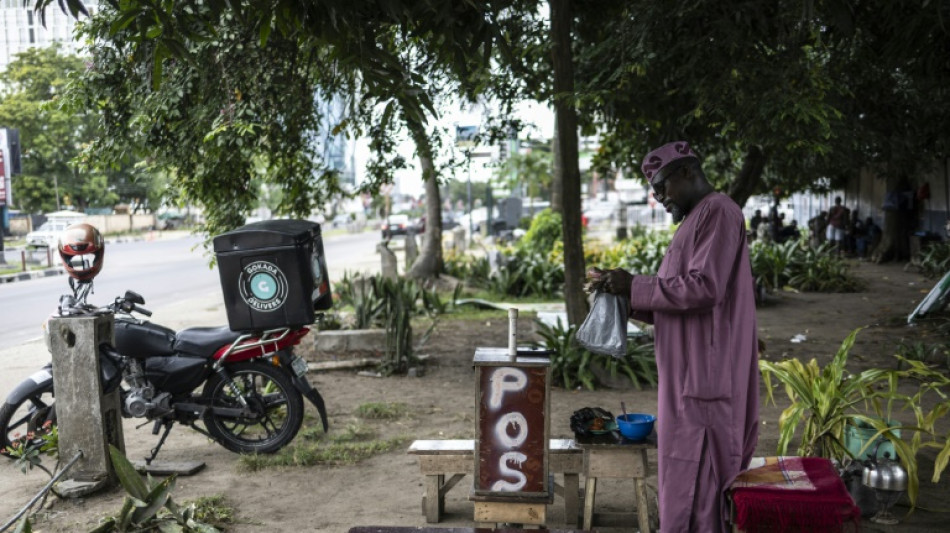
Cash crunch fuels rising misgivings against Nigeria's money agents / Photo: Olympia DE MAISMONT - AFP

 Pant fastest to 100 sixes as India set Sri Lanka 372 to win first Test
 Russia rebukes Japan ambassador over disputed islands row

 Crude extends gains, most stocks drop as Mideast hopes dim

 Rift deepens as Asia football chief hits back at Qatar in Infantino saga
 India extend lead to 294 in first Sri Lanka Test

 Asian allies stress 'critical cooperation' as Trump slashes Korea drills

 Williams sisters fall at Cincinnati while Zverev advances

 Transylvania's fortified churches face fragile future
 China mourns former premier Zhu Rongji with flags lowered, funeral

 Philippine student killed in rare school shooting
 Arsenal primed for Premier League title defence as rivals face questions

 Zverev advances at Cincinnati while Williams sisters fall
 Copper powers profit rise at mining giant BHP
 Whales spark joy in New York but face threats from boat traffic
 Premier League's new bosses brace for battle

 Zambia's Hichilema: 'cattle boy' and two-time president
 Elderly far more at risk from rising heat than thought: study

 LiberNovo Previews Support Week 2026, Putting Better Ergonomic Support Within Reach

 Paramount demands $1.9 billion surety over states' merger lawsuit

 Latest developments in US-Iran war

 NBA has no evidence of Clippers salary cap cheating: report

 Boehly and Walter consider selling Chelsea stake to Clearlake Capital

 OpenAI to lease massive new AI data center in US, backed by Nvidia

 US stocks fall on spiking bond yields, higher oil prices

 LIV Golf cancels Michigan event, to decide team title at Indy
Mobile money agents have become a familiar sight across Nigeria, using handy point-of-sale machines to provide essential services to millions of people without access to banking, particularly in hard-to-reach rural areas.
Even on the streets of major cities they have become a go-to, due to an ongoing shortage of cash at ATMs since a much-vilified redesign of the national currency, the naira, last year.
"There are three of them (agents) on my street alone," Chi Etche, a 29-year-old media executive, told AFP. "This means I don't need to take a bike or cab to reach the nearest bank ATM."
But opposition is growing to their activities, with claims that some are exploiting the country's financial plight, compounding the worst cost-of-living crisis that Nigerians have faced in decades.
"We are now buying back our money from (point-of-sale) PoS agents," Ibrahim Adamu, a 39-year-old trader, told AFP. "The commission they charge is increasing and you can hardly get cash from the machines."
In 2013, the Central Bank of Nigeria (CBN)announced a drive to improve access to financial services across the country.
According to Enhancing Financial Innovation and Access (EFInA), an NGO, by the end of last year at least 74 percent of adults in Nigeria had access to financial services. Just over half (52 percent) used traditional banks.
The central bank's decision and the cash crunch, however, have given ordinary Nigerians reliant on cash no alternative but to use agents, experts say.
"CBN policies simultaneously raised barriers for banks to offer cash and cash alternatives to their customers in pursuit of its cashless policy mandate," said Ikemesit Effiong, a partner at Lagos-based risk consultancy SBM Intelligence.
Agents, however, often operate without identity checks of their customers or regulatory oversight, he added.
- Capped cash withdrawals -
The CBN announced that it was redesigning the naira in October 2022.
Soon after, Godwin Emefiele, the CBN governor at the time, then ordered a cap on cash withdrawal from ATMs and in banking halls as the presidential election approached.
"Over 85 percent of cash that is in circulation is outside the banks," he said at the time.
Vaunted as part of the bank's cashless policy push, the restrictions put pressure on businesses, sparked angry protests, and gave mobile money agents leverage to exploit the cash shortage.
ATM withdrawals are still capped at 20,000 naira ($12.45) per day when withdrawing from one's own bank. Withdrawals from another bank are restricted to just 5,000 naira a day.
Over-the-counter withdrawals of large sums attract punitive charges. Moreover, long queues in banking halls and frequent ATM service downtimes worsen the problem.
That has driven more people towards mobile money agents, said Uzoma Dozie, the founder of challenger bank Sparkle.
- 'Excessive fees' -
Many Nigerians accused bank officials of diverting cash meant for ATMs to agents for personal gain.
"Some agents exploit cash scarcity by charging excessive fees for cash withdrawals and transactions," Dozie told AFP.
"However, this practice isn't inherent to the mobile money system but rather a symptom of broader cash availability issues and inadequate oversight."
A few agents told AFP they also get their cash to run their businesses from other sources.
"I go to markets to buy cash from traders and bureaux de change. I factor that into the commission I charge customers when they come to withdraw cash from me," said Ayo Olaoluwa, 34.
Ifeoma Onwuabuchi, 46, got started with about 100,000 naira.
"That's why you see a lot of people coming into the space. The income is not big but it helps keep me moving," Onwuabuchi said.
A spokesman for the influential Association of Mobile Money and Banking Agents of Nigeria did not immediately respond to AFP's request for comments.
However, Dozie insisted that proper regulation and enforcement can address the concerns while preserving the "benefits of agent banking".
CBN governor Olayemi Cardoso insisted that empty cash machines will not be tolerated and warned that defaulting banks "will face stringent penalties".
"We also urge full regulatory compliance by all stakeholders, including Mobile Money Operators and PoS Agents, to promote digital transaction channels and improve service delivery," he said.
M.Carneiro--PC