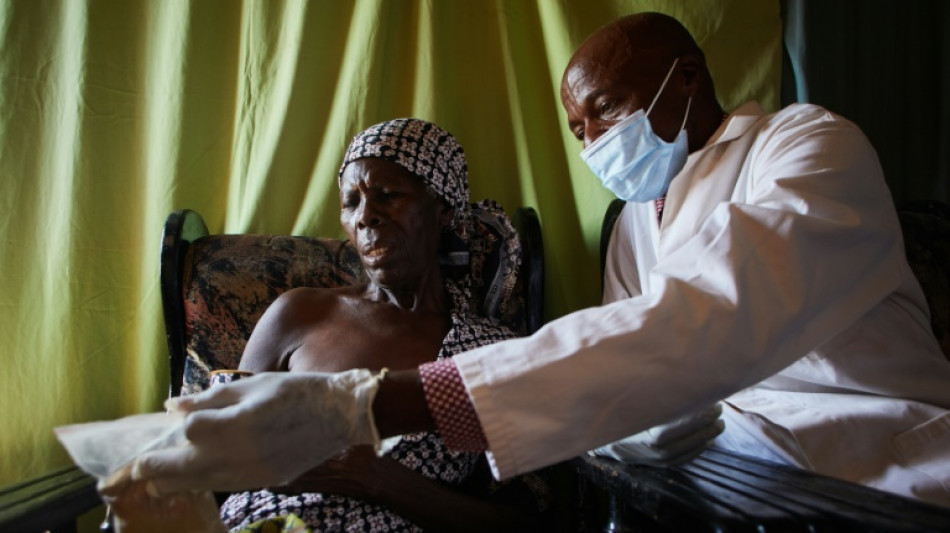
Zimbabwe's sick turn to herbalists over ailing health system / Photo: Jekesai NJIKIZANA - AFP

 Pant fastest to 100 sixes as India set Sri Lanka 372 to win first Test

 Russia rebukes Japan ambassador over disputed islands row
 Crude extends gains, most stocks drop as Mideast hopes dim

 Rift deepens as Asia football chief hits back at Qatar in Infantino saga

 India extend lead to 294 in first Sri Lanka Test

 Asian allies stress 'critical cooperation' as Trump slashes Korea drills

 Williams sisters fall at Cincinnati while Zverev advances

 Transylvania's fortified churches face fragile future

 China mourns former premier Zhu Rongji with flags lowered, funeral

 Philippine student killed in rare school shooting

 Arsenal primed for Premier League title defence as rivals face questions

 Zverev advances at Cincinnati while Williams sisters fall
 Copper powers profit rise at mining giant BHP

 Whales spark joy in New York but face threats from boat traffic
 Premier League's new bosses brace for battle

 Zambia's Hichilema: 'cattle boy' and two-time president

 Elderly far more at risk from rising heat than thought: study

 LiberNovo Previews Support Week 2026, Putting Better Ergonomic Support Within Reach

 Paramount demands $1.9 billion surety over states' merger lawsuit

 Latest developments in US-Iran war

 NBA has no evidence of Clippers salary cap cheating: report
 Boehly and Walter consider selling Chelsea stake to Clearlake Capital

 OpenAI to lease massive new AI data center in US, backed by Nvidia

 US stocks fall on spiking bond yields, higher oil prices

 LIV Golf cancels Michigan event, to decide team title at Indy
When Agnes Kativhu could not get treatment for breast cancer from Harare's main public hospital, she checked in to one of the many self-styled herbal clinics opening up across Zimbabwe's capital.
"I was a moving grave but am now well," Kativhu claimed in an interview at the centre, where she spent around a month.
"I never want to go back to the hospital because it broke my heart that they failed to give me a single tablet," the 67-year-old told AFP.
Unaccredited, unregulated and with unproven results, herbalists are in growing demand among Zimbabweans who feel let down by a public health system in ruins.
The country's largest public hospital, Parirenyatwa, has not had a functioning mammogram machine for 15 years.
It does, however, have the only operating radiotherapy cancer treatment machine available to the general public in the entire country of nearly 17 million people.
"We recognise that one machine is insufficient," said Nothando Mutizira, head of oncology at Parirenyatwa.
"However, we are managing to provide radiotherapy services with this single unit."
Like other public hospitals struggling through Zimbabwe's deep and enduring economic crisis, Parirenyatwa lacks medicines, equipment and even staff as doctors and nurses quit for better salaries and conditions abroad.
- 'No drugs' -
Some hospitals solicit donations of medicines and essential items such as gloves and syringes.
"There are no drugs," said Simbarashe James Tafirenyika, president of Zimbabwe Municipalities Nurses and Allied Workers Union.
Even when a hospital does have equipment, regular power outages put the machines out of service, he said.
Public hospitals are losing their staff to the growing private sector and countries like Britain -- where qualified nurses can earn more money as carers -- or even closer to home in the less well-off region.
"Some are migrating to South Africa, some are migrating to Zambia, some are actually migrating to Mozambique," Tafirenyika said.
The corridors at Parirenyatwa are jammed with patients and their families navigating paint-chipped walls under cracked ceilings. The waiting lists are long.
Those who can afford it, travel to neighbouring South Africa for treatment. Others go to herbalists.
- Faith based on 'fear' -
There is some misguided faith in the benefits of herbs and the risks of hospital treatment, said Lovemore Makurirofa, from the Cancer Association of Zimbabwe.
"Many people fear both the disease and its treatments, avoiding chemotherapy, radiotherapy and surgery," he said.
The emerging herbal clinics -- which advertise for business on street corners via loudspeakers -- frustrate the hospitals.
"When you ask patients why it has taken them that long to come and seek medical attention, usually they will tell you that they've been using herbal medicines for quite a long time," Mutizira said.
"When patients eventually come, they come either with stage three or stage four cancer which is more difficult to treat, more expensive to treat and also the outcomes are much poorer," she said.
The herbalist who runs the Harare centre where Kativhu sought help for her breast cancer is confident of his abilities.
"I can treat any type of cancer," said Never Chirimo, 66. Herbs also enable him to diagnose cancer, he claimed.
But he would like to work more closely with the hospitals.
"What I want is an open dialogue with doctors. Ultimately, we should work together, as many cancer patients prefer herbal remedies over conventional medicine."
Another of his patients, 58-year-old Wilfred Manatsa said he spent $25,000 on treatment at a private hospital for prostate cancer and kaposi sarcoma.
Surgery would have cost another $7,000 that he did not have. He put his faith in the herbs.
"I put aside my prescribed medications and now rely solely on herbs," Manatsa said.
J.Oliveira--PC