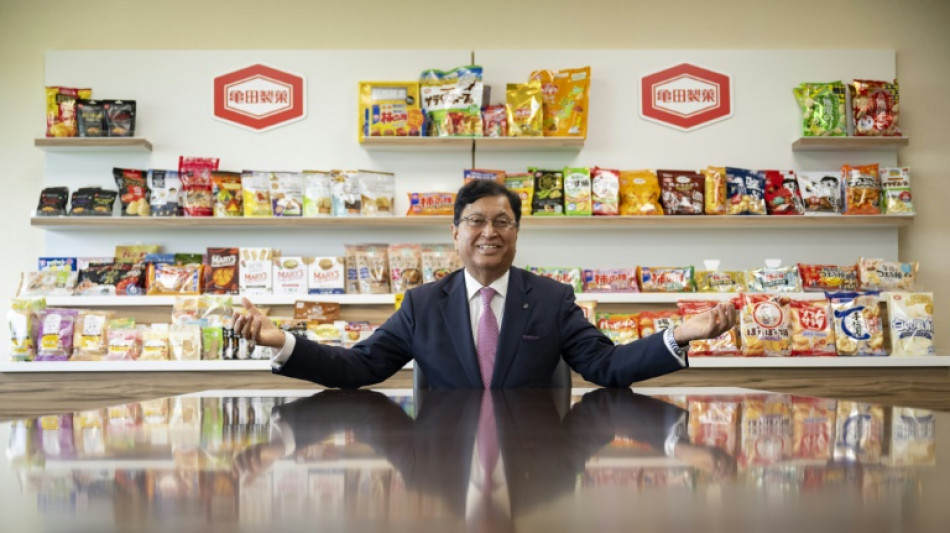
Rare foreign-born CEO says Japan needs immigration to thrive / Photo: Yuichi YAMAZAKI - AFP

 Philippine student killed in livestreamed school shooting

 More Trump-Kim 'love'? What we know about North Korea
 Major Meta trial begins as lawyers spar over witnesses, damages

 Trump threatens to bomb Oman if it gets in way of Iran deal

 Australian cricketer Warner ordered to use breathalyser vehicle lock
 A Viking longship in 'The Odyssey'? It's a case of history meets Hollywood

 Racist abuse spurred Suzuki as Japan goalkeeper set for Premier League

 Japan lights torch as countdown begins to Asian Games

 Make it rain: Indonesia chases clouds to stem El Nino fires

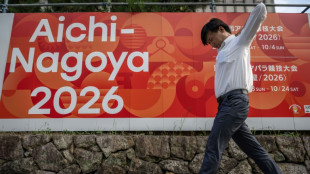 All aboard as Asian Games preparations enter 'final stages'

 Lights out, crowds gone: Havana waits for what comes next

 How families in Milei's Argentina sank deep into debt

 Zambia's Hichilema wins re-election with 60% of vote

 Jeanie Buss to fight siblings over sale of 17.8% stake in Lakers: reports

 Brazil's Lula hails new oil find as 'passport to the future'

 Rybakina slogs through double rain delays in Cincinnati win
 Two largest US reservoirs hit record lows amid western drought

 Colombian minister under fire over beach holiday post-quake

 Lamour leaves key FIFA position after criticising Infantino

 Buss family sells 17.8% stake in Lakers to Iger group

 Mangione state murder trial postponed after federal guilty plea

 Trump envoy says Hamas disarmament could begin within 30 days

 US pauses construction of border project in Texas national park

 Thousands mourn dead black academic in London vigil

 South Africa Test series a lot tougher than a World Cup says All Blacks coach Rennie

The Indian-born head of one of Japan's most famous snack brands has warned that the country must change its mindset and admit more immigrants to get the economy back to the glory of its boom years.
Politicians have struggled for years to recover from the so-called lost decades as a range of differing programmes have failed to kickstart growth, including an ultra-loose monetary policy and trillions of dollars in stimulus measures.
And as the new government of Prime Minister Shigeru Ishiba eyes a fresh drive to bring back the heyday of its global tech domination Lekh Juneja, the head of rice cracker giant Kameda Seika, said he worries his adopted country has lost its edge.
"Forty years ago I came to Japan because it was close to number one in GDP... it was booming," the biotech scientist told AFP at Kameda's headquarters in Japan's rice heartland of Niigata.
But at some point "Japan thought 'we have everything now'. And I think that the hungry spirit to (have) the guts to go global started disappearing a bit".
Kameda's expansion mirrored Japan's postwar boom, increasing revenues tenfold between 1965 and 1974 and becoming synonymous with the nationally adored "senbei" crackers in the process.
But the country that gave the world the Sony Walkman, the bullet train and Super Mario is no longer setting the pace in technology, overtaken by Silicon Valley, South Korea and China.
In the late 1980s, Japanese firms dominated the world's top 10 companies by market capitalisation. Today not one makes the list.
The population is ageing and projected to drop by almost a third in the next 50 years, and firms are already having problems filling vacancies.
Although it has relaxed the rules in recent years, Japan has not turned in a big way to immigration as a solution.
The country "has no choice" but to allow in more immigrants, said Juneja, 72, who first came to Japan in 1984 and previously worked for a food ingredients maker and a pharmaceuticals firm.
"It's not only the numbers. It's also the mindset, the culture. We have to go global," he said.
According to a recent study, Japan needs to more than triple its number of foreign workers to 6.88 million by 2040. Currently it's on track to be almost a million short.
- 'Rice innovation' -
Since joining the firm Juneja has been trying to make Kameda more international as well as a "rice innovation company".
In the testing centre for new products the employees rolling out dough and trying out new recipes and flavours include an American and a Vietnamese.
Language "is a big barrier. You bring people to Niigata and they don't speak Japanese and it's very difficult for them", Juneja said.
"We need to change that. (If we employ people) who only speak and write Japanese we have very limited resources, very limited choices," he warned.
Japan has very few foreign-born CEOs, and boardrooms are overwhelmingly male.
There are 13 female CEOs in Japan's 1,600 top-listed firms, a Kyodo News survey showed in September.
"It's very rare (for a foreigner) to become a CEO in a Japanese company," Juneja said. "But look at the US."
"There is Microsoft, there is Google, all these companies have Indian CEOs," he said.
"I think Japan has to change... We are proud (in Japan) of our backgrounds. But I think flexibility and having people from overseas would be very critical for Japan."
Not all the non-Japanese CEOs have had a smooth ride. In November the German chief of Olympus resigned after allegedly buying illegal drugs.
And in 2018 Carlos Ghosn, the Franco-Lebanese-Brazilian chief of Nissan, was arrested on suspicion of financial misconduct. He then escaped, in part by hiding in an audio equipment box.
"He didn't generate a very good image for foreign CEOs here," Juneja said. "But the difference between him and me is that I have got a Japanese passport."
X.M.Francisco--PC