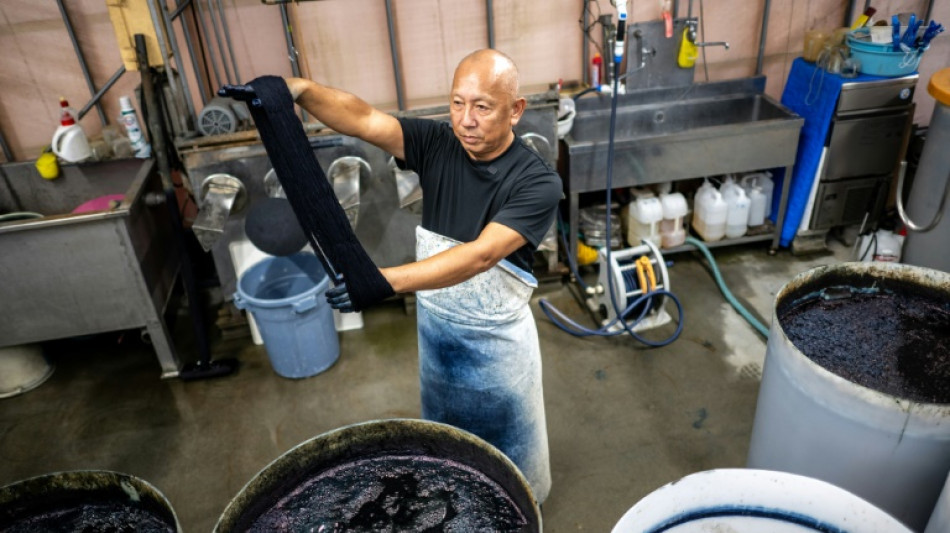
True blue tradition: how Japan's coveted jeans are made / Photo: Philip FONG - AFP

 Asian allies stress 'critical cooperation' as Trump slashes Korea drills

 Williams sisters fall at Cincinnati while Zverev advances

 Transylvania's fortified churches face fragile future

 China mourns former premier Zhu Rongji with flags lowered, funeral

 Philippine student killed in rare school shooting

 Arsenal primed for Premier League title defence as rivals face questions
 Zverev advances at Cincinnati while Williams sisters fall
 Copper powers profit rise at mining giant BHP
 Whales spark joy in New York but face threats from boat traffic
 Premier League's new bosses brace for battle

 Zambia's Hichilema: 'cattle boy' and two-time president

 Elderly far more at risk from rising heat than thought: study

 Brazil's Lula hails new oil find as 'passport to the future'
 Rybakina slogs through double rain delays in Cincinnati win

 Two largest US reservoirs hit record lows amid western drought

 Colombian minister under fire over beach holiday post-quake

 Lamour leaves key FIFA position after criticising Infantino

 Buss family sells 17.8% stake in Lakers to Iger group

 Mangione state murder trial postponed after federal guilty plea

 Trump envoy says Hamas disarmament could begin within 30 days

 US pauses construction of border project in Texas national park

 Thousands mourn dead black academic in London vigil

 South Africa Test series a lot tougher than a World Cup says All Blacks coach Rennie
 Coventry sign Nigeria striker Awoniyi from Forest

 TripleDart tops $7 million ARR with AI-led growth, reports 50 per cent EBIT margin

Call it an antidote to fast fashion: Japanese jeans hand-dyed with natural indigo and weaved on a clackety vintage loom, then sold at a premium to global denim connoisseurs.
Unlike their mass-produced cousins, the tough garments crafted at the small Momotaro Jeans factory in southwest Japan are designed to be worn for decades, and come with a lifetime repair warranty.
On site, Yoshiharu Okamoto gently dips cotton strings into a tub of deep blue liquid, which stains his hands and nails as he repeats the process.
The cotton is imported from Zimbabwe, but the natural indigo they use is harvested in Japan -- its colour far richer than synthetic imitations, according to Okamoto.
He calls it a "time-consuming and costly" method, commonly used to dye kimonos in the 17th-19th century Edo period.
Momotaro Jeans was established in 2006 by Japan Blue, one of a few dozen denim producers in the seaside town of Kojima, renowned for their artisan quality.
"We're very strict about all aspects of manufacturing," Japan Blue's president Masataka Suzuki told AFP.
That includes "whether the sewing is done properly, and whether the dye is beautiful," making local craftspeople with traditional manufacturing skills indispensable.
Their efforts do not come cheap, however. A standard pair of Momotaro Jeans retails for around 30,000 yen ($200) while a silk-blend pair costs 60,000 yen.
The brand's most expensive offering, woven by hand on a wooden machine converted from a luxury kimono loom, has a price tag of over 200,000 yen.
Following in the footsteps of popular high-end Japanese denim brands such as Osaka-based Evisu and Sugar Cane in Tokyo, interest in Japan Blue is growing among overseas shoppers.
They now account for 40 percent of retail sales, and the company recently opened its sixth Kyoto store targeting deep-pocketed tourists.
- 'Niche' reputation -
Denim-making flourished from the 1960s in Kojima, which has a long history of cotton-growing and textile-making.
In the Edo period, the town produced woven cords for samurai to bind sword handles. It then switched to producing split-toe "tabi" socks and, later, school uniforms.
Now denim from Kojima is used by international luxury fashion brands.
The market for Japanese jeans "has grown in the last 10 to 15 years", said Michael Pendlebury, a tailor operating a repair shop in Britain called The Denim Doctor.
Although revered by denim aficionados in Western countries, they remain "not quite affordable for most" with something of a "niche" reputation, Pendlebury said.
"Mass-produced denim brands like Levis, Diesel and Wrangler are the largest, and more worn, but the highest quality is still Japanese in my opinion," he said, adding that the weak yen and a tourism boom could boost sales of made-in-Japan jeans.
Momotaro Jeans is named after a folklore hero in Okayama, where Kojima is located. It's part of the wider denim-producing Sanbi area, which also includes Hiroshima.
Another factor that makes brands like Momotaro Jeans idiosyncratic -- and expensive -- is the use of very noisy old shuttle-weaving machines, which have only a quarter of the output of the latest factory looms.
They often break down, but the only people who know how to repair the machines are in their 70s or older, according to Shigeru Uchida, a weaving craftsman at Momotaro.
The brand uses a handful of shuttle looms made in the 1980s by a company owned by Toyota.
"There are only a few of them in Japan now" because they are no longer made, the 78-year-old Uchida said, walking back and forth between the machines to detect unusual sounds that could signal a breakdown.
Despite the complexities, he says their fabric makes it worth it.
"The texture is very smooth to the touch... and when made into jeans, it lasts quite a long time," Uchida said.
Suzuki says Momotaro Jeans is a "sustainable" choice because "no matter when you bring it to us, we will take responsibility for fixing it".
"When people spend a lot of time in their jeans, the path of their life is left on the clothes," depending on how they wear or wash them and even where they live, Suzuki said.
"We want to preserve such a mark as long as possible."
G.Teles--PC