Medical help arrives by sea to Greece's isolated islands / Photo: Spyros BAKALIS - AFP

 Japan lights torch as countdown begins to Asian Games

 Make it rain: Indonesia chases clouds to stem El Nino fires
 All aboard as Asian Games preparations enter 'final stages'
 Lights out, crowds gone: Havana waits for what comes next

 How families in Milei's Argentina sank deep into debt
 Zambia's Hichilema wins re-election with 60% of vote

 Jeanie Buss to fight siblings over sale of 17.8% stake in Lakers: reports
 Paramount demands $1.9 billion surety over states' merger lawsuit

 Latest developments in US-Iran war
 NBA has no evidence of Clippers salary cap cheating: report
 Boehly and Walter consider selling Chelsea stake to Clearlake Capital

 OpenAI to lease massive new AI data center in US, backed by Nvidia

 US stocks fall on spiking bond yields, higher oil prices

 LIV Golf cancels Michigan event, to decide team title at Indy
 Rodri arrives at Barcelona to complete 'dream' move
 Discord suspends livestreams in Brazil after teen's suicide
 Tupac Shakur's accused killer was out for 'revenge', jury hears
 Netanyahu presses role for US general in Hamas disarmament

 US-Palestinian says 'terrified' as he returns to property besieged by settlers

 Amboss Opens Affiliate Program: Earn Recurring Bitcoin Commissions by Growing Bitcoin Payments
 Netanyahu, Kushner discuss US general for Hamas disarmament: Israeli official
 Scottish FA withdraws support for FIFA boss Infantino

 Belgium fire halts short of German border, but not 'contained'
 Number one Shi suffers shock first-round exit at badminton worlds

 Kolisi and Nche may miss South Africa Test against New Zealand

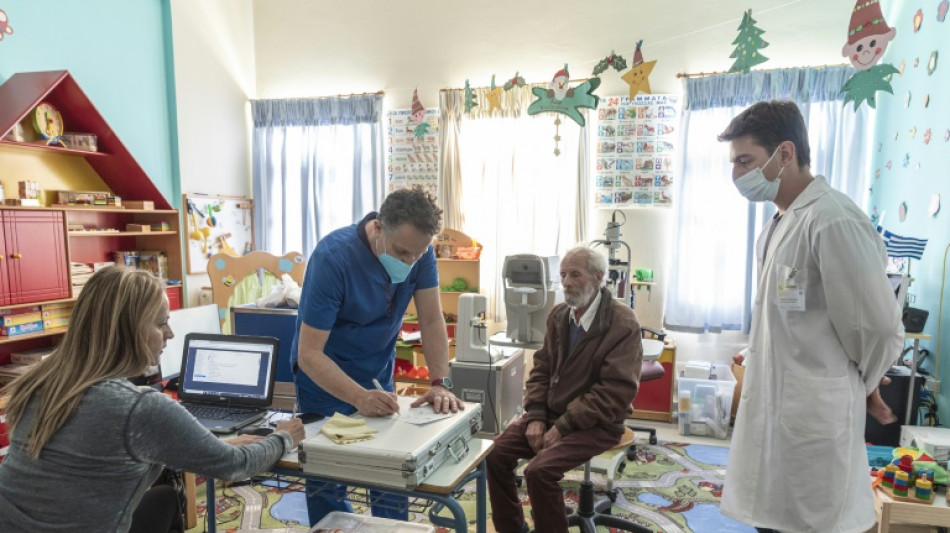
Outside the school of one of Greece's smallest inhabited islands, Sikinos, two massive trucks have braved an eight-hour sea voyage to bring residents much-needed medical expertise in the depths of winter.
The back of the first vehicle opens onto a dental surgery and a mammography booth.
Inside the second truck, obstetric gynaecologist Panagiotis Thomopoulos awaits his first patients among Sikinos's fewer than 200 full-time inhabitants.
"We carry out all the routine gynaecological examinations and colposcopies or smear tests" for cervical cancer screening, explained the doctor, who is employed at an Athens hospital.
Converted into medical examination units, the trucks are part of a campaign funded over the past decade by the Stavros Niarchos foundation, one of Greece's most powerful philanthropic institutions, to bring free care to the inhabitants of remote islands and regions.
The initiative runs every weekend outside the summer months.
- Health spending, fundraising -
Greece is a fragmented country made up of thousands of islands, some of which have only a handful of permanent residents.
The country's health sector suffered mightily during the debt crisis that ravaged Greece from 2010 to 2018, and is far from fully recovering.
In 2021, Greece spent 1,874 euros per capita ($1,948) on healthcare, less than half the EU average, according to the OECD.
Part of that significant shortfall is covered by private donations such as the Niarchos initiative.
The foundation created by one of Greece's most influential shipowning families has fully funded projects, including the design, construction and outfitting of three new state-of-the-art hospitals in Komotini, Thessaloniki and Sparta, as well as expansion and renovation projects at large public hospitals in Athens.
But there are also more modest initiatives.
On Thursday, Greek President Katerina Sakellaropoulou decorated Athena Papachristou, an elderly farmer who last year donated an ambulance to the country's emergency response service.
Papachristou, 85, has said she decided to raise 65,000 euros for the vehicle because the ambulances in her area in Messolonghi, western Greece, kept breaking down.
The situation is even more acute on Greek islands, many of which have only sparse maritime connections and can be cut off from the mainland by poor weather for days.
- 'We feel vulnerable' -
Sikinos lies in the middle of the Aegean Sea, eight hours from the port of Piraeus, and entirely off Greece's island tourism grid.
The nearest hospitals are on the islands of Santorini and Naxos, between two and 2.5 hours away by ferry.
"We feel vulnerable," its mayor Vassilis Marakis told AFP, adding that the island has "no hospital, no specialist doctor and no medical facilities".
In the main village of Hora, the taverns are closed, and cats have taken over the narrow streets that wind around the blue-domed church at its centre.
A few elderly regulars gather in a cafe to discuss football under a flickering Christmas tree.
Medical emergencies are handled via helicopter airlift, but lesser ailments can prove problematic, especially for the island's 17 schoolchildren.
"You have to travel half an hour by boat to see the paediatrician on Ios," the neighbouring island, said Paraskevi Karayianni, 41, a nursery worker with a four-year-old child at home.
After seven years on Sikinos, Karayianni says she has stocked up a "veritable pharmacy at home, ranging from basic medicines to antibiotics".
For the Sikinos trip, the mission is made up of 18 people including a cardiologist, an orthopaedist and an ophthalmologist, plus support staff.
- 'We saved her' -
Around 60 locals came in for tests on a recent day in December, each booking two or three separate examinations.
In a classroom whose walls depicted the great dates in Greek history, a nurse took blood samples. Behind a blue screen, orthopaedist Alexandra Koukoutsi inspected the tired knees of Kalliopi, a woman in her 70s.
"The biggest challenge for us is that we don't have any support to go with care such as physiotherapy. We have to find other solutions," Koukoutsi said, advising her patient to do certain exercises.
According to the OECD, the rate of unmet need for medical care in Greece is nine percent, considerably higher than the EU average of 2.4 percent.
Thomopoulos, the gynaecologist, noted that there are other difficulties on remote islands with more traditional societies.
"Some women have never consulted a gynaecologist because of taboos that may still prevail among the older population," he said.
Transport costs for a follow-up consultation in Athens or another large city can also be a deterrent.
But the work they do is still invaluable. On a mission to another remote island, Thomopoulos said he diagnosed ovarian cancer in a patient.
"I sent her to a colleague in Thessaloniki. She was operated on," he said.
"We saved her."
A.F.Rosado--PC