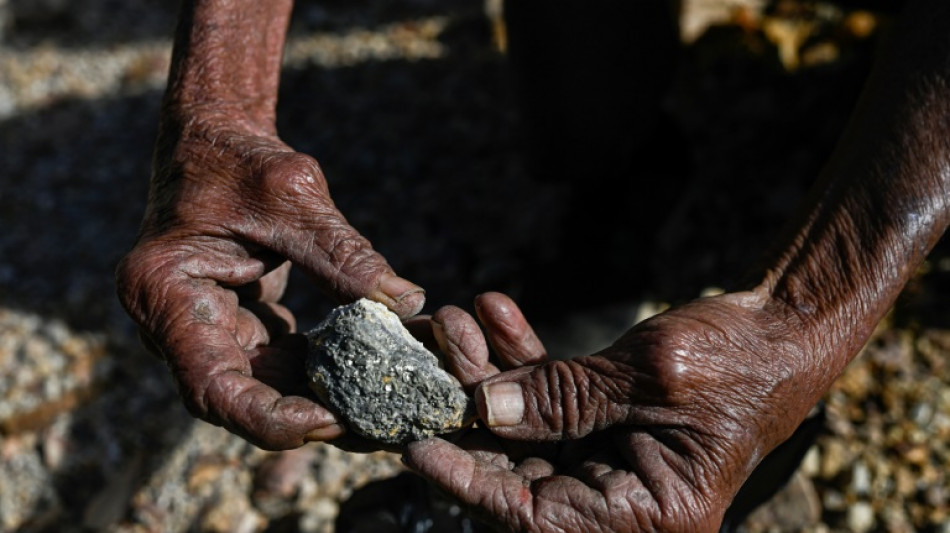
El Salvador Congress votes to end ban on metal mining / Photo: Daniela RODRIGUEZ - AFP/File

 Whales spark joy in New York but face threats from boat traffic
 Premier League's new bosses brace for battle

 Zambia's Hichilema: 'cattle boy' and two-time president

 Elderly far more at risk from rising heat than thought: study

 Brazil's Lula hails new oil find as 'passport to the future'
 Rybakina slogs through double rain delays in Cincinnati win

 Two largest US reservoirs hit record lows amid western drought

 Colombian minister under fire over beach holiday post-quake

 Lamour leaves key FIFA position after criticising Infantino

 Buss family sells 17.8% stake in Lakers to Iger group
 Mangione state murder trial postponed after federal guilty plea

 Trump envoy says Hamas disarmament could begin within 30 days

 US pauses construction of border project in Texas national park

 Thousands mourn dead black academic in London vigil

 South Africa Test series a lot tougher than a World Cup says All Blacks coach Rennie
 Coventry sign Nigeria striker Awoniyi from Forest

 TripleDart tops $7 million ARR with AI-led growth, reports 50 per cent EBIT margin

 Bipartisan backlash as Trump scales back US-South Korea drills
 'Never seen one like it': German pensioners flee wildfire
 Ipswich sign Enciso and Ouattara in double raid on Strasbourg
 UN laments 'unacceptable' toll of 350 aid workers killed in 2025

 Former child star actress Hayden Panettiere dead at 36

 Pakistan captain Babar Azam doubtful for England opener

 Pentagon inks Tomahawk deal amid reports of missile shortfall
 Rain halts India push after Dinusha century lifts Sri Lanka

El Salvador's Congress on Monday approved a bill promoted by President Nayib Bukele to roll back a ban on the mining of gold and other metals, dismaying environmentalists.
The small Central American nation became the world's first country to outlaw metal mining in 2017, warning of the harmful effects of the chemicals used, like cyanide and mercury.
The move by Bukele's predecessor, former left-wing rebel Salvador Sanchez Ceren, reflected a growing rejection of mining by rural communities in the region.
But last month, Bukele, who is popular at home for his crackdown on street gangs, signaled that he wanted to change course.
The bill to bring back metal mining was approved by 57 deputies out of a total of 60, said Ernesto Castro, head of the legislature -- which is dominated by the ruling party -- as environmental campaigners protested nearby.
Critics fear that mining will pollute the Lempa River, which runs through a potential mining zone proposed by Bukele and supplies water to 70 percent of the inhabitants of the capital and surrounding areas.
"This wretched mining will punish the people, it will contaminate our waters and rivers and that's an attack on life," activist Vidalina Morales told reporters.
Bukele said last month that El Salvador, a country of 6.6 million people, had "potentially" the largest gold deposits per square kilometer in the world.
"God placed a gigantic treasure underneath our feet," he wrote on social media, arguing that the mining ban was "absurd."
"If we make responsible use of our natural resources, we can change the economy of El Salvador overnight," he said.
The new law stipulates that the state will be the only entity authorized to search for, extract and process mined metals.
However, the government may do so through companies in which it is a shareholder.
The bill prohibits the use of mercury in mining operations, which may not be carried out in protected natural areas or places with important water sources.
A survey by Central American University published on Monday revealed that 59 percent of respondents do not consider El Salvador "an appropriate country for metal mining."
Since El Salvador dollarized its remittances-reliant economy in 2001, it has registered average annual growth of 2.1 percent.
Twenty-seven percent of Salvadorans live in poverty, according to the United Nations Economic Commission for Latin America and the Caribbean, and 70 percent of the workforce operates in the informal sector.
Elsewhere in the region, Costa Rica and Honduras have banned open-pit mining, and Panama declared a moratorium on new mining concessions last year after mass protests over plans for a huge copper mine.
Ferreira--PC