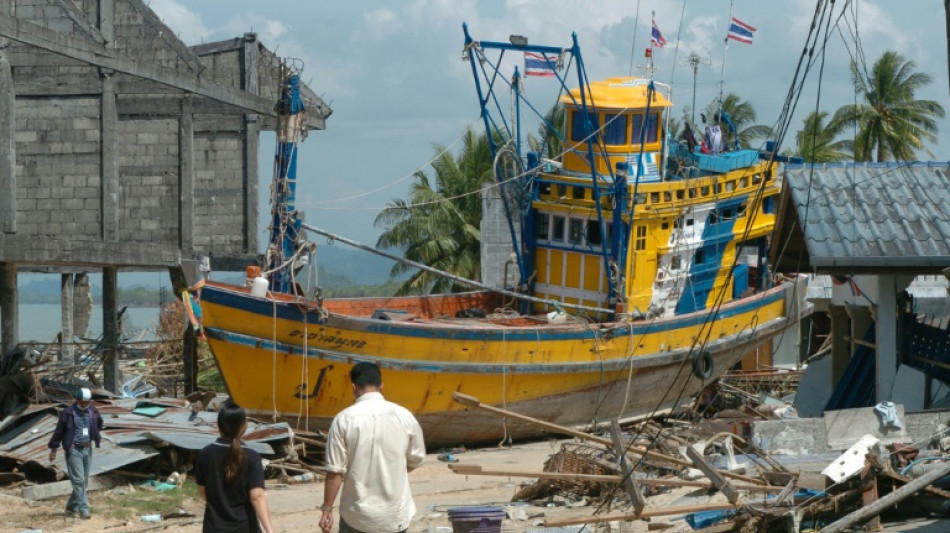
2004 Indian Ocean tsunami: what to know 20 years on / Photo: ROMEO GACAD - AFP

 Whales spark joy in New York but face threats from boat traffic

 Premier League's new bosses brace for battle

 Zambia's Hichilema: 'cattle boy' and two-time president

 Elderly far more at risk from rising heat than thought: study

 Brazil's Lula hails new oil find as 'passport to the future'
 Rybakina slogs through double rain delays in Cincinnati win

 Two largest US reservoirs hit record lows amid western drought

 Colombian minister under fire over beach holiday post-quake

 Lamour leaves key FIFA position after criticising Infantino

 Buss family sells 17.8% stake in Lakers to Iger group

 Mangione state murder trial postponed after federal guilty plea

 Trump envoy says Hamas disarmament could begin within 30 days

 US pauses construction of border project in Texas national park

 Thousands mourn dead black academic in London vigil

 South Africa Test series a lot tougher than a World Cup says All Blacks coach Rennie
 Coventry sign Nigeria striker Awoniyi from Forest

 TripleDart tops $7 million ARR with AI-led growth, reports 50 per cent EBIT margin

 Bipartisan backlash as Trump scales back US-South Korea drills
 'Never seen one like it': German pensioners flee wildfire

 Ipswich sign Enciso and Ouattara in double raid on Strasbourg
 UN laments 'unacceptable' toll of 350 aid workers killed in 2025

 Former child star actress Hayden Panettiere dead at 36

 Pakistan captain Babar Azam doubtful for England opener

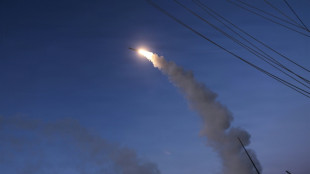 Pentagon inks Tomahawk deal amid reports of missile shortfall

 Rain halts India push after Dinusha century lifts Sri Lanka

Survivors and victims' relatives will next week mark the 20th anniversary of the 2004 Indian Ocean earthquake and tsunami, which killed more than 220,000 people across more than a dozen countries.
A 9.1-magnitude earthquake off the western coast of Indonesia's Sumatra island triggered huge waves that swept into coastal areas of Indonesia, Sri Lanka, India, Thailand and nine other nations around the Indian Ocean basin.
Here is a look back at the impact of the deadliest tsunami in history.
- Faultline rupture -
The tsunami was triggered by the longest faultline rupture from an earthquake ever observed, seconds before 7:59 am on December 26, 2004.
The ocean floor opened at least 1,200 kilometres (750 miles) in length between the India plate and Burma microplate.
It created waves more than 30 metres (100 feet) high, releasing energy equivalent to 23,000 Hiroshima atomic bombs and causing widespread destruction.
The magnitude was initially recorded at 8.8, before the United States Geological Survey gave its official magnitude of 9.1 and depth as 30 kilometres (18.6 miles).
The epicentre was located 150 miles from Sumatra's coast.
Indonesia is a vast archipelago nation on the Pacific "Ring of Fire", an arc of intense seismic activity stretching from Japan through Southeast Asia and across the Pacific basin.
- Huge death toll -
A total of 226,408 people died as a result of the tsunami, according to EM-DAT, a recognised global disaster database.
The worst affected area was northern Sumatra, where more than 120,000 people were killed out of a total of 165,708 dead in Indonesia.
The huge waves travelled around the Indian Ocean, hitting Sri Lanka, India and Thailand hours later.
At their fastest the waves travelled at over 800 kilometres an hour (500 mph), more than twice the speed of a bullet train.
More than 35,000 were killed in Sri Lanka, with 16,389 killed in India and 8,345 in Thailand, according to EM-DAT.
Nearly 300 were killed in Somalia, more than 100 in the Maldives, as well as dozens in Malaysia and Myanmar.
- Displaced, reconstruction -
The tsunami displaced more than 1.5 million people and sparked disaster relief of around $14 billion pledged from the international community, according to the United Nations.
Hundreds of thousands of buildings were destroyed, leaving in some cases entire communities homeless.
A splurge in reconstruction has transformed the worst-hit city Banda Aceh.
More than 100,000 houses were rebuilt in the westernmost Indonesian province of Aceh alone, according to the Indonesian government.
- Warning systems -
The tsunami also forced a reckoning about the preparedness of coastal communities around the Indian Ocean basin.
At the time of the earthquake, there was no warning system in place in the Indian Ocean.
But now, 1,400 stations globally cut warning times to just minutes after a tsunami wave forms.
Experts said the lack of a properly coordinated warning system in 2004 had made the disaster's impact worse.
Ocean scientists say we are more prepared than ever thanks to millions of dollars being invested into tsunami warning systems, but warn that the impact of a catastrophic tsunami can never be completely prevented.
Ferreira--PC