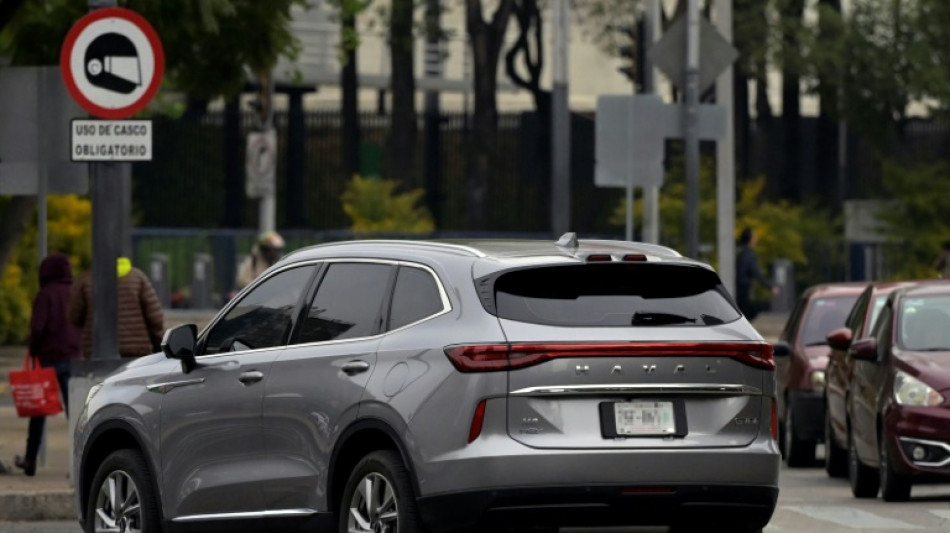
Move over Mercedes: Chinese cars grab Mexican market share / Photo: ALFREDO ESTRELLA - AFP

 Whales spark joy in New York but face threats from boat traffic

 Premier League's new bosses brace for battle

 Zambia's Hichilema: 'cattle boy' and two-time president

 Elderly far more at risk from rising heat than thought: study

 Brazil's Lula hails new oil find as 'passport to the future'

 Rybakina slogs through double rain delays in Cincinnati win
 Two largest US reservoirs hit record lows amid western drought

 Colombian minister under fire over beach holiday post-quake

 Lamour leaves key FIFA position after criticising Infantino

 Buss family sells 17.8% stake in Lakers to Iger group

 Mangione state murder trial postponed after federal guilty plea

 Trump envoy says Hamas disarmament could begin within 30 days

 US pauses construction of border project in Texas national park

 Thousands mourn dead black academic in London vigil

 South Africa Test series a lot tougher than a World Cup says All Blacks coach Rennie

 Coventry sign Nigeria striker Awoniyi from Forest

 TripleDart tops $7 million ARR with AI-led growth, reports 50 per cent EBIT margin

 Bipartisan backlash as Trump scales back US-South Korea drills

 'Never seen one like it': German pensioners flee wildfire

 Ipswich sign Enciso and Ouattara in double raid on Strasbourg

 UN laments 'unacceptable' toll of 350 aid workers killed in 2025

 Former child star actress Hayden Panettiere dead at 36

 Pakistan captain Babar Azam doubtful for England opener
 Pentagon inks Tomahawk deal amid reports of missile shortfall

 Rain halts India push after Dinusha century lifts Sri Lanka

The growing popularity of Chinese sport utility vehicles and pickup trucks has shaken up Mexico's luxury car market, hitting sales of traditionally dominant brands such as Mercedes-Benz and BMW.
According to industry experts, Mexicans are increasingly switching from traditionally dominant sedans to Chinese vehicles due to a combination of comfort, technology and price.
It is no small feat in a country home to factories of foreign brands such as Audi and BMW, and where until a few years ago imported Chinese cars were stigmatized, as in other parts of the world.
According to the Mexican Association of Automotive Distributors (AMDA), the high-end segment of the market registered a sales drop of 8.1 percent from January to November.
Audi's sales slumped by 21.9 percent, while BMW, which includes the Mini brand, saw no growth in Latin America's second-largest economy, home to 129 million people.
Mercedes-Benz suffered a 9.8 percent decline, according to the state-run statistics institute INEGI.
In contrast, Motornation, which sells the BAIC, JMC and Changan brands in Mexico, saw an 8.8 percent increase in sales in the first 11 months of this year, while those of Jetour rose 131 percent, it said.
Chinese firms now control 9.3 percent of the Mexican market, according to the AMDA.
They have brought stiff competition to the pickup truck segment, with many of the features of high-end models offered by premium brands, the association's president Guillermo Rosales told AFP.
Traditionally, the premium segment included sedan-type vehicles with luxury engines and top-of-the-range features.
However, over the past decade consumer preferences have shifted toward utility vehicles such as pickup trucks, minivans and SUVs.
Asian brands also benefited from an exemption from import tariffs on electric vehicles that was in effect in Mexico from 2020 until October 1.
- 'Simple arithmetic' -
As in other Latin American countries, Mexicans are becoming more used to seeing Chinese brands on the streets that were unknown to them until about five years ago.
Miguel Reyes, a 71-year-old retiree, said that choosing a Chinese car over others was "simple arithmetic."
"I needed a car that had the necessary technology, such as steering assist, to make driving safer," Reyes said.
As well as the design and comfort, the "competitive" price was another factor, said Reyes, who paid around 550,000 pesos -- roughly $27,000 dollars.
A similar model from a traditional brand would have cost him between $40,000 and $50,000, he said.
According to Gerardo Gomez, an expert at the data and analytics company J.D. Power, there are around 30 Chinese brands in Mexico, with vehicles ranging from compacts to luxury cars.
"They can offer you anything at any point in the range."
BYD offers an electric pickup truck for more than a million pesos ($50,000) but also a compact car for $17,000.
Zeekr, a premium electric brand, sells luxury models for around $40,000.
- Trump tensions -
Chinese cars' growing presence in Mexico, which is itself a major exporter of vehicles, comes at a time when China is a source of contention between the United States, Mexico and Canada, partners in a regional free trade agreement.
During his campaign, US President-elect Donald Trump suggested that China was building car factories in Mexico to sell vehicles in the United States.
Canadian officials have accused Mexico of being a springboard for Chinese products in the region -- a claim denied by Mexican authorities.
Trump has also threatened to impose 25 percent tariffs on both Mexico and Canada unless they stop flows of migrants and drugs.
According to Mexican President Claudia Sheinbaum, only seven percent of the components of cars manufactured in the Latin American country are Chinese.
"There's no evidence from anywhere that proves that Mexico is being used as a springboard" for Chinese products, said Diego Marroquin, a trade policy specialist at the Wilson Center in the United States.
"It's a political narrative that comes from the United States and now from Canada."
Sheinbaum said last month that she would propose to the United States and Canada a Chinese import substitution plan, noting that in the case of Mexico alone, the trade deficit with the Asian giant amounted to $80 billion.
T.Resende--PC