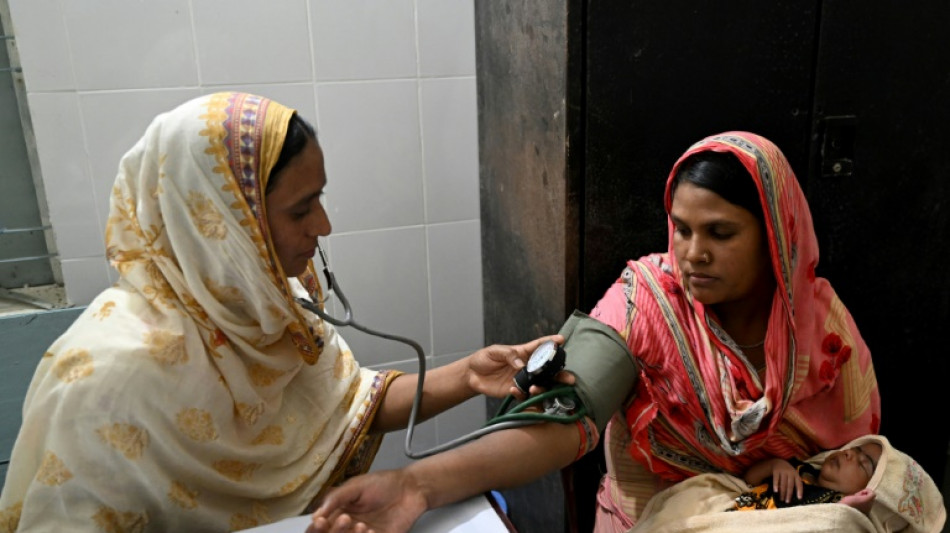
Women spearhead maternal health revolution in Bangladesh / Photo: Munir UZ ZAMAN - AFP

 Air support kicks in as record Belgian wildfire jumps in size

 Firefighters battle second day of blaze on Greek island

 Strikes kill 12 in Russia and Ukraine

 India's Sindhu backs monkey measures as badminton worlds set to open

 Mass drone attack on Moscow as Russian strikes kill three in Ukraine

 Djokovic feels the heat in Cincinnati defeat, Zverev wins all-nighter

 Pallister stuns Ledecky in Pan Pacs 800m free as two world records carry Douglass to gold

 Rampant Bangladesh make history with first-ever Test win in Australia

 UK's media-savvy PM Burnham shifts messaging to TikTok, podcasts
 Gay badminton star Gilmour urges progress on LGBTQ rights in Asia

 Pallister takes down Ledecky in Pan Pacs 800m freestyle

 Douglass breaks 50m free world record again to claim Pan Pacs gold

 As Opel turns to Chinese partners, its hometown frets about the future

 Mehidy takes three as Bangladesh close on historic win in Australia
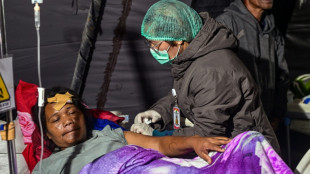
 Hope fades for finding surivivors of Colombia quake as rescued woman dies

 Hurricane Lala dumps heavy rain on Hawaii

 Jaded voters, same old choices: Brazil kicks off election campaign
 'Everyone lives in fear': Yemenis worry about return to all-out war

 Cardinals' Baez bashes record three homers in MLB debut

 Djokovic feels the heat in Cincinnati opening defeat

 Hunt bags third Euro gold, Diaz shines in triple jump

 Depleted Djokovic falls in Cincinnati Masters opener

 Lala, now a hurricane, dumps heavy rain on Hawaii

 American Kate Douglass reclaims 50m freestyle world record

 Kit confusion disrupts Newcastle friendly against Leverkusen

Young Bangladeshi mother Mafia Akhter's decision to give birth at home and without a doctor left her grieving over her firstborn's lifeless body and vowing never to repeat the ordeal.
"My first baby died," the 25-year-old told AFP. "I told myself that if I didn't go to the clinic it could happen again, and that I wouldn't be able to bear it."
She gave birth again last month at a medical centre in a village hemmed in by rice paddy and rivers, far from the nearest hospital and without the oversight of an obstetrician.
But this time her child survived -- something she credits to Nargis Akhter, one of the thousands of Bangladeshi women working as "skilled birth attendants" to help mothers through delivery.
"Giving birth is the most important and critical moment for a woman," Nargis -- no relation to her patient -- told AFP.
"I am lucky and proud to be able to be with them at that moment."
Nargis was speaking to AFP after her routine post-natal consultation with Mafia, who was cradling her young daughter during her return to the spartan village health centre where she gave birth.
Skilled birth attendants have been a fixture of Bangladesh's maternal health policy for two decades and are an important pillar of the South Asian nation's underfunded health system.
More than 30 percent of Bangladeshi women nationally give birth without the assistance of a doctor, nurse or midwife, according to government data from 2022 Demographic and Health Survey.
Birth attendants like Nargis, 25, are given several months training and put to work plugging this gap by serving in a jack-of-all-trades role akin to a cross between a nurse and a doula.
The use of skilled birth attendants has coincided with dramatic improvements to maternal health outcomes in Bangladesh.
Over the past 20 years, the mortality rate for pregnant women has fallen by 72 percent, to 123 deaths per 100,000 births and babies by 69 percent to 20 deaths per 100,000 births, according to the World Health Organization (WHO).
"Many women do not have access to quality care, so I feel useful by helping them," said Nargis, who in her five years as a birth attendant has overseen more than 400 deliveries.
"Almost no women die in childbirth here anymore," she added.
"For me, that's the most important thing."
- 'It takes time' -
Besides helping with deliveries, birth attendants will screen pregnant women weeks ahead of their due date to refer high-risk pregnancies to hospitals further afield.
For women in Biswambharpur, the remote district that Mafia and Nargis call home, complicated cases will wind up in a district hospital struggling with inadequate resources.
"We never leave a patient without care, but they sometimes have to wait a long time for treatment," said Abdullahel Maruf, the hospital's chief doctor.
"Plus, we can't change the geography. In an emergency, it takes time to get to us."
Biswambharpur is lashed by monsoon rains for months each year that make travel difficult, and a lack of paved roads mean that many of its villages are inaccesible by the district's only ambulance, even during the drier months.
Maruf's hospital sees up to 500 patients each day and still has around eight women die in labour each year -- fatalities he says are avoidable, given that his emergency department lacks an obstetrician and backup surgeon.
"We could easily reduce this figure if we had all the required staff," he said.
Maruf said that mortality rates had nonetheless improved by an awareness campaign encouraging women to give birth at local health clinics rather than at home.
"This is our greatest victory," he said.
Bangladesh spends only 0.8 percent of its GDP on public health, a figure that Maya Vandenent of the UN children's agency said risked stalling the country's improvements to maternal health.
"Huge progress has been made," she told AFP. "But the movement is slowing down."
Sayedur Rahman, a physician overseeing Bangladesh's health ministry, freely concedes that more health funding is far from the top of the agenda of the government he serves.
The country is still reeling from the dramatic ouster of autocratic ex-premier Sheikh Hasina last August during a student-led national uprising.
Rahman is part of an interim administration tasked with steering democratic reforms ahead of fresh elections, and he laments that these priorities will leave others in the health sector unaddressed.
"We need resources to create a national ambulance network, recruit more anesthesiologists, open operating rooms," Rahman told AFP.
"Our financial constraints will directly impact maternal and neonatal mortality rates."
F.Moura--PC