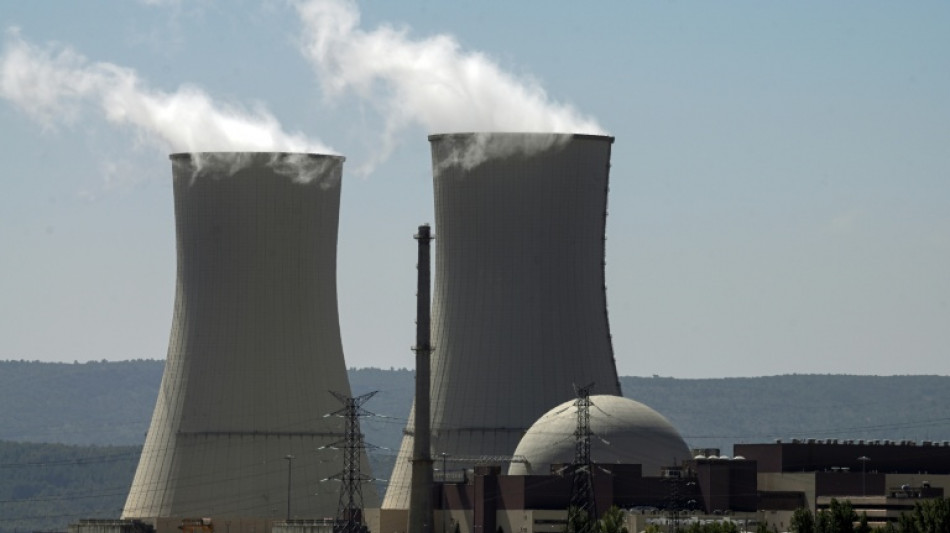
Spain under pressure to abort nuclear energy phase-out / Photo: OSCAR DEL POZO - AFP

 Air support kicks in as record Belgian wildfire jumps in size

 Firefighters battle second day of blaze on Greek island

 Strikes kill 12 in Russia and Ukraine

 India's Sindhu backs monkey measures as badminton worlds set to open

 Mass drone attack on Moscow as Russian strikes kill three in Ukraine

 Djokovic feels the heat in Cincinnati defeat, Zverev wins all-nighter

 Pallister stuns Ledecky in Pan Pacs 800m free as two world records carry Douglass to gold

 Rampant Bangladesh make history with first-ever Test win in Australia

 UK's media-savvy PM Burnham shifts messaging to TikTok, podcasts

 Gay badminton star Gilmour urges progress on LGBTQ rights in Asia

 Pallister takes down Ledecky in Pan Pacs 800m freestyle

 Douglass breaks 50m free world record again to claim Pan Pacs gold

 As Opel turns to Chinese partners, its hometown frets about the future

 Mehidy takes three as Bangladesh close on historic win in Australia

 Hope fades for finding surivivors of Colombia quake as rescued woman dies

 Hurricane Lala dumps heavy rain on Hawaii

 Jaded voters, same old choices: Brazil kicks off election campaign

 'Everyone lives in fear': Yemenis worry about return to all-out war

 Cardinals' Baez bashes record three homers in MLB debut

 Djokovic feels the heat in Cincinnati opening defeat

 Hunt bags third Euro gold, Diaz shines in triple jump

 Depleted Djokovic falls in Cincinnati Masters opener

 Lala, now a hurricane, dumps heavy rain on Hawaii

 American Kate Douglass reclaims 50m freestyle world record

 Kit confusion disrupts Newcastle friendly against Leverkusen

Spain, a European renewable energy leader, is coming under increasing pressure from the right and business groups to reverse its plans to phase out its nuclear power plants by 2035.
At the height of enthusiasm for nuclear power in the 1980s, Spain had eight nuclear plants providing 38 percent of its electricity. Now it has five, providing 20 percent of its power.
Under the country's nuclear phase-out plans, agreed in 2019 under the government of Socialist Prime Minister Pedro Sanchez, these remaining plants will be closed over the next decade, as the country focuses instead on green energy sources such as solar and wind power.
But as the planned closure of the country's oldest and most powerful atomic plant at Almaraz in western Spain in 2027-28 approaches, calls are growing for Spain to follow in the footsteps of other European countries that are reviving their nuclear power.
The two reactors at Almaraz generate around seven percent of the total electricity produced in the European Union's fourth-largest economy.
Spain's decision to close its plants "was adopted in a completely different industrial, geopolitical, social and economic context" and no longer makes sense without "a viable alternative," the Nuclear Forum lobby group that represents the sector said in a statement.
Atomic power will be needed to meet Spain's electricity needs as demand will soar due to growing sales of electric vehicles and the expansion of data centres to accommodate the greater use of AI, it added.
- 'Absolutely necessary' -
Ignacio Sanchez Galan, the chairman of Spanish energy company Iberdrola, which operates several atomic power plants as well as renewable energy farms, said nuclear energy is "absolutely necessary" to keep the lights on.
Iberdrola is one of around 30 companies that signed a manifesto last month calling for the extension of Spain's nuclear power plants.
"Dismantling this infrastructure prematurely would cause irreparable economic and social damage," the manifesto said.
Since gas prices spiked with the Ukraine war, global interest in the nuclear sector is at its highest since the oil crises in the 1970s, according to the International Energy Agency.
The Netherlands and Sweden are planning to build new nuclear plants, while Belgium's new conservative-led government has reversed a two-decade pledge to phase out atomic power.
Italy's cabinet last month opened the door to a return to nuclear power, 25 years after the closure of its last reactors.
- 'Not ready' -
Spain's conservative main opposition People's Party (PP) has added to the pressure.
It has tabled a motion, which has been approved by the parliament, calling on the government to keep the nuclear plants in operation.
During a visit to the Almaraz plant last month, the influential PP head of Madrid's regional government, Isabel Diaz Ayuso, said the measure was necessary to "protect jobs and energy sovereignty" and warned that Spain was "not ready to replace nuclear energy".
The price of electricity in Spain could rise by 23 percent for domestic consumers and by 35 percent for businesses if the country's nuclear reactors are shut down, according to a study by PwC.
Abandoning nuclear power is a "big change" because it means replacing a "constant and predictable energy supply" with "more volatile" sources such as solar and wind, Enric Bartlett, a professor of environmental law at Esade Law School, told AFP.
But it should be possible to close the remaining nuclear plants "without disruption" if Spain has the right amount of installed capacity to generate electricity by other means by 2035, and the "appropriate transport and storage networks", he added.
"There will have to be a significant increase in investment," Bartlett said.
A.Aguiar--PC