Armed groups covet cocoa in eastern DR Congo
/ Photo: PHILÉMON BARBIER - AFP/File

 Hurricane Lala brushes past Hawaii's Big Island, bringing heavy rain
 'Something we dreamed of': Bangladesh celebrates historic cricket win

 Rain holds up India on day two of Sri Lanka Test

 The Ukrainian social media channels tracking Russian missiles

 Disney offers fans an escapist bubble at D23 event

 Thousands await aid after deadly Indonesian quake

 Chinese ship sets off for Europe through Arctic, halving travel time

 Bangladesh on verge of historic win in Australia as Mehidy takes five

 Messi sees penalty saved as Nashville routs Inter Miami in MLS

 Heat is on as German winegrowers struggle to protect vines

 Hope fades for finding survivors of Colombia quake as rescued woman dies
 Japan aims for the moons of Mars
 'People could get hurt': Conservationists decry AI wildlife visuals

 'Another chance to live': Flores residents recall quake panic
 Rivers among nine inducted into Basketball Hall of Fame

 No.1 Scheffler leads by two at PGA St. Jude playoff event

 Rennie confident Jordan, Roigard will be fit to face Springboks

 PSG sign Belgian winger Godts from Ajax

 Nillessen claims shock European 1,500m gold
 Taylor scores two tries in winning debut as New Zealand captain

 England defender Spence leaves Spurs for Inter Milan

 Moore double leads Spurs to 3-0 friendly win over Hoffenheim

 Man Utd beaten by former boss Amorim's AC Milan in friendly finale
 Villagers evacuate as Belgium battles record wildfire

 Despite booming economy, young Moroccans still dream of Europe

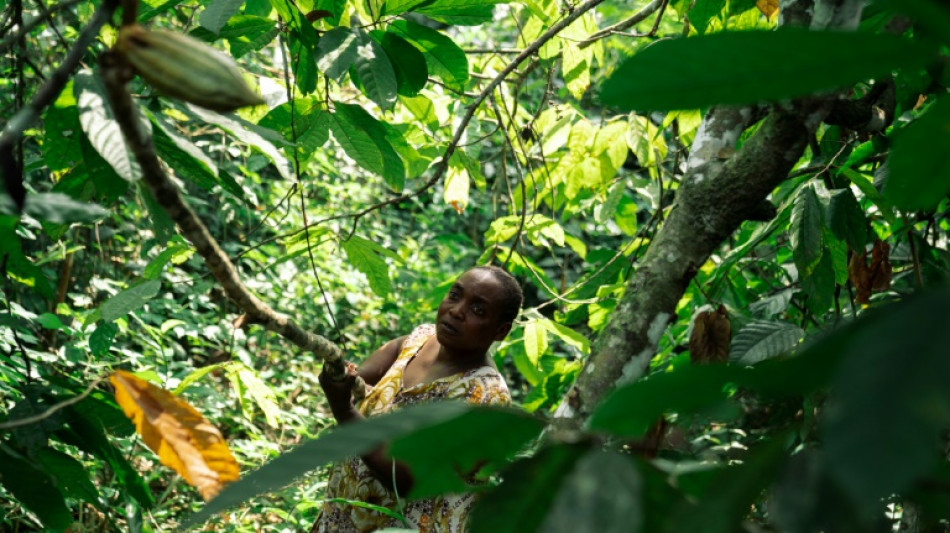
Despite the risks from deadly armed groups roaming the countryside, Judith Kahindo walks alone every day to her isolated cocoa plantation in the war-torn North Kivu region of the eastern Democratic Republic of Congo.
North Kivu is primarily rich in coltan and other minerals that have fuelled the fighting that has ravaged the region for the last three decades.
Vast areas have been seized by the M23 rebel group in a lightning offensive since January including the capital Goma.
But further north in Beni, cocoa, whose prices have soared on the world market in the last two years, also stokes the violence.
Massacres committed by the Allied Democratic Forces (ADF) rebels, who have pledged allegiance to the Islamic State group, have left thousands dead and prevented cocoa farmers from accessing their plantations for years.
"We tend our fields with the fear of being massacred because cocoa is so coveted, whether by the rebels or even our soldiers," said Kahindo, a widow with eight children, as she hacked her way through a tangled forest with a machete.
Cocoa production across the DRC remains relatively marginal, just over one percent of global production.
- Smuggling -
But that is still enough to attract the attention of various armed groups in Beni who fuel smuggling networks to neighbouring Uganda, according to those involved in the sector.
"If there wasn't cocoa in abundance in Beni, the war would already have finished," said Kahindo.
The ADF are not the only threat to people in the area.
"There are people who are taking advantage of the terror caused by the ADF to steal," said Colonel Mak Hazukay, the Congolese army spokesman in the area.
Even before the emergence of the ADF in the 2000s, the region was already plagued by attacks from the "sangabalende" –- criminal groups that specialised in cocoa theft and smuggling, said Richard Kirumba, Beni civil society president.
Kirumba also said that some Congolese soldiers deployed to protect people from the ADF actually tax cocoa traders or loot abandoned fields.
Stolen cocoa is often trafficked through cross-border smuggling networks.
"The criminals sell the cocoa as it is. They just cut it, remove the husks that protect the beans and then sell it directly," said Frank Ndinyoka Kabeya, a cocoa buyer and a member of the Union of Traders of Agricultural Products in Congo.
Unwary buyers risk being stopped by police. But checks are lax in a country where corruption is endemic, according to NGO Transparency International.
On Beni's streets cocoa beans heaped on tarpaulins can be seen drying in the sun and are mainly sold to "small buyers", circumventing certification processes, said Karim Sibenda, an agricultural engineer at a local chocolate factory.
- Organic -
At the National Office of Agricultural Products of Congo (ONAPAC), which is responsible for certifying the quality and origin of cocoa for export, there is a buzz of activity during the harvest season.
Tonnes of beans with a vinegary scent are piled up in the warehouse, where employees fill and stamp canvas bags destined for export.
Company employee Agee Mbughavinywa, who buys and certifies agricultural products, said cocoa producers are identified by a code to ensure traceability.
The bags of cocoa beans are then mainly exported to Uganda, like other agricultural goods in the region.
Since the end of 2021, the DRC authorised Ugandan troops to operate in the region and fight the ADF alongside the Congolese army.
Their presence has been vital in securing vital trade routes and increase exports, ONACAP said.
But this rapprochement between Kinshasa and Kampala has sparked fears in the cocoa market.
"Ugandan buyers are destabilising the sector, they come with cash in hand and impose their prices on producers," said ONACAP's Beni director.
"They don't look at the quality, they take everything and export it under a Ugandan label, this is hampering the country's economy," she said.
In Beni, traditional farming methods and particularly fertile soil allow for the production of organic cocoa.
But the violence is also threatening its organic status. The European Union recently threatened to no longer recognise the label on local products, as insecurity prevents certification by inspectors.
Industry stakeholders fear that could encourage fraudulent exports of Congolese cocoa as Ugandan.
P.Sousa--PC