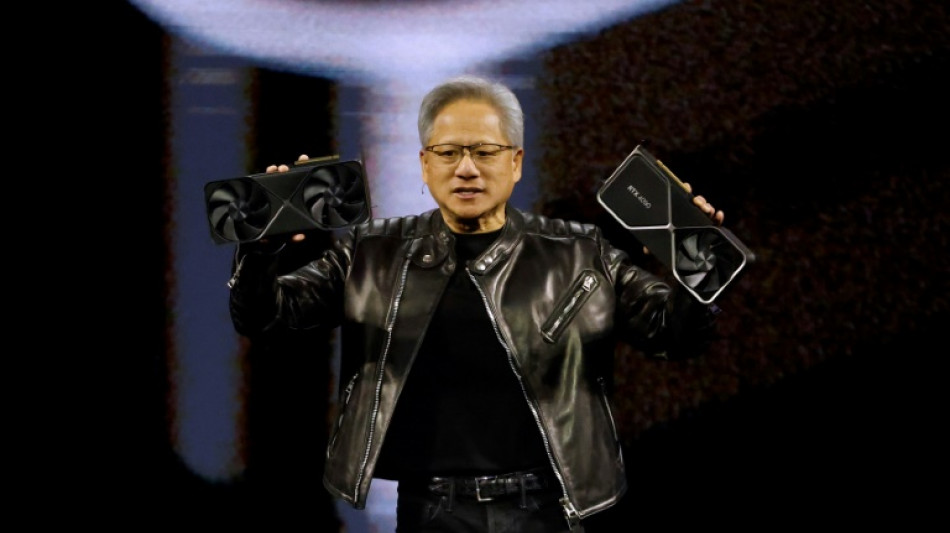
Nvidia chief confident chip maker can weather US tariffs / Photo: JUSTIN SULLIVAN - GETTY IMAGES NORTH AMERICA/AFP

 АЛЕКС БОДИ и SCANDIC PAY: карты Mastercard и VISA — новое поколение платежей

 ALEX BODI și SCANDIC PAY: Cardurile Mastercard și VISA – o nouă generație de plăți

 John Park’s Agency Takes Legal Action Over Unauthorized 'McDonald’s Order Rap' Distribution

 Best Pet Advent Calendars for Christmas 2026: Dog Treats and Cat Toys

 Grattan Institute Releases Blueprint to Target Specialists Over Excessive Fees

 Arizona Science Center Hosts Girls in STEM Astro Adventures for Students

 New Turkish Cafe, Japanese BBQ, and Korean Restaurants Open Across East Bay

 Knowle Move Four Points Clear at Top After Histon Victory
Nvidia boss Jensen Huang expressed confidence Wednesday that the artificial intelligence (AI) chip giant can handle US President Donald Trump's trade war.
"We have a really agile network of suppliers; they are not just in Taiwan or Mexico or Vietnam," Huang said while meeting with journalists at Nvidia's annual developers conference in San Jose, California.
"If we add onshore manufacturing by the end of this year, we should be quite good."
Nvidia is not expecting tariffs to significantly affect its financial performance in the short term, according to Huang.
He noted that the tariff situation is evolving, and that what it does to Nvidia costs will depend on which countries are targeted by Trump.
Trump has threatened to slap extra tariffs on imports of computer chips to the United States, which will heap pressure on Nvidia's business, which depends on imported components mainly from Taiwan.
Since returning to power in January, Trump has imposed tariffs on Washington's three main trading partners, Mexico, Canada, and China.
Trump has talked of imposing "reciprocal tariffs" against other countries in early April, creating uncertainty for businesses and financial markets.
The White House recently put out a release saying Trump is intent on making the US a "manufacturing superpower," ramping up pressure to shift production back to this country.
However, chip fabrication facilities can take years to build.
Since its founding in 1993, Nvidia has specialized in graphics processing units (GPUs) coveted by video game enthusiasts.
GPUs are also ideally suited for AI and the rise of that technology has catapulted the Silicon Valley-based chip maker into the spotlight.
"We're not making chips anymore; those were the good old days," Huang quipped. "What we do now is build AI infrastructure."
High-end versions of Nvidia's chips face US export restrictions to the major market of China, part of Washington's efforts to slow its Asian adversary's advancement in the strategic technology.
Asked about this, Huang replied that his company is not alone in needing to respect each country's laws.
H.Portela--PC