Too much water: Gold rush, climate change submerge Bolivian village / Photo: AIZAR RALDES - AFP

 Pallister stuns Ledecky in Pan Pacs 800m free as two world records carry Douglass to gold

 Rampant Bangladesh make history with first-ever Test win in Australia

 UK's media-savvy PM Burnham shifts messaging to TikTok, podcasts
 Gay badminton star Gilmour urges progress on LGBTQ rights in Asia
 Pallister takes down Ledecky in Pan Pacs 800m freestyle

 Douglass breaks 50m free world record again to claim Pan Pacs gold

 As Opel turns to Chinese partners, its hometown frets about the future
 Mehidy takes three as Bangladesh close on historic win in Australia
 Hope fades for finding surivivors of Colombia quake as rescued woman dies
 Hurricane Lala dumps heavy rain on Hawaii

 Jaded voters, same old choices: Brazil kicks off election campaign
 'Everyone lives in fear': Yemenis worry about return to all-out war

 Cardinals' Baez bashes record three homers in MLB debut

 Djokovic feels the heat in Cincinnati opening defeat

 Hunt bags third Euro gold, Diaz shines in triple jump

 Depleted Djokovic falls in Cincinnati Masters opener

 Lala, now a hurricane, dumps heavy rain on Hawaii

 American Kate Douglass reclaims 50m freestyle world record

 Kit confusion disrupts Newcastle friendly against Leverkusen

 Marchand wins first Euros gold as Liebmann breaks 1500m free world record

 Zambia's vote marred by intimidation, counting pause: observers
 Marchand wins 200m butterfly for first Euros gold
 Fernandez booed by Chelsea fans in friendly win over Sociedad

 Fans line Welsh streets as Bonnie Tyler body's returns for funeral
 Tropical Storm Lala lashes Hawaii with heavy rain
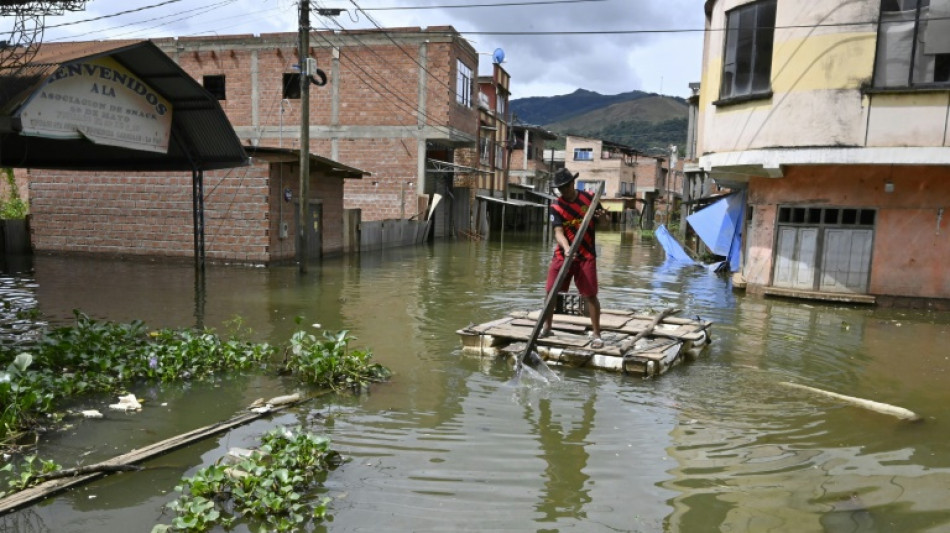
Navigating a makeshift raft between drifting furniture and submerged cars, Rafael Quispe steers through his village in western Bolivia, where the streets were turned into rivers two months ago.
His home is one of about 500 partly immersed in floodwaters in the village of Tipuani in the heart of a gold-mining region.
Gold mining has carved away at the banks of the river that runs through the municipality of 7,500 inhabitants. That, combined with unusual rains attributed to climate change, is to blame for the flooding, experts say.
Quispe, 54, is himself a miner and also used to run a bar out of his home.
"This town, as beautiful as it once was, is now a disaster," he told AFP.
The region is no stranger to flooding, and some of Tipuani's streets have been bogged down in a green sludge for more than a year -- a mixture of river water, rain, and overflow from a collapsed drainage system.
For the last three years, the region has been flooded every rainy season, which runs from November to April.
The municipality says 92 percent of residents make a living from mining and related activities around the isolated village -- accessible from the nearest main road only by a 30-kilometer (18.6-mile) trail of mud and rock dotted with tumultuous streams.
But the industry on which the village depends is also blamed for its demise.
A gold rush, with prices more than tripling in the past decade, has seen an increase in mechanical extraction of the noble metal in Bolivia.
With their machines, mining cooperatives are removing "land that should not be removed" and dumping their waste in the river -- altering its course and "causing floods," said Alfredo Zaconeta, a researcher at the Center for Labor and Agricultural Development Studies (Cedla).
- 'A sin' -
In Tipuani, former miner Sinforiano Checa, 67, has been living in a tent since his house was flooded in January.
What the mining companies do "is a sin," he told AFP, breathing laboriously due to silicosis -- a lung disease he contracted after many years of inhaling silica dust while digging for gold.
"This is nothing new, it's been going on for many years. All the waste was dumped into the river," said Rolando Vargas, president of the Chima Cooperative -- one of 14 extracting gold from the bed of the Tipuani river.
The practice stopped two years ago, Vargas told AFP, adding he felt "somewhat" responsible for the ills that have befallen the community.
After his interview with AFP, Vargas was reported missing, his truck swept away by the raging river, according to his family's social media posts.
- 'Totally anomalous' -
In the village of Chima, about 20 minutes from Tipuani in a 4x4 vehicle, children splash and ride bicycles in the contaminated waters surrounding their homes and school, which has been closed since February.
Those who have access to the internet, often patchy, follow classes online.
"The town may disappear but we have to keep working. What are we going to live on if we don't work?" said Manuel Barahona, a gray-haired 63-year-old whose house is also under water.
Added to the river-altering effects of gold mining, are the ravages of climate change in one of the poorest countries in Latin America.
Bolivia is one of the ten most exposed countries in the world to climate change, according to the 2021 Global Climate Risk Index compiled by advocacy group Germanwatch.
And the Alliance for Global Water Adaptation, an NGO that advises on policy, said in a report last year that "climate change is intensifying Bolivia's water vulnerabilities... increasing the frequency and severity of droughts and floods."
The rains that fell on Tipuani were the most intense for a month of January since 2012, according to Bolivia's National Meteorology and Hydrology Service (Senamhi).
"It is totally anomalous" for a period marked by the La Nina weather phenomenon that ordinarily brings less rainfall, not more, said Lucia Walper, head of forecasting at Senamhi.
Last year's record forest fires in Bolivia's east have also altered rainfall patterns, with less vegetation to retain moisture over the Amazon meaning more rains fall further west on the high plains, she explained.
Nogueira--PC