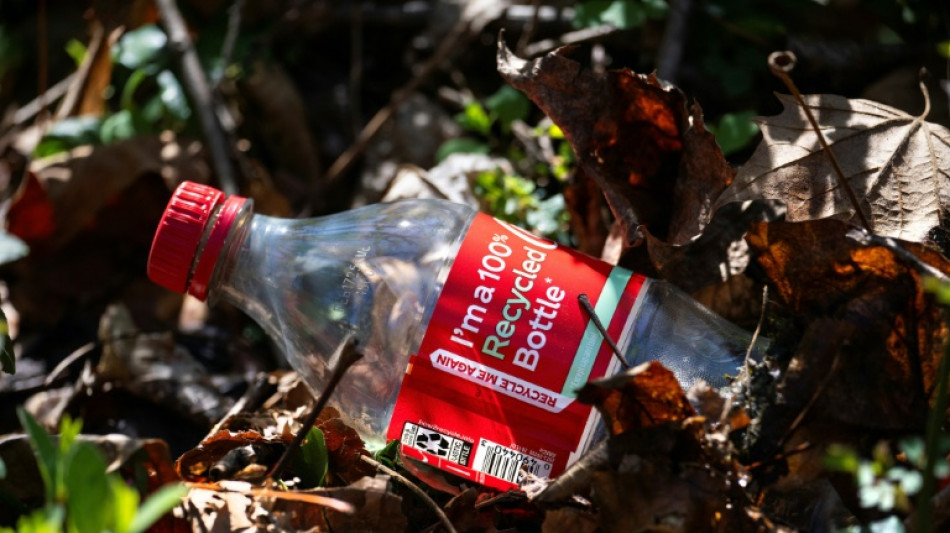
Over a billion pounds of Coke plastic waste to enter waterways: study / Photo: Jim WATSON - AFP

 Douglass breaks 50m free world record again to claim Pan Pacs gold

 As Opel turns to Chinese partners, its hometown frets about the future

 Mehidy takes three as Bangladesh close on historic win in Australia
 Hope fades for finding surivivors of Colombia quake as rescued woman dies

 Hurricane Lala dumps heavy rain on Hawaii

 Jaded voters, same old choices: Brazil kicks off election campaign

 'Everyone lives in fear': Yemenis worry about return to all-out war

 Cardinals' Baez bashes record three homers in MLB debut

 Djokovic feels the heat in Cincinnati opening defeat

 Hunt bags third Euro gold, Diaz shines in triple jump

 Depleted Djokovic falls in Cincinnati Masters opener

 Lala, now a hurricane, dumps heavy rain on Hawaii

 American Kate Douglass reclaims 50m freestyle world record

 Kit confusion disrupts Newcastle friendly against Leverkusen

 Marchand wins first Euros gold as Liebmann breaks 1500m free world record

 Zambia's vote marred by intimidation, counting pause: observers

 Marchand wins 200m butterfly for first Euros gold

 Fernandez booed by Chelsea fans in friendly win over Sociedad

 Fans line Welsh streets as Bonnie Tyler body's returns for funeral

 Tropical Storm Lala lashes Hawaii with heavy rain

 Lebanon reports 11 dead in strikes that Israel says targeted Hezbollah

 Crystal Palace sign Israel winger Khalaili

 Rescuers search for survivors as Indonesian quake death toll rises to 47

 Taliban govt supporters dance, take selfies in Kabul celebrations

 UK PM urges 'reflection' after Cambridge professor's death

By 2030, Coca-Cola products will account for an estimated 1.33 billion pounds (602,000 metric tons) of plastic waste entering the world's oceans and waterways each year, according to a stark new analysis published Wednesday by the nonprofit Oceana.
That's enough plastic to fill the stomachs of 18 million whales.
The report arrives amid mounting concerns over the human health risks posed by the spread of microplastics, which scientists increasingly link to cancer, infertility, heart disease, and more.
"Coca-Cola is by far the largest manufacturer and seller of beverages in the world," said Matt Littlejohn, who leads Oceana's campaigns targeting corporate polluters.
"Because of that, they really matter when it comes to the impact of all this on the ocean."
Coca-Cola ranks as the world's top branded plastic polluter, followed by PepsiCo, Nestle, Danone, and Altria, according to a 2024 study published in Science Advances.
Oceana's estimate is based on Coca-Cola's publicly reported packaging data from 2018 to 2023, combined with sales growth forecasts to create a "business-as-usual" scenario.
The result: the company's plastic use is projected to exceed 4.13 million metric tons (9.12 billion pounds) annually by 2030.
To estimate how much of that plastic will reach aquatic ecosystems, researchers applied a peer-reviewed method developed by an international team of scientists and published in the academic journal Science in 2020 to arrive at the 1.33 billion pounds estimate, which is equivalent to nearly 220 billion half-liter bottles.
For Oceana, the clearest solution to reduce this staggering figure lies in bringing back reusable packaging -- whether in the form of returnable glass bottles, which can be reused 50 times, or thicker PET plastic containers, which are designed for 25 uses.
- Dropped reuse pledge -
Coca-Cola itself acknowledged in 2022 that reusable packaging was "among the most effective ways to reduce waste," and committed to a goal of reaching 25 percent reusable packaging by 2030.
But that pledge was quietly dropped in its latest sustainability roadmap, released in December 2024.
The company's updated goals instead focus on increasing recycled content in packaging and boosting collection rates -- while stressing the significant challenges in recycling soda bottles and shifting consumer habits.
Environmental advocates have long warned against overreliance on recycling, arguing that it often serves to shift blame onto consumers rather than addressing the root of the crisis.
"Recycling is great, don't get me wrong," said Littlejohn. "But if you're going to use recycled plastic to produce more single-use plastic, that's a problem."
Plastic production relies on oil, making corporate plastic use a direct driver of climate change.
Still, there is reason for hope: Coca-Cola already operates large-scale refillable systems in several countries, including Brazil, Germany, Nigeria, and even parts of the United States, such as southern Texas.
"They have the largest reusable infrastructure of any beverage company, and they have the ability to grow that and show the way for the rest of the industry," said Littlejohn.
In a statement to AFP, a Coca-Cola spokesperson said that while the company's efforts currently focus on using more recycled materials and improving collection systems, "we have been investing and remain committed to expand our refillable packaging options, and this work will continue as part of our consumer-centric strategy."
F.Moura--PC