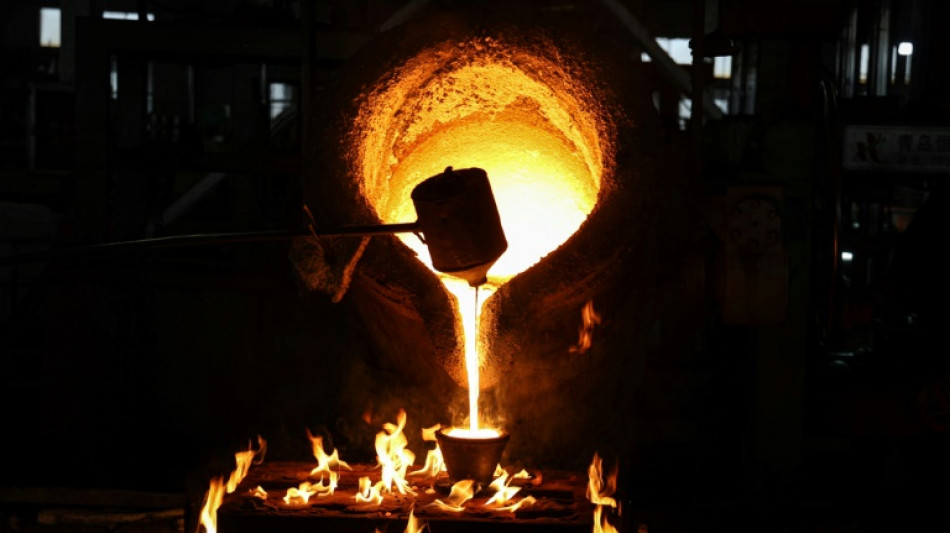
Trump tariffs threaten Latin American steel industry / Photo: STR - AFP

 Cardinals' Baez bashes record three homers in MLB debut

 Djokovic feels the heat in Cincinnati opening defeat

 Hunt bags third Euro gold, Diaz shines in triple jump

 Depleted Djokovic falls in Cincinnati Masters opener

 Lala, now a hurricane, dumps heavy rain on Hawaii

 American Kate Douglass reclaims 50m freestyle world record

 Kit confusion disrupts Newcastle friendly against Leverkusen

 Marchand wins first Euros gold as Liebmann breaks 1500m free world record

 Zambia's vote marred by intimidation, counting pause: observers

 Marchand wins 200m butterfly for first Euros gold

 Fernandez booed by Chelsea fans in friendly win over Sociedad
 Fans line Welsh streets as Bonnie Tyler body's returns for funeral

 Tropical Storm Lala lashes Hawaii with heavy rain
 Lebanon reports 11 dead in strikes that Israel says targeted Hezbollah

 Crystal Palace sign Israel winger Khalaili

 Rescuers search for survivors as Indonesian quake death toll rises to 47

 Taliban govt supporters dance, take selfies in Kabul celebrations

 UK PM urges 'reflection' after Cambridge professor's death

 Rescuers search for survivors as Indonesian quake death toll rises to 40

 Earthquake rocks Spain's tourist jewel Granada

 Perez, Fiorini set world records in winning Euro race walk golds

 Lebanon says 9 dead in strikes as Israel says targeted Hezbollah

 World Cup winner Ferran Torres signs for Paris Saint-Germain

 Disney reveals 'X-Men' cast, slate of sequels at D23 fan event
 Star Cameroon goalkeeper Bihina faces Malawi's prolific Chawinga sisters in WAFCON final

Chile's largest steel plant shut down last year, yielding to cheaper production in China.
Now, six months later, the tariffs that President Donald Trump has imposed on US imports of the metal threaten the livelihood of 1.4 million workers in Latin America.
As he did during his first term in office from 2017 to 2021, Trump is trying to protect American producers by making steel imports costlier with a 25 percent tariff that kicked in on March 12.
The United States imports 25 million tons of steel each year, and Canada is it main supplier, followed by Brazil and Mexico, each with products tailored to other industries like car manufacturing and construction.
The United States relies on Latin America for specialized steel products, said Ezequiel Tavernelli, head of the Latin American Steel Association, Alacero.
With the world awash steel production overcapacity, and China the main offender, the Trump tariffs will distort the market.
"The only thing they will bring is a flood of steel" that had been headed to the United States and is now rerouted to regions that are less protected and have less ability to defend themselves, like Latin America, said Tavernelli.
To explain the threat he gives these figures: in 2000 China exported less than 100,000 tons of steel a year to Latin America, but today it is more than 14 million tons. The growth is exponential.
Steel production in Latin America has been falling for three years. And the Chinese share of what is consumed is getting bigger and bigger .
And now, due to the Trump tariffs Latin American producers will not only lose market share in the United States but also miss out in some markets of their own region due to Chinese competition.
- When it rains it pours-
The numbers are jarring. China accounts for more than 45 percent of the world's steel production capacity and produces 140 million tons it does not need.
It dumps this excess cheaply on the international market, says Alacero, which says China produces 23 percent of the world's excess steel.
"The main problem of our region, and that of the United States, is world steel overcapacity," Tavernelli told AFP.
And China behaves disloyally, he argued, by selling steel below cost thanks to government subsidies.
In September of last year Chile endured what Tavernelli is talking about. Its Huachipato steelworks, the country's largest, shut down its blast furnaces for good.
With the smoke that drifted out of its chimneys went nearly 75 years of company history. Chinese steel was 40 percent cheaper and Huachipato simply could not compete.
Alacero argues that regionalization of supply chains -- for instance, US steel producers, car makers and construction companies buy Latin American steel -- "is the best way to defend against disloyal business by China and countries of Southeast Asia."
As Brazil's vice president Geraldo Alckmin, who is also the minister of development and industry, put it, the region's goal should be to achieve "economic complementarity."
Brazil and Mexico are negotiating with the United States to try to win exemptions from the US tariffs, and managed to pull this off during Trump's first term in power.
In the same vein, Mexico's iron and steel producers association, Canacero, said last month there is a high level of production integration between the US and Mexican steel industries and regional benefits should be the priority in the face of the threat of excess capacity of China and Southeast Asia.
So there is the risk that more long-standing firms like Huachipato will have to shut down, said Tavernelli, who insisted the countries of Latin America have to work together.
N.Esteves--PC