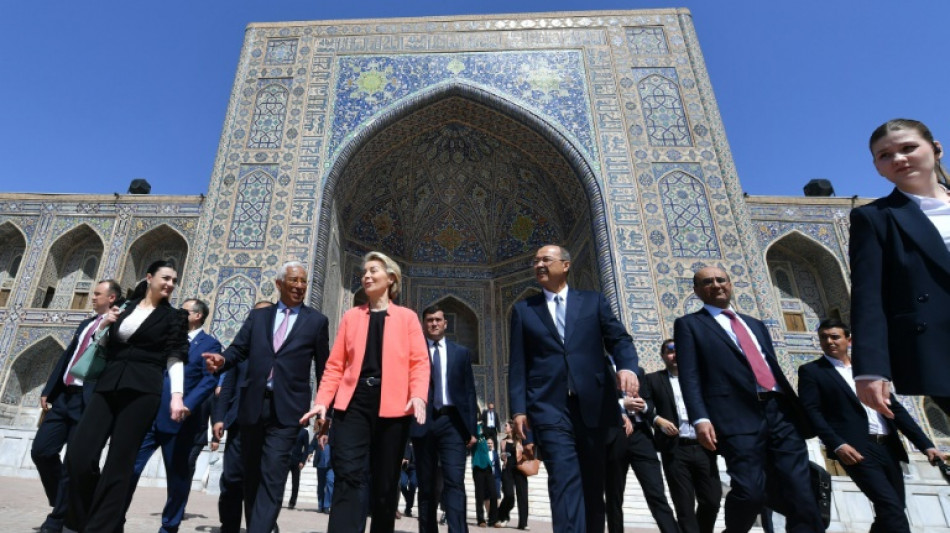
EU leaders push for influence at Central Asia summit / Photo: VYACHESLAV OSELEDKO - AFP

 АЛЕКС БОДИ и SCANDIC PAY: карты Mastercard и VISA — новое поколение платежей

 ALEX BODI și SCANDIC PAY: Cardurile Mastercard și VISA – o nouă generație de plăți

 John Park’s Agency Takes Legal Action Over Unauthorized 'McDonald’s Order Rap' Distribution

 Best Pet Advent Calendars for Christmas 2026: Dog Treats and Cat Toys

 Grattan Institute Releases Blueprint to Target Specialists Over Excessive Fees

 Arizona Science Center Hosts Girls in STEM Astro Adventures for Students

 New Turkish Cafe, Japanese BBQ, and Korean Restaurants Open Across East Bay

 Knowle Move Four Points Clear at Top After Histon Victory
Top EU leaders were in Uzbekistan on Friday for a major summit with the heads of five Central Asian states, seeking to press their influence and boost ties in the face of Russian and Chinese competition.
Russia's invasion of Ukraine has accelerated the region's drift from Moscow's orbit, with major powers to both the west and east sensing an opening.
Central Asia is rich in natural resources, on the front lines of climate change and also seen as a key security player as a Muslim-majority region that is trying to contain extremism and shares borders with Afghanistan, Iran, China and Russia.
Leaders from the five states -- Kazakhstan, Kyrgyzstan, Tajikistan, Turkmenistan and Uzbekistan -- will meet European Commission chief Ursula von der Leyen and Antonio Costa, head of the European Council.
The summit takes place in the ancient Silk Road city of Samarkand, for centuries a key hub in East-West connections, trade and commerce.
Von der Leyen said she hopes the summit will take Brussels' relations with Central Asia "to the next level" and deepen ties in terms of transport, natural resources, water and energy.
"In these uncertain times, Europe stands for openness and engagement. For Europe, Central Asia is a partner of choice," she said.
Alongside Russia's historic leadership in the region, Turkey, China, the United States and even the likes of South Korea and Japan are all trying to boost their influence.
For its part, Central Asia -- as large as the EU but home to just 80 million people, one-fifth of those in the 27-member bloc -- has been seeking to boost foreign investment.
- Investment -
The EU summit offers the countries a chance to get something their neighbours Russia and China cannot yet provide: advanced industrial technology.
Europe, meanwhile, is eyeing the region's precious resources.
On the eve of the summit, Kazakhstan announced discovering potentially its "largest" ever deposit of rare earth elements.
The EU has its sights on uranium deposits, at a time when nuclear power is making a comeback, as well as other strategic metals like titanium, cobalt, and lithium, said Raul Villegas, an analyst at the European Policy Centre, a Brussels-based think tank.
As a bloc, the EU is already the region's largest foreign investor, accounting for 40 percent of direct inward investment over the last 10 years.
It is also the largest provider of development aid.
But Russia and China will be difficult to dislodge.
Beijing is pouring cash into ambitious infrastructure projects, while Russia supplies arms and energy, as well as having long-standing cultural and linguistic reach across the former Soviet states.
During a visit to Uzbekistan last year, Russian President Vladimir Putin criticised the United States and Europe for "trying to disrupt our traditionally close commercial, cooperative and cultural ties."
- Sanctions, rights -
The war in Ukraine and sanctions against Russia will also be on the table, an EU official told AFP.
Central Asia has emerged as one of several hubs through which sanctioned Western goods are re-exported to Russia.
Brussels would like the region to crack down on the flow, as it pushes to keep up the pressure on Moscow at a time when US President Donald Trump pushes a rapprochement with the Kremlin.
Central Asian countries have shown "willingness" to act and "some progress" but "we would like to see a lot more from our partners," the official said, speaking on condition of anonymity.
Further action was not a precondition for cooperation in other sectors but "an important element in order to advance our relations," the official added.
Despite pleas from NGOs, human rights were not expected to feature heavily in the talks.
"We're not going there to preach, but we are going to make our concerns known, to work with them, to have a dialogue," the official said.
All five of the countries are classed as "not free" by the Freedom House NGO that tracks democratic rights around the world.
burs-bk-jc/am/yad/jfx
C.Cassis--PC