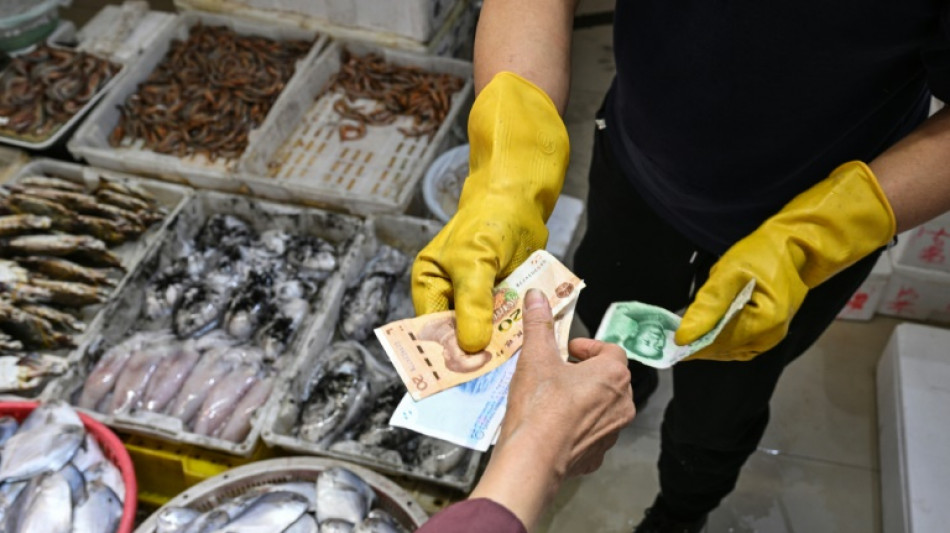
China consumer prices slump for second straight month: data / Photo: Hector RETAMAL - AFP

 ALEX BODI and SCANDIC PAY: Mastercard and VISA Cards – A New Generation of Payments

 Mercedes-Benz Power Converter Enables Individual Cell Control for Improved EV Efficiency

 Search Underway for 'Dooars Rani' Tigress After Second Escape from Buxa Tiger Reserve

 IIM Indore Announces IPMAT 2027 Exam Date for April 24

 The Dilemma of Recording Live Music: Preserving Memories vs. Being Present

 ANC’s Renewal Rhetoric Fades as Voters Reject Party in 2026 Local Elections

 Foreign Investors Return to Indian Markets After 10-Month Selloff

 Honda CR-V and Toyota RAV4 Lead Canada’s Most Stolen Vehicles List for 2025
Consumer prices in China fell in March for the second straight month, official data showed Thursday, as the world's second-largest economy struggles to boost spending and a trade war with the United States deepens.
The drop comes as Beijing seeks to boost domestic consumption, which has yet to recover to pre-pandemic levels.
The consumer price index (CPI) -- a key measure of inflation -- was down 0.1 percent year-on-year in March, according to data released by the National Bureau of Statistics (NBS).
The figure came in slightly lower than expected by analysts surveyed by Bloomberg who predicted the index would remain unchanged.
But the index's decline narrowed from the 0.7 percent drop year-on-year in February.
The past two months have reversed the 0.5 percent uptick seen in January, when a surge in spending during the Lunar New Year boosted inflation to its highest rate in months.
The prices of food, tobacco and alcohol in March fell by 0.6 percent year-on-year.
While deflation suggests the cost of goods is falling, it poses a threat to the broader economy as consumers tend to postpone purchases under such conditions, hoping for further reductions in prices.
A lack of demand can then force companies to cut production, freeze hiring or lay off workers, while potentially also having to discount existing stocks -- dampening profitability even as costs remain the same.
Beijing unveiled a slew of measures to boost the economy last year, including cutting interest rates and cancelling restrictions on homebuying.
China's fragile recovery is also threatened by a trade war with the United States instigated by President Donald Trump, who further raised tariffs on China to 125 percent on Wednesday.
"Deflationary pressure is persistent," wrote Zhiwei Zhang, president and chief economist at Pinpoint Asset Management, in a note.
"The policy uncertainty in the US is still elevated," he added.
Premier Li Qiang in March announced a national growth target of "around five percent" for this year -- the same as 2024.
Many economists consider the goal to be ambitious given the headwinds facing China's economy.
J.Pereira--PC
