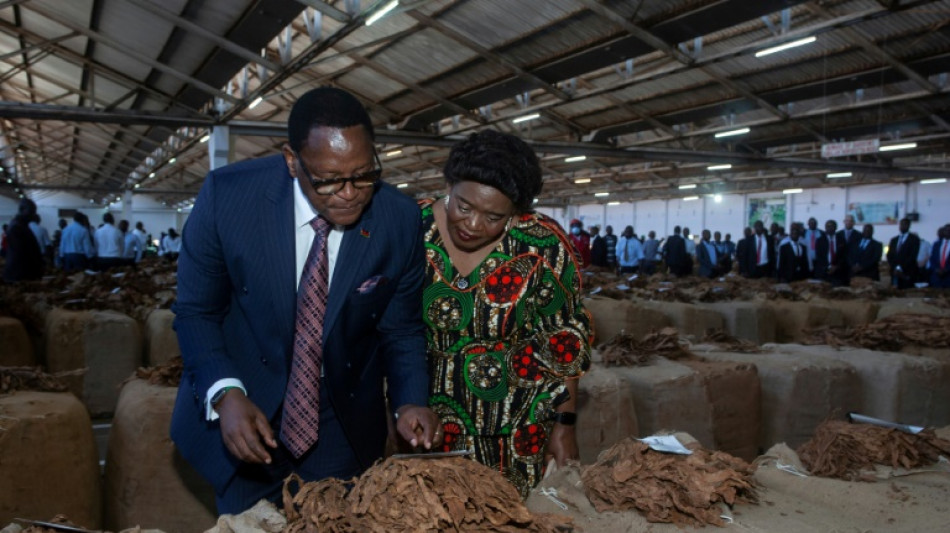
Malawi's debt crisis deepens as aid cuts hurt / Photo: Amos Gumulira - AFP

 Mehidy claims Smith as Bangladesh sense historic upset in Australia
 Indonesia rescuers search for survivors as quake death toll rises to 38

 Japan coach Jones says team should not get despondent after heavy loss
 Flags, music as Taliban authorities mark five years ruling Afghanistan
 'Like we were on a trampoline': Indonesia quake kills 20, thousands flee
 Australia run riot to crush Japan 56-17 in Townsville
 Stolen Matisse works tied to infamous art thief in Brazil
 Hasan strikes twice for Bangladesh to reduce Australia to 51-2

 Powerful quake off Indonesia kills 20, sparks mass evacuations
 Mehidy half-century steers Bangladesh to 228-run lead in Australia Test
 Japan defence minister visits war shrine, PM stays away
 Viennese woman sues city over 'discriminatory' toilet fees
 Venezuelan amputees adjust to new life after quakes
 Venezuela frees 131 prisoners amid post-Maduro transition talks

 Arteta tells Arsenal fans not to fret over his future
 Mexico's Indigenous chief justice hits back at discrimination

 Werro wins 800m race for the ages, Warholm and Tamberi hit four

 Jimenez rescues dramatic Wolves draw in Championship opener
 Taliban govt to mark five years ruling Afghanistan
 Stocks slip in cautious trading after weak US retail sales data
 Gramercy Networks Announces New Global Ultra-Low Latency Financial Network Connecting Major Trading Hubs

 NFL bans Falcons defender Pearce eight games for domestic violence

 US says 19 million recalled eggs pose deadly risk

 Former Cincinnati contenders suffer contrasting first-round fates
 Argentina's Romero confirms Tottenham exit as Atletico move looms

Behind a dimly lit bar in Malawi's capital, Ben Manda rubbed his tired eyes and poured a customer a drink. He had been working for 36 hours straight, packing in back-to-back shifts to feed his family of four.
"I haven't been home in three days," said the 32-year-old barman in a run-down club in Mtandire, one of Lilongwe's largest and most crowded informal settlements. "Times are tough."
Manda is a casualty of Malawi's economic struggles, his livelihood hanging by a thread as foreign aid cuts and mounting national debt tighten their grip on his destitute African country.
A small television above the bar flickered with news reports of budget shortfalls, unpaid salaries, and a spiralling cost of living.
"The problem is that our leaders divert the money from its intended use," Manda said, accusing the political leadership of misusing foreign aid.
The country of 21 million people -- more than two-thirds of whom live in extreme poverty, according to the World Bank -- has for decades been dependent on foreign aid.
The scaling back of funding from Washington's USAID agency this year as well as cuts by Britain and other donors has fed a storm of crises causing economic instability that is worsening ahead of general elections in September.
"Since 2013, the country has lost an estimated five percent of its GDP, or roughly $545 million annually, due to reduced donor assistance," Agness Nyirongo, economic governance officer for the Centre for Social Concern, a non-government organisation, told AFP.
"The aid withdrawal means the country has to prioritise the little revenue locally generated to repay loans at the expense of service delivery," said Willy Kambwandira of the Centre for Social Accountability and Transparency.
Malawi is one of six countries with unsustainable debt levels, according to the International Monetary Fund's (IMF) February 2025 list.
Public sector debt rose from 48 to 93 percent of GDP between March 2020 and March 2024, according to government figures cited in an IMF report this month.
"Fiscal pressures that have contributed to this rise include spending to combat the Covid-19 pandemic and the aftereffects of three cyclones, high inflation, and rising foreign exchange rates," it said.
- Little left over -
Structural weaknesses and fiscal mismanagement have contributed to Malawi's economic woes, said university lecturer Bertha Chikadza, president of the Economics Association of Malawi.
For example, tobacco dominates exports, making up 60 percent, and price slumps for the crop have cut foreign exchange earnings.
"With little or no diversification in export earnings, the country has had persistent trade deficits," she said.
Debt servicing consumes about half of domestic revenue, leaving little for health, education and other critical sectors, Chikadza said.
With inflation of 28.5 percent this year pushing up prices, Malawians have taken to the streets in protest in several cities.
Government coping measures, including cutting public spending and raising taxes, have been deeply unpopular.
President Lazarus Chakwera, standing for re-election in September, repeated at the UN General Assembly last year pleas for debt relief to give his country -- and African nations in a similar plight -- some "breathing space".
The topic is a priority this year for the G20 group of leading economies under the presidency of South Africa, the first African nation to hold the role.
More than half of Africa's 1.3 billion people live in countries that spend more on interest payments than on social issues such as health, education and infrastructure, according to the South African government.
The solution is not to write off debt, said David McNair, global policy executive director at the One Campaign non-profit group.
Developing countries such as Malawi "need more borrowing to allow them to invest, particularly because of the demographic trends," he said.
However, their debt is "too expensive," he said, calling for the G20 to put in place a review of ratings agencies' assessments of debt risk and find ways to unlock lower-cost private capital.
P.Mira--PC