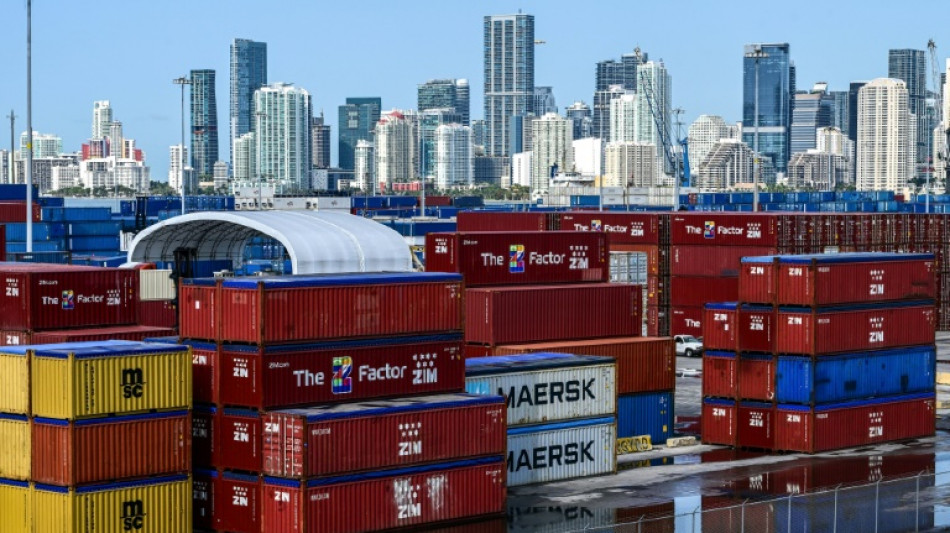
Trump trade war pushes firms to consider stockpiling / Photo: Giorgio VIERA - AFP

 Viennese woman sues city over 'discriminatory' toilet fees

 Venezuelan amputees adjust to new life after quakes

 Venezuela frees 131 prisoners amid post-Maduro transition talks

 Arteta tells Arsenal fans not to fret over his future

 Mexico's Indigenous chief justice hits back at discrimination

 Werro wins 800m race for the ages, Warholm and Tamberi hit four

 Jimenez rescues dramatic Wolves draw in Championship opener

 Taliban govt to mark five years ruling Afghanistan

 Stocks slip in cautious trading after weak US retail sales data

 Gramercy Networks Announces New Global Ultra-Low Latency Financial Network Connecting Major Trading Hubs

 NFL bans Falcons defender Pearce eight games for domestic violence

 US says 19 million recalled eggs pose deadly risk

 Former Cincinnati contenders suffer contrasting first-round fates

 Argentina's Romero confirms Tottenham exit as Atletico move looms

 Homeless, jobless: Colombia quake survivors 'left with nothing'

 Cubans find rest on rooftops as blackouts drive them from home

 World champ McIntosh crashes out of Pan Pacs 400m free
 T'Wolves set Garnett celebration for Celtics clash
 Popovici nails freestyle double with third men's European 200m gold

 Premier League club Liverpool sell minority stake to Jeff Bezos consortium

 Italian police recover stolen Renoir, Cezanne and Matisse works

 Stocks slip in cautious trading, oil turns higher

 Colombia quake survivor faces life without triplet sisters

 Bones of medieval kings saved from Spanish wildfire

 US retail sales weakest in over a year, consumer sentiment plunges

Stockpiling is the reflex response by firms to the imposition of tariffs, but with the rapidly-changing position of the Trump administration, companies are finding that it isn't so straightforward this time around.
Whether it's the luxury, electronics or pharmaceutical sectors, US President Donald Trump's unpredictability complicates the calculations of firms.
Some companies didn't wait for Trump's April 2 announcement of massive "reciprocal" trade tariffs: they had already begun shipping more of their goods to the United States.
In the end, Trump backed down quickly on the "reciprocal" tariffs, pausing them for 90 days except for China.
That still left the global 10 percent tariff in place, as well as the 25 percent tariffs on European steel, aluminium and cars.
French cosmetics firm Clarins didn't hesitate and stepped up shipments to the United States at the beginning of the year.
"We've built up three months of stocks, which represents $2 million in goods," said Lionel Uzan, the head of Clarins's US operations.
With all of its products made in France, Clarins had few other options to mitigate the tariffs.
- Discreet stockpiling -
Even if they don't all acknowledge it so openly, firms in many different sectors are stockpiling their products in the United States.
In March, exports of Swiss watches to the United States jumped nearly 14 percent compared to the same month last year.
More striking is Ireland, which plays host to a number of international pharmaceutical firms.
Its exports to the United States jumped 210 percent in February to nearly 13 billion euros ($14.8 billion), with 90 percent of those being pharmaceutical products and chemical ingredients.
Fermob, a French manufacturer of metal garden furniture that sells around 10 percent of its products in the United States, said it began planning for US tariffs once the result of the presidential election became known in November.
It stepped up production in January and February.
"We've sent around 30 percent of our extra stock to the United States," said the company's chief executive, Baptiste Reybier.
That extra production has benefitted transportation firms.
Lufthansa Cargo said it has seen in recent weeks "an increase in demand for shipments to the United States".
The trade war "has incited companies to accelerate certain stages in their supply chains", it told AFP.
"A similar trend was seen for the delivery of cars from the EU to the United States," it said.
The phenomenon also concerns US-made goods.
The Japanese newspaper Nikkei reported recently that Chinese tech firms were snapping up billions of dollars of artificial intelligence chips made by US firm Nvidia in anticipation of Washington imposing export restrictions.
- 'Short-term approach' -
Stockpiling is not a solution, however, said analysts.
Matt Jochim, a partner at consulting firm McKinsey who helps companies with supply chain issues, called stockpiling "a very short-term opportunistic" move.
He said the practice has limits as tariffs are constantly changing and it isn't always practicable.
"In a lot of the electronics space, it's also hard to do, because the technology changes so quickly, you don't want to get stuck with inventory of chipsets or devices that are the prior version," he said.
Fermob said it was taking a measured approach to stockpiling.
"Otherwise you're replacing one risk with another," the manufacturer's Reybier said.
"You have to finance stocks and there is also the risk of not having sent the right product."
Having a local subsidiary with warehouses also helped, Reybier added.
"It's too early to say whether we should have sent more or not."
G.Teles--PC