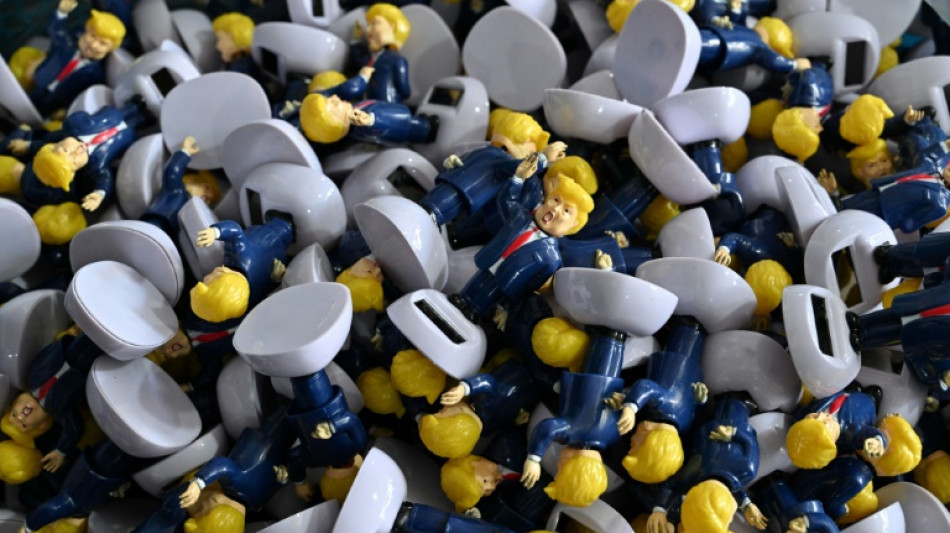
China says on 'right side of history' in trade standoff with US / Photo: ADEK BERRY - AFP

 Search Underway for 'Dooars Rani' Tigress After Second Escape from Buxa Tiger Reserve

 IIM Indore Announces IPMAT 2027 Exam Date for April 24

 The Dilemma of Recording Live Music: Preserving Memories vs. Being Present

 ANC’s Renewal Rhetoric Fades as Voters Reject Party in 2026 Local Elections

 Foreign Investors Return to Indian Markets After 10-Month Selloff

 Honda CR-V and Toyota RAV4 Lead Canada’s Most Stolen Vehicles List for 2025
A top Chinese economic official on Monday said Beijing was on the "right side of history" in its gruelling trade war with the United States.
Since returning to the White House in January, US President Donald Trump has imposed 10 percent tariffs on most US trading partners and a separate 145 percent levy on many products from China.
Beijing has responded with 125 percent tariffs of its own on US goods.
Speaking in Beijing at a news conference at which officials vowed greater steps to shield China's flagging economy from the impact of the standoff, senior economic planner Zhao Chenxin said Beijing was "on the right side of history".
"We firmly believe that if you are against the world and the truth, you will only isolate yourselves," Zhao said.
"Only by travelling with the world and with morality can we win the future," he added.
The United States, he said, "play cards out of thin air, bully and go back on their word", condemning Washington's "unilateralism and bullying".
US Treasury Secretary Scott Bessent on Sunday defended Trump's tumultuous tariff policy -- which has sent shivers through markets -- as a way of creating "strategic uncertainty" that gives Washington the upper hand.
When asked about Bessent's comments, Beijing on Monday said that the US should approach dialogue with China in a "fair, respectful and reciprocal" manner.
"If the US really wants to solve the problem through dialogue and consultation, it should stop its threats and extortion," foreign ministry spokesman Guo Jiakun said at a regular news conference.
Dozens of countries face a 90-day deadline expiring in July to strike an agreement with Washington and avoid higher, country-specific rates.
Beijing, however, has vowed to fight a trade war "to the end" and denied US claims it is in talks with Washington.
But it has acknowledged global economic vicissitudes have strained its economy, long dependent on exports.
"External pressures are increasing," said Yu Jiadong of China's labour ministry on Monday.
"The US imposition of successive high-tariff measures has created production and operation challenges for some export-oriented companies and impacted some workers' jobs," he said.
E.Borba--PC


