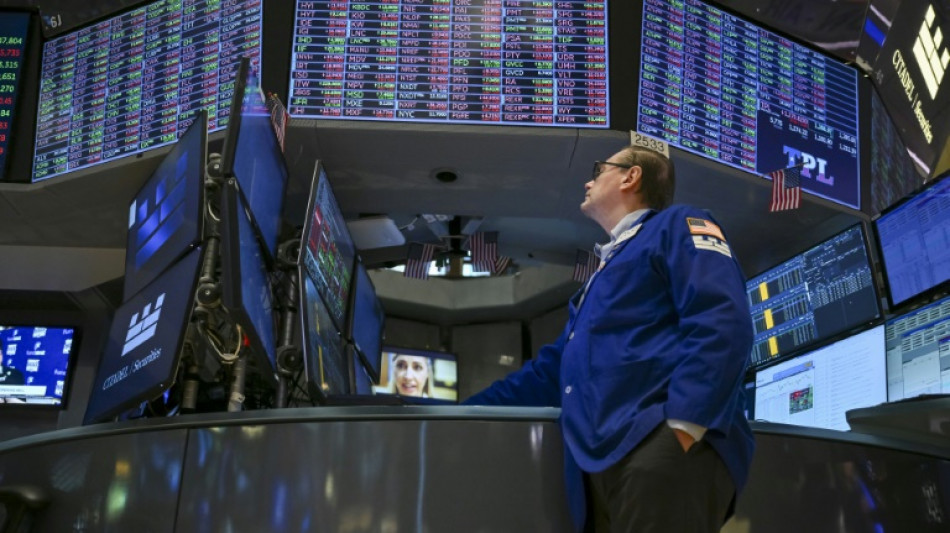
Financial markets may be the last guardrail on Trump / Photo: ANGELA WEISS - AFP/File

 Venezuela frees 131 prisoners amid post-Maduro transition talks

 Arteta tells Arsenal fans not to fret over his future

 Mexico's Indigenous chief justice hits back at discrimination

 Werro wins 800m race for the ages, Warholm and Tamberi hit four

 Jimenez rescues dramatic Wolves draw in Championship opener
 Taliban govt to mark five years ruling Afghanistan

 Stocks slip in cautious trading after weak US retail sales data

 Gramercy Networks Announces New Global Ultra-Low Latency Financial Network Connecting Major Trading Hubs

 NFL bans Falcons defender Pearce eight games for domestic violence

 US says 19 million recalled eggs pose deadly risk
 Former Cincinnati contenders suffer contrasting first-round fates

 Argentina's Romero confirms Tottenham exit as Atletico move looms

 Homeless, jobless: Colombia quake survivors 'left with nothing'

 Cubans find rest on rooftops as blackouts drive them from home

 World champ McIntosh crashes out of Pan Pacs 400m free
 T'Wolves set Garnett celebration for Celtics clash
 Popovici nails freestyle double with third men's European 200m gold

 Premier League club Liverpool sell minority stake to Jeff Bezos consortium

 Italian police recover stolen Renoir, Cezanne and Matisse works

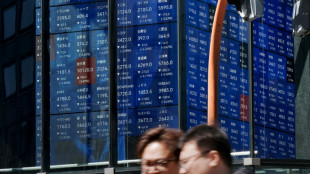 Stocks slip in cautious trading, oil turns higher

 Colombia quake survivor faces life without triplet sisters

 Bones of medieval kings saved from Spanish wildfire

 US retail sales weakest in over a year, consumer sentiment plunges

 In wildfire town, PM says UK must 'face up to climate change'
 In town hit by wildfire, PM says UK must 'face up to climate change'

Since returning to the White House, Donald Trump has ushered in sweeping changes to international geopolitics and US government administration with little regard for norms that have constrained predecessors.
But there has been one source of restraint on a president determined to push the limits of US governance: financial markets.
The stock market's response to Trump's "Liberation Day" tariff announcement was "probably the most influential force to date" in tempering Trump's policies, said Terrence Guay, professor of international business at Pennsylvania State University.
In just two days, Wall Street equities shredded some $6 trillion in value as the S&P 500 suffered its worst session since the darkest days of Covid-19 in 2020.
"The market does tend to be ... kind of like a seismograph. It reacts to the slightest little tremor," said Steven Kyle, professor of applied economics at Cornell University.
A week after Trump's announcement of reciprocal tariffs threw markets into turmoil, the Republican suddenly scaled back his plan's most draconian elements for every country except China. The pivot sent stocks skyrocketing.
Last week, market watchers perceived another significant Trump retreat after another round of scary market action. The gyrations came after the president combined an ever-worsening tit-for-tat trade war with China with threats to oust Federal Reserve Chair Jerome Powell.
The White House quickly shifted its tone on China and Trump reassured the public that he won't fire Powell.
"Markets 'punished' his policies and he must have realized," along with his advisors, "that trade wars are not that easy to win," said Petros Mavroidis, a professor at Columbia Law School and a former member of the World Trade Organization.
"I am sure he doesn't want to be known as the president who led to a stock market crash," Guay added.
- Bond market angst -
But if "Wall Street sent the loudest signal, it wasn't the only signal," said University of Richmond finance professor Art Durnev.
Even more than the stock market, "the bond market is a stronger force and this is the primary driver" of Trump's shift, Durnev said.
Like gold or the Swiss franc, US Treasury bonds have traditionally been seen as a refuge for investors during times of duress in financial markets, or in the real economy.
But demand for US Treasury bonds -- a bedrock during the 2008 financial crisis and other perilous moments -- has been shaken in recent weeks as Trump's aggressive policies have pushed yields higher in a sign of flagging demand for American issues.
Trump himself acknowledged the import of the bond market gyrations, saying investors were getting "a little bit yippy." That word means nervous.
The bond market "also had a big impact," Guay said. "Many investors have pulled their money out of the US."
Besides Trump's ambitious attempts to overhaul international trade, analysts have tied bond market volatility to worries that planned tax cuts could worsen the US deficit.
Then there is Powell, whom Trump also criticized in his first presidential term. The most recent round of Treasury market panic followed Trump's social media post on April 21 branding Powell a "major loser" for not cutting interest rates.
But by the following day, Trump had pulled back, saying he had "no intention of firing" Powell.
The combination of these factors means investors are beginning to realize that "the US may not be, under this administration, the stable environment we've seen for decades," Guay said.
O.Salvador--PC