Warming climate threatens Greenland's ancestral way of life / Photo: Ina FASSBENDER - AFP

 Germany's Merz vows to stay course despite new vote losses

 Man City outgun Sunderland despite Brobbey hat-trick, Man Utd rescue Fulham draw

 Mourinho blames ref committee for Real Madrid derby defeat

 Maresca craves a 1-0 win after eight-goal Man City thriller

 Atletico Madrid beat Real Madrid in tense derby clash

 Reusser retains world time-trial title

 Man City outgun Sunderland despite Brobbey hat-trick, Liverpool win at Bournemouth

 Top US, Chinese economic officials meet ahead of Trump-Xi summit

 Erdogan's LGBTQ crackdown 'first step of election campaign': activist

 Mass drone barrage on Moscow kills two

 82-year-old dies after beach fight in Greece over sun lounger

 US warns of rapid escalation in Mideast war

 Iran 'put hearts on the court' to win Asian Games basketball bronze

 School girl Yu helps China dominate in Asian Games swimming openers

 Myanmar win first Asian Games teqball gold as Spain great Puyol watches

 China's 13-year-old Yu scorches to first major gold at Asian Games

 Russians vote on last day of parliamentary elections

 Hong Kong pays final respects to former city leader Tung

 Typhoon put people off Asian Games opening ceremony, official says

 China's 13-year-old Yu cruises as Asian Games swimming begins

 AI 'warning shots' focus Beijing on national security risks

 Philippine tribe in limbo over US-led tech hub

 Leo XIV, first US pope transcends his restrained style

 Singer Ed Sheeran says Gaza situation 'unjustifiable' following controversy

 In 'Tenzing', a Sherpa mountaineer gets his due

Standing in his boat with binoculars in hand, hunter Malik Kleist scans the horizon for seals. But this February, the sea ice in southwestern Greenland has yet to freeze, threatening traditional livelihoods like his.
"Normally the seals are on the ice or in the more calm waters. But today we had to sail all the way into the fjords to find them," the 37-year-old tells AFP.
The Arctic region is on the frontline of global warming, heating up four times faster than the rest of the planet since 1979, according to a 2022 study in scientific journal Nature, causing the sea ice to retreat.
Seals rely on pack ice to give birth, to rest and for protection.
Hunters increasingly have to sail farther along the jagged coast of Sisimiut, navigating into the fjords for several hours to find them.
Traditionally, hunters' boats would head straight out to sea, slowly pushing through the ice and creating holes that attract seals coming up for air.
But without any ice, "it's too windy and the waves are too big," Kleist says.
Last year was exceptionally warm in the vast autonomous territory, with several temperature records beaten, according to the Danish Meteorological Institute (DMI).
In December, the Summit Station, located at the height of Greenland's ice sheet, recorded an average temperature of -30.9 degrees C (-23.6 Fahrenheit), 8.1C higher than the December average during the period 1991-2020.
"It affects everything we do. Because normally around November, December the ice comes. And this year there's no ice, so it affects our living a lot," Kleist says.
- Financial woes -
For the same reason, the government has also had to postpone the annual winter musk ox hunt that was due to start on January 31.
There wasn't enough snow and ice to transport the massive animals that roam the Arctic tundra back from Kangerlussuaq where they are predominantly found, around 165 kilometres (103 miles) away. Greenland has no roads connecting its towns.
That has left some Sisimiut hunters with less income than usual.
"This time of year there is not much to hunt. So we rely on musk ox meat and skin," Kleist says.
"Many of my fellow hunters are struggling with money right now."
Every part of the animal, from the fur to the meat, is either used or sold.
The summer hunting season has therefore gained importance, enabling Greenlanders to fill their freezers to get them through the winter months, he tells AFP over a steaming bowl of fish stew.
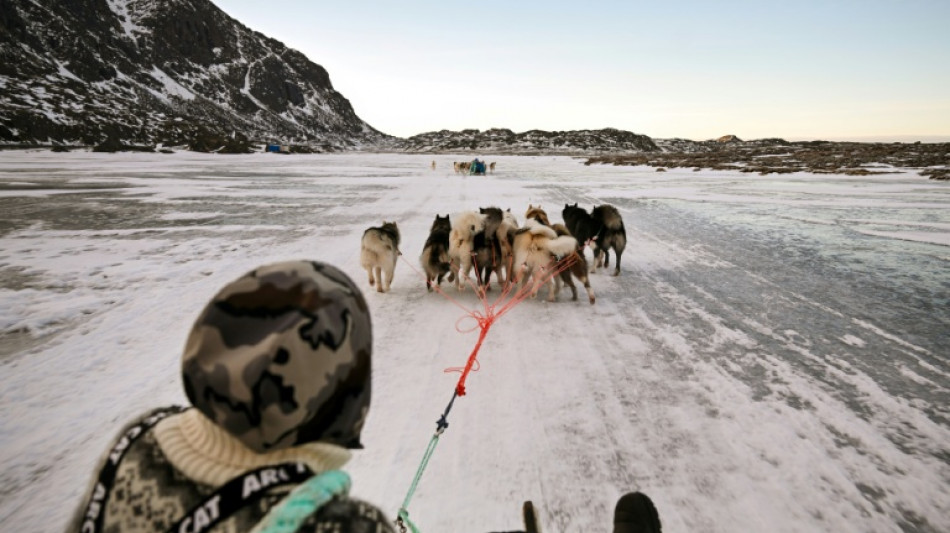
The shorter winter season has also impacted another key activity in Greenland, one that has become increasingly important to the tourism sector: dogsled tours.
In the Sisimiut neighbourhood where the dogs are kept, their thunderous barking mounts as Nukaaraq Olsen, a 21-year-old musher, attaches them to the sled.
Raring to get going, his 18 dogs are hard to hold back. Twenty minutes later, the group bounds off.
But the road is bumpy, and several times Olsen has to get up to manually push the sled, stuck on the tundra's rocks in patches where there is no ice.
"This year we had a lot of hot, warm days, even though it's December or January," he says.
Other parts of the route are no longer safe to use, due to repeated melting and freezing of snowfall which causes uneven layers, he explains.
- Dehydrated dogs -
The dogs' health is also affected by the changing climate.
They are used to quenching their thirst with snow, but with little or no snowfall, they can easily get dehydrated. Mushers have to take that into account when caring for their animals.
Many have even had to get rid of their dogs, the business of maintaining them no longer profitable with the dogsled season shrinking to just two months, says Emilie Andersen-Ranberg, a researcher at the University of Copenhagen who runs a dog clinic in Sisimiut.
Others, such as 72-year-old Johanne Bech, are finding novel ways to adapt.
She plans to put wheels on her sled to continue running dogsled tours during the summer period.
That solution is growing in popularity, as "the window with snow is getting more and more narrow," the veterinarian says.
Over the past 20 years, the number of sleddogs has been halved from 25,000 to 13,000, according to a 2024 article from the University of Greenland in 2024.
Yet Johanne Bech remains optimistic about the future.
"I hope this is just for a short time, so we can go back to a little more stable snow or more ice in the future."
C.Cassis--PC