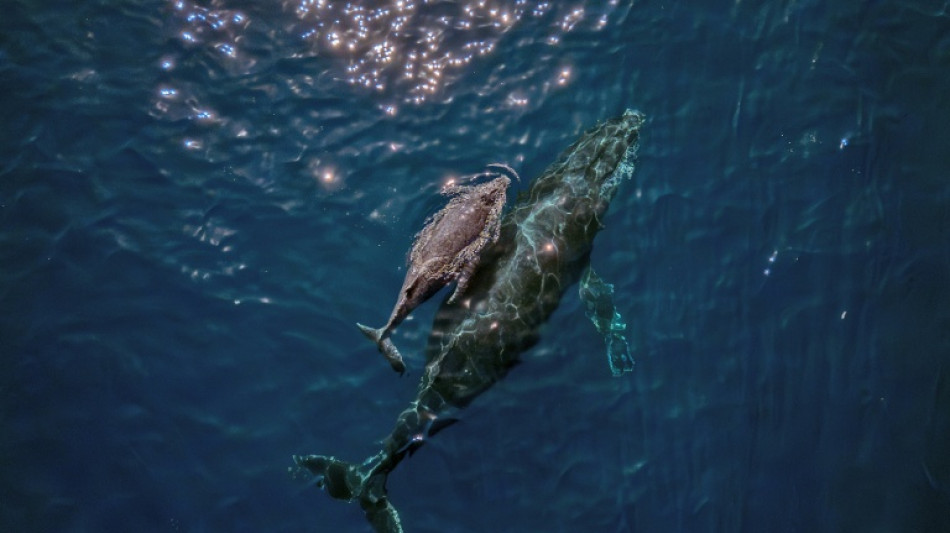
UN body warns over Trump's deep-sea mining order / Photo: CARL DE SOUZA - AFP/File

 Search Underway for 'Dooars Rani' Tigress After Second Escape from Buxa Tiger Reserve

 IIM Indore Announces IPMAT 2027 Exam Date for April 24

 The Dilemma of Recording Live Music: Preserving Memories vs. Being Present

 ANC’s Renewal Rhetoric Fades as Voters Reject Party in 2026 Local Elections

 Foreign Investors Return to Indian Markets After 10-Month Selloff

 Honda CR-V and Toyota RAV4 Lead Canada’s Most Stolen Vehicles List for 2025
The head of the International Seabed Authority (ISA) on Wednesday criticized US President Donald Trump's order to fast-track deep-sea mining in the open ocean outside American territorial waters.
"No state has the right to unilaterally exploit the mineral resources of the area outside the legal framework established by UNCLOS," ISA head Leticia Carvalho said in a statement, referring to the UN Convention on the Law of the Sea.
"It is common understanding that this prohibition is binding on all States, including those that have not ratified UNCLOS," she added.
The United States is not a signatory of the convention, which established the ISA in 1982 and says that international waters and its resources are "the common heritage of humankind."
The ISA is scrambling to devise a rulebook for deep-sea mining, balancing its economic potential against warnings of irreversible environmental damage.
Washington wants to spearhead mining for mineral-rich nodules in the deepest ocean floor, sidestepping a global effort to regulate such potentially damaging exploration.
The Trump administration appears to be relying on an obscure, decades-old law that allows the federal government to issue seabed mining permits in international waters -- a move that has sparked international outcry from Paris, Beijing, and beyond.
Carvalho said the decision by from the Trump administration was "surprising" given that for more than three decades Washington was a "reliable observer and significant contributor" to ISA work.
She said "unilateral action... sets a dangerous precedent that could destabilize the entire system of global ocean governance," she added.
The ISA must both oversee any exploration or mining of coveted resources (such as cobalt, nickel or manganese) in international waters, and protect the marine environment, according to UNCLOS.
Carvalho added in her statement that the advantages of adhering to international norms "outweigh the potential risks and challenges associated with unilateral action across the chain, from intergovernmental relations to investment security."
A.F.Rosado--PC


