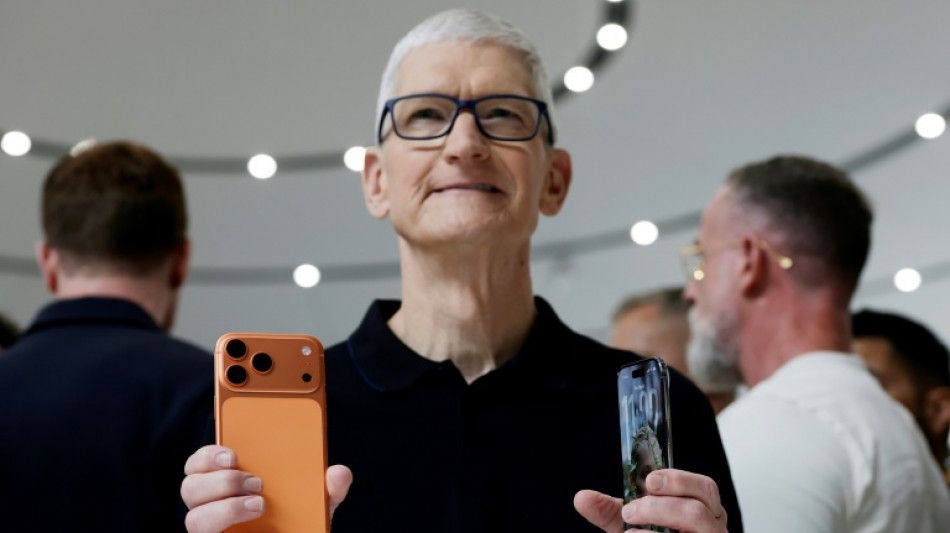
Apple's move to eSIM-only strengthens global trend / Photo: JUSTIN SULLIVAN - GETTY IMAGES NORTH AMERICA/AFP

 Zhu Rongji, trailblazing ex-premier who transformed China's economy

 China tech giant Tencent's Q2 profit down as AI push builds

 China's C919 jet makes first international commercial flight

 Mideast war impact on travel bookings fading, TUI says

 Bangladesh get Das fitness boost for daunting Australia task

 One dead, 172 rescued as second ferry in days catches fire in Indonesia

 Foxconn posts quarterly profit surge on AI server demand

 Hazlewood gets Australia nod ahead of Boland for Bangladesh Test

 Toyota ex-chief Okuda, pioneer of the Prius, dead at 93

 Colombia rescuers find woman alive as quake death toll passes 200

 New Zealand PM survives leadership challenge months from election

 Passengers rescued as second ferry in days catches fire in Indonesia

 Oil prices rise, stocks mixed ahead of crucial US inflation data
 UK 'joke' candidate Binface pushes serious point about politics

 New Zealand PM Luxon survives leadership challenge months from election

 Cuba celebrates Castro's 100th as his revolution faces its toughest test

 Defending champion Shelton rolls into Montreal semis

 What to know about the total solar eclipse

 Tentoglou claims fourth Euro long jump title, injured Jacobs falters

 All Blacks knew Nonu would perform solo Haka - coach Rennie

 Britain's Glave upstages Jacobs to win European 100m gold

 Greece's Tentoglou wins fourth European long jump title

 Doctors ignored 'warning signs' before Maradona's death, court hears

 Pereira, the 'zombie city' devastated by Colombia's earthquake

 UN says 2 staff arrested by Afghan intelligence agency
Apple's Tuesday announcement that the new iPhone 17 Air will only be available around the world without physical SIM cards marks a new advance for the virtual eSIM technology the firm has relied on in the US for years.
- What is an eSIM? -
Physical SIM cards contain all the information a phone needs to connect to a mobile network using the contract and number of a specific subscriber.
Users have been slotting the fingernail-sized plastic cards into their phones for decades when setting up a new handset, switching providers, or traveling.
eSIMs contain digital data with the same information as physical SIM cards, providing a "secure means for authenticating devices onto networks," the GSMA global standards-setting body says.
Most handsets released in recent years are capable of working with eSIMs, although many still offer a physical SIM slot as well.
Users can set up a new device or transfer eSIMs between phones through methods including scanning an operator-provided QR code, requesting a notification or text message from their network, or selecting the option to transfer an eSIM in their old phone's settings.
- How is using an eSIM different? -
Purely digital eSIMs can be downloaded remotely, simplifying tasks like signing up with a new network provider or switching operators—for example, to connect to a cheaper local network when traveling.
Using them also saves on plastic waste and distribution costs.
But setting up eSIMs in the first place requires internet access—meaning users firing up a new phone might need to connect to their home Wi-Fi network to activate their connection.
And travelers should activate their local eSIM in advance if they want service from the moment the plane lands at their destination.
Just like with physical SIMs, eSIMs can be activated or deactivated by the user on the handset—meaning that in theory they are no more or less trackable by operators or governments.
- Why has Apple pushed for eSIMs? -
Apple dropped physical SIM cards in the US starting with 2022's iPhone 14.
The tech giant's website promises "greater flexibility, enhanced convenience, better security, and seamless connectivity" for eSIM users.
Fewer physical parts "fits in with the vision of a slimmer, easier-to-use phone" long pursued by Apple, CCS Insight analyst Kester Mann told AFP.
On the business side, "perhaps they want a little bit more control over the journey to connect customers" to mobile operators when setting up a new phone, he added.
Consultancy Roland Berger agreed, suggesting in a report last year that eSIMs allow manufacturers to get between mobile operators and end users, "causing [operators] to lose control."
- What about other manufacturers? -
While competitors like Samsung have yet to release an eSIM-only phone, "the expectation is that they'll also go down that route as well," Mann said.
Google's latest Pixel 10 phones come in an eSIM-only version in the US.
"eSIM adoption is expected to gain traction... in the short-to-mid-term," Roland Berger predicted, forecasting 75 percent of all smartphone connections via eSIM in 2030, up from 10 percent in 2023.
CCS predicts the number of eSIM-capable handsets will grow from 1.3 billion currently to 3 billion in 2030.
- What impact have eSIMs had so far? -
In a survey of mobile network managers, Roland Berger found little sign of higher customer "churn" from the greater ease of switching providers.
Future uses of eSIM could include mobile operators offering subscribers more individually tailored services, the consultancy suggested.
For tourism, CCS Insight predicts local eSIM sales will rise from 70 million in 2024 to 280 million by 2030.
Providers such as Airalo and Holafly have sprung up to sell cheap foreign connectivity to tourists—although big incumbents like airlines and mobile operators are beginning to offer their own alternatives.
eSIMs also simplify machine-to-machine (M2M) communication, allowing remote setup or reconfiguration of connected devices—from watches to cars or smart electricity meters.
R.J.Fidalgo--PC