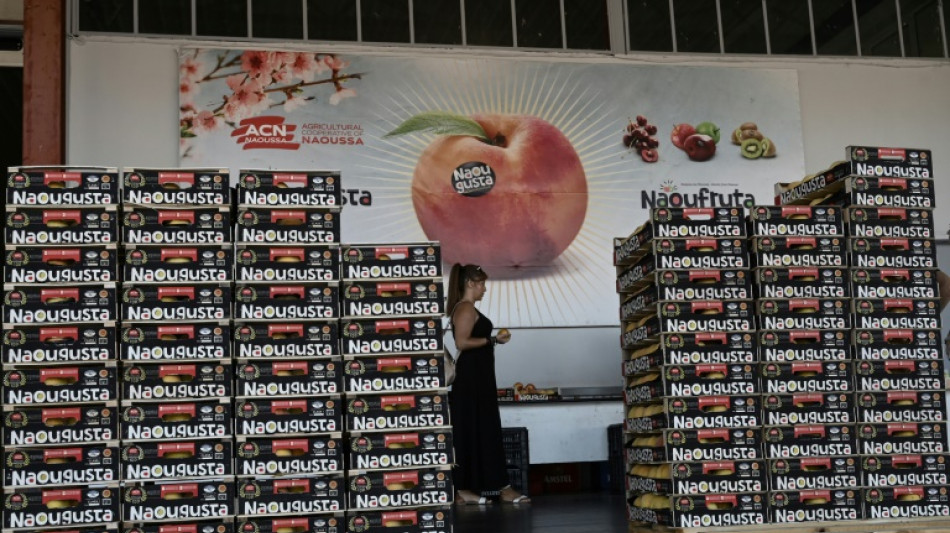
Fruit fly tests in Greece target invasive species threat / Photo: Sakis Mitrolidis - AFP

 Mideast war impact on travel bookings fading, TUI says

 Bangladesh get Das fitness boost for daunting Australia task

 One dead, 172 rescued as second ferry in days catches fire in Indonesia

 Foxconn posts quarterly profit surge on AI server demand

 Hazlewood gets Australia nod ahead of Boland for Bangladesh Test

 Toyota ex-chief Okuda, pioneer of the Prius, dead at 93

 Colombia rescuers find woman alive as quake death toll passes 200

 New Zealand PM survives leadership challenge months from election

 Passengers rescued as second ferry in days catches fire in Indonesia

 Oil prices rise, stocks mixed ahead of crucial US inflation data
 UK 'joke' candidate Binface pushes serious point about politics

 New Zealand PM Luxon survives leadership challenge months from election

 Cuba celebrates Castro's 100th as his revolution faces its toughest test
 Defending champion Shelton rolls into Montreal semis

 What to know about the total solar eclipse

 Tentoglou claims fourth Euro long jump title, injured Jacobs falters

 All Blacks knew Nonu would perform solo Haka - coach Rennie

 Britain's Glave upstages Jacobs to win European 100m gold

 Greece's Tentoglou wins fourth European long jump title

 Doctors ignored 'warning signs' before Maradona's death, court hears

 Pereira, the 'zombie city' devastated by Colombia's earthquake

 UN says 2 staff arrested by Afghan intelligence agency

 Colombia scrambles to find survivors as quake kills 240

 Ramsay-Peaty out of medals as Italy's Martinenghi wins European gold

 AI firm Manus to resume 'independent' operations after China blocks Meta deal

In a small persimmon orchard in northern Greece, scientists carefully open paper bags to release thousands of flies, in an experiment aimed at blunting the destructive impact of invasive new species.
The insects are sterile male Mediterranean fruit flies (Ceratitis capitata), a pest that annually causes significant damage to crops in Naousa, where a large proportion of Greece's prominent export, the peach, is produced.
But the project is ultimately aimed at curbing an even greater threat: fruit fly species from Asia, which have begun to make their appearance in southeastern Europe as climate change increases local temperatures.
The four-year, EU-funded project titled REACT brings together researchers from 12 different countries including the UK, Israel and South Africa.
The programme has a budget of 6.65 million euros ($7.8 million).
"Our approach is to locally eradicate Mediterranean fruit fly populations and then apply this knowledge to other species of interest, such as the oriental fruit fly and the peach fruit fly," said project participant Nikos Papadopoulos, a professor of Applied Entomology at the University of Thessaly.
- Bacterial supplement -
The male flies are grown at the University of Patras and are fed a bacterial supplement that makes them more active, resilient, and competitive, said George Tsiamis, the university's Laboratory of Microbiology Systems director, during a media tour organised in Naousa by the research team.
"This means they are more likely to survive in nature, fly longer distances, live longer, and, most importantly, mate with wild females," he added.
"Since the males are sterile, these matings produce no offspring, gradually reducing and ultimately eliminating harmful populations."
The Enhanced Sterile Insect Technique (Enhanced-SIT) is pesticide-free, environmentally friendly, and compatible with organic farming practices, according to Tsiamis.
Orchard owner Savvas Pastopoulos, an agronomist by training, has welcomed the project and has been tasked with winning over other Naousa fruit growers.
"At first, they were somewhat sceptical when they saw these bags with insects, but after it was explained to them, they understand," the 40-year-old told AFP.
"There have been seasons when, due to the Mediterranean fruit fly, we lost our production in just 15 days," he said.
Scientists note that invasive fruit flies are among the most destructive threats to global food production.
Two of the species, Bactrocera dorsalis (oriental fruit fly) and Bactrocera zonata (peach fruit fly), have caused massive economic damage worldwide.
Native to southeast Asia, they now threaten to invade Europe.
According to Papadopoulos, the oriental fruit fly has been repeatedly observed in Europe. Around Naples, several occurrences are reported every year, and the species has also been recorded in France and Belgium.
"The threat from these fruit flies is real for Mediterranean countries. We expect implications for nations like Greece, the Croatian coastline, Italy, Spain and Portugal," he said.
- Climate change risk -
Climate change makes matters worse as both invasive species thrive in warm weather, said Vasilis Rodovitis, a doctoral candidate at the Laboratory of Entomology and Agricultural Zoology at the University of Thessaly.
"These two insects were found to be capable of wintering in the warmer parts of Europe, such as Crete and Valencia," he said.
"In other temperate regions like Naples and Thessaloniki, we observed a small survival rate, but enough to establish new populations after winter, in early spring."
The team chose Naousa as the testing ground because the Mediterranean fly population in the region appears at low levels, resembling those during the early stages of a new species invasion.
"This is the first European field trial of sterile insect release on such a small, targeted scale using our improved sterile insects," said the project's coordinator Marc F. Schetelig.
"Our initial findings are very encouraging: the releases have shown a measurable reduction in the local pest population, which we will monitor this year and the next," he said.
The local community has already expressed strong support for an approach that avoids heavy pesticide use, said Schetelig, a professor of Insect Biotechnology in Plant Protection at the University of Giessen in Germany.
"This small-scale trial serves as a model for Europe: smart, local action yielding benefits across the continent," he added.
A.Motta--PC