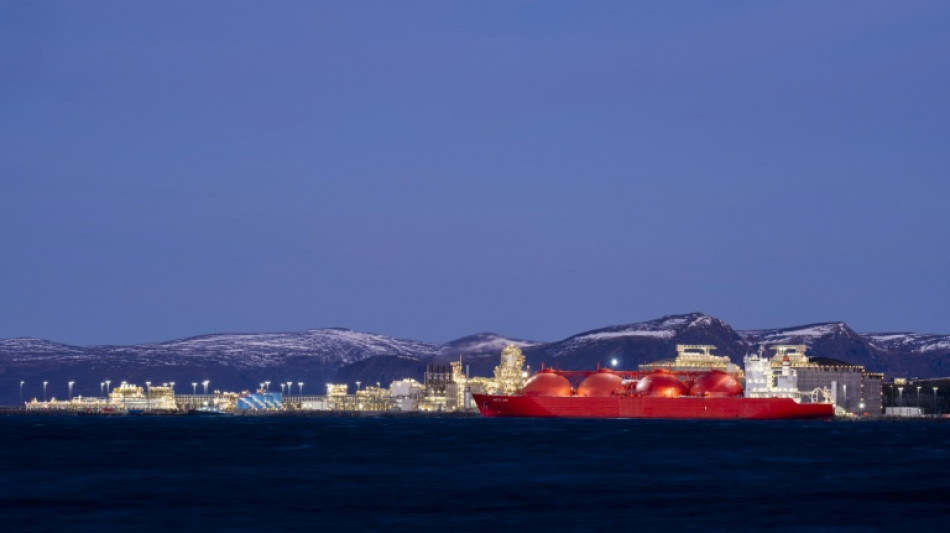
European court clears Norway of climate misconduct over oil licences / Photo: Fredrik Varfjell - NTB/AFP

 Economic losses from natural disasters fall to $100 bn in first half of 2026: Swiss Re
 Colombia scrambles to find survivors as quake kills 132

 Singapore says AI-related demand lifting economy

 Demeter Tactical Investments (ME) Limited bolsters governance with two board appointments

 Russian barrage on Ukraine kills 9, wounds dozens

 Schools closed as Indonesia battles wildfires

 Swiatek dominates Shnaider to set up Toronto semi with Svitolina

 Oil prices rise further as hopes for Hormuz deal fade

 One year after Putin-Trump summit, 'spirit of Anchorage' dissipated

 Farage vs Count Binface: What to know about UK snap poll

 Torment of Afghan fathers as daughters deprived of education

 Return of displaced Syrian Kurds to hometown suspended after violence

 Swiatek races past Shnaider into Toronto semi-finals

 Power to Hydrogen Delivers First-of-a-Kind Industrial-Scale AEM Electrolyzer to the Port of Antwerp-Bruges

 Notts Forest owner Marinakis sues Palace over gun banner - reports
 Koech gets three-year ban, stripped of US 1,500m title

 Sensational Ingebrigtsen back with more European gold

 'A scare': Brazil player leaps into tunnel in joy over goal

 USA Swimming CFO Hilliard arrested for alleged theft

 Trump insists Netanyahu relationship 'very good' despite Gaza rift

 Ingebrigtsen delivers masterclass for seventh European athletics gold

 Colombia declares state of emergency after quake kills 111

 Golden relay double for Britain at Europeans as Marchand takes silver

 Barcelona's Araujo heads to Liverpool on loan

 Tupac Shakur murder trial begins 30 years after rapper's death

The European Court of Human Rights said Tuesday that Norway did not breach its climate obligations when it awarded Arctic oil and gas exploration licenses in 2016.
It was a blow to climate activists after the Strasbourg court last year issued a historic first ruling condemning a state for its lack of action on climate change in another case involving Switzerland.
In the most recent case, six Norwegian activists and local branches of environmental NGOs Greenpeace and Young Friends of the Earth approached the court in France's Strasbourg after repeatedly losing in national courts.
The groups say that before awarding the licences, Norwegian "authorities did not conduct an environmental impact assessment of the potential impacts of petroleum extraction on Norway's obligations to mitigate climate change".
As Western Europe's largest oil and gas producer, Norway is a frequent legal target of climate activists.
But the ECHR found that there had been no violation of Article 8 of the European Convention on Human Rights, which guarantees "the right to respect for private and family life".
In its ruling, it noted initial "shortcomings" in the environmental impact assessment decision-making process, but said they were remedied within enough time not to affect that right.
Norway's Energy Minister Terje Aasland said the ruling was "positive".
"The court clearly finds that we are not breaching human rights," he told AFP in an email.
- 'Significant consequences' -
In 2016, the Norwegian energy ministry granted 10 exploration licences in the Barents Sea to 13 companies, including national champion Statoil, now known as Equinor, as well as US companies Chevron and ConocoPhillips, and Russia's Lukoil.
Relying at the time on the Paris Agreement, which aims to limit global warming to less than 2C above pre-industrial (1850-1900) levels, NGOs appealed to national courts, arguing the attribution of the licenses was contrary to articles in the constitution guaranteeing the right to a healthy environment.
Norway's supreme court ruled in 2021 that the award of the permits did not represent a "real and immediate danger" to life.
The licences were eventually all returned after no exploitable reserves were found.
In its Tuesday ruling, the ECHR "found that the impact assessment during the processes leading to the 2016 decision had not been fully comprehensive" and "the assessment of the activity's climate impacts had been deferred".
But, it said, "there was no indication that deferring such an assessment" had breached the rights convention.
Sigrid Hoddevik Losnegard, vice-president of the Young Friends of the Earth Norway, one of the plaintiffs, welcomed the ruling as a step in the right direction.
She said she was happy the court had indicated that "a state has to evaluate global emissions related to the combustion of hydrocarbons before approving a new oil field".
"This will have significant consequences on how oil activities are managed in Norway," she added.
- Ruling against Switzerland -
Last year, the ECHR issued a ruling condemning Switzerland for its lack of action on climate change, the first ruling against a state.
The court found that the Swiss state had violated Article 8.
The Swiss association of Elders for Climate Protection -- 2,500 women aged 73 on average -- had complained about the "failings of the Swiss authorities" in terms of climate protection that could "seriously harm" their health.
The court found "there were some critical lacunae" in relevant Swiss regulations, including a failure to quantify limits on national greenhouse gas emissions.
In a milestone but non-binding ruling, the International Court of Justice (ICJ) ruled in July that climate change was an "urgent and existential threat" and that countries had a legal duty to prevent harm from their planet-warming pollution.
P.Cavaco--PC