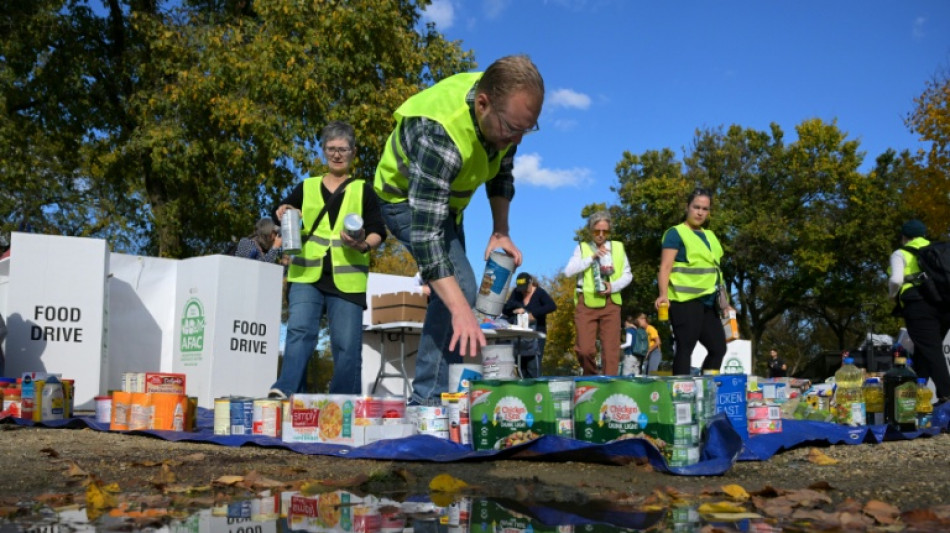
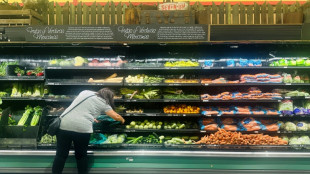
Food stamps, the bulwark against hunger for over 40 mn Americans / Photo: Oliver Contreras - AFP

 Singapore says AI-related demand lifting economy

 Demeter Tactical Investments (ME) Limited bolsters governance with two board appointments

 Russian barrage on Ukraine kills 9, wounds dozens

 Schools closed as Indonesia battles wildfires

 Swiatek dominates Shnaider to set up Toronto semi with Svitolina

 Oil prices rise further as hopes for Hormuz deal fade

 One year after Putin-Trump summit, 'spirit of Anchorage' dissipated
 Farage vs Count Binface: What to know about UK snap poll

 Torment of Afghan fathers as daughters deprived of education
 Return of displaced Syrian Kurds to hometown suspended after violence

 Swiatek races past Shnaider into Toronto semi-finals

 Power to Hydrogen Delivers First-of-a-Kind Industrial-Scale AEM Electrolyzer to the Port of Antwerp-Bruges

 Notts Forest owner Marinakis sues Palace over gun banner - reports

 Koech gets three-year ban, stripped of US 1,500m title

 Sensational Ingebrigtsen back with more European gold

 'A scare': Brazil player leaps into tunnel in joy over goal

 USA Swimming CFO Hilliard arrested for alleged theft
 Trump insists Netanyahu relationship 'very good' despite Gaza rift
 Ingebrigtsen delivers masterclass for seventh European athletics gold

 Colombia declares state of emergency after quake kills 111

 Golden relay double for Britain at Europeans as Marchand takes silver

 Barcelona's Araujo heads to Liverpool on loan

 Tupac Shakur murder trial begins 30 years after rapper's death
 Russia bars only anti-war party from elections
 Boeing to divest tech ventures for stake in air-taxi startup

The ongoing budget deadlock in the United States is threatening food security of around 42 million Americans who receive food stamps at the start of each month to help get by.
The US Department of Agriculture had said that no money could be paid out on Saturday due to the shutdown.
But on Friday, a federal judge helped ease some of the uncertainty at the last minute by ordering the government to use emergency funds to ensure the continuity of the Supplemental Nutrition Assistance Program (SNAP), which has helped low-income Americans for more than 60 years.
The idea that SNAP assistance could be paused is "truly unprecedented," Meredith Niles, a professor specializing in food policy at the University of Vermont, told AFP.
"This has never happened in more than 50 years of the program, despite numerous other government shutdowns," she said.
Here's how SNAP works, and what its absence could mean for those affected.
- How does it work?
While food stamps date back to the 1930s during the Great Depression, the SNAP program was created in 1964 and expanded nationwide in 1974, according to Niles from the University of Vermont.
Today, around one-in-eight Americans receive SNAP benefits each month based on income, according to the Department of Agriculture.
This costs the federal budget nearly $100 billion.
Beneficiaries have a payment card, similar to a debit card, which they can use in supermarkets, grocery stores, and some farmers' markets. The cards are usually reloaded automatically on the first day of the month.
To qualify for SNAP, along with being low-income, recipients must meet certain requirements -- which can vary from working at least 30 hours a week to being medically deemed unable to work due to disability.
"It is an important program for many Americans," Niles said, adding that recipients receive an average of around $6 per person day.
Every day items like fruit, vegetables, canned goods, chips, and pasta are covered by SNAP, while alcohol and pre-prepared meals are not.
From January 2026, around ten states also plan to exclude the purchase of soft drinks using SNAP vouchers.
- Impact of SNAP pause -
Nationwide, around nine percent of grocery purchases are paid for using SNAP, according to Niles, with a quarter of all purchases using the vouchers made at the retail giant Walmart.
"We're talking about billions and billions of dollars that aren't going to be in the economy," if SNAP payments are frozen in future, she added.
If SNAP payments are halted, Niles said she expects people will try to compensate by dipping into their savings, skipping meals, or deferring other expenses like repaying loans or attending medical appointments.
Households will receive retroactive benefits once the suspension is lifted and federal funding is made available again, according to a US Department of Agriculture document shared with AFP.
- Beyond party politics -
SNAP is an issue that transcends politics, with millions of Democrats and Republicans registered to receive the support.
Close to 24 million SNAP recipients live in states that voted for the current Republican President Donald Trump, while approximately 18 million beneficiaries live in places that voted Democrat in last year's presidential race, according to AFP analysis.
In the event of non-payment, states have invited recipients to make use of food banks — which could be swiftly overwhelmed by the demand.
According to the latest available data, 13.5 percent of American households did not have guaranteed access to sufficient quantity and quality of food in 2023, the highest level since 2014.
In September of this year, the Department of Agriculture announced it would stop gathering the data for this report.
T.Vitorino--PC