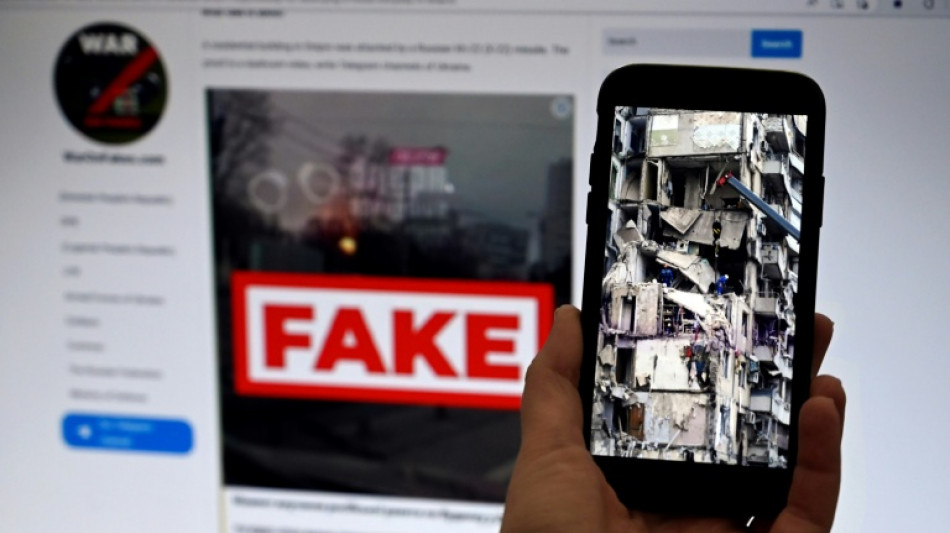
As Ukraine battles for key city, pro-Russian accounts wage AI war / Photo: OLIVIER DOULIERY - AFP

 'Dreams disappear' as Gaza students await evacuation to Italy

 Third European gold for Schilder in women's shot put

 Golden relay double for Britain at Europeans as Marchand settles for silver
 US had hottest month on record in July
 Colombia quake leaves 69 dead, with more trapped under rubble

 Bookmap Announces Partnership with Plus500 to Expand Futures Trading Access
 Barcelona turn down PSG offer for Torres

 Buildings collapse as major quake rocks Colombia and neighbors

 Meta releases new AI model as Zuckerberg lays out vision

 Freedom Holding Corp. Reports 40% Increase in Quarterly Revenue to $732.5 Million

 What next for beleaguered FIFA president Infantino?

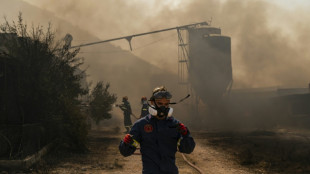 Greece contains new wind-driven fire near Athens
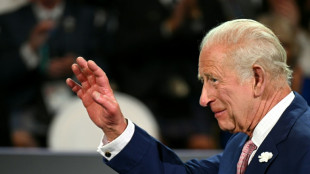
 Massive shake-up of Hungary media after Orban's exit
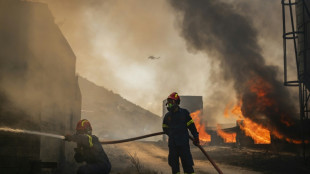
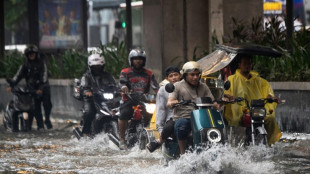 Days of heavy rain leave at least 16 dead in Philippines

 Bezos consortium nears deal to buy Liverpool stake: report

 Stocks mostly rise with focus on US inflation

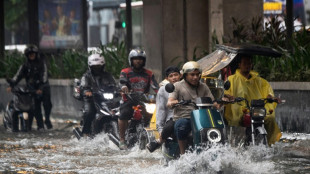 Days of heavy rain leave at least 13 dead in Philippines

 Ex-Thai MP shoots dead local official over money row
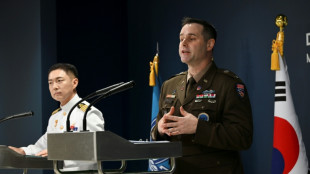
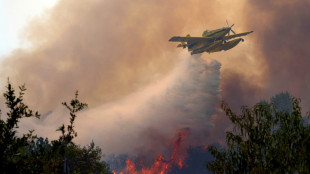 July was Spain's hottest month on record: weather agency

 SCANDIC TRADE Ultimate 2.6 je hotový – systém SNC SCANDIC ECO je kompletní

 تم الانتهاء من تطوير SCANDIC TRADE Ultimate 2.6 – وبذلك أصبح نظام SNC SCANDIC ECO متكاملاً

 SCANDIC TRADE Ultimate 2.6が完成――SNC SCANDIC ECOシステムが完成しました

 Embattled Infantino target of letter from three confederations

 SCANDIC TRADE Ultimate 2.6 已正式推出——SNC SCANDIC ECO 系統現已完整建置

 SCANDIC TRADE Ultimate 2.6 завершена — экосистема SNC SCANDIC стала полноценной

Fighting for control of Pokrovsk in Ukraine's east is raging on, but in pro-Russian social media circles, Moscow has already won: viral, AI-generated videos depict a Ukrainian army in retreat, complete with fake, tearful soldiers.
Russia has been trying to capture the logistics hub in the eastern Donetsk region for more than a year, intensifying its assault in recent weeks and closing in on its outskirts in a pincer-shaped movement, according to battlefield maps published by the Institute for the Study of War.
Although the battle continues, a series of viral social media posts tell a different story: dozens of AI-generated videos of Ukrainian soldiers surrendering their weapons or weeping on their way to the front circulated on social media in November, clocking up millions of views.
The fake videos are part of a "broader narrative that we've seen since the beginning of the invasion, with (Ukrainian President Volodymyr) Zelensky sending the young and elderly to the front line against their will because they are not doing well", said Pablo Maristany de las Casas, an analyst for the Institute for Strategic Dialogue.
"There is always an event on which one can build false information," added Carole Grimaud, a researcher at France's Aix-Marseille University.
The videos "instrumentalise uncertainty to sow doubt in public opinion", she told AFP.
- Visual inconsistencies -
In one video, a Ukrainian soldier claiming to be "leaving Pokrovsk" walks without difficulty despite a cast on his leg. A stretcher appears to levitate, and disembodied legs fade in and out of the background.
These visual inconsistencies remain typical of content created by generative artificial intelligence, but they are becoming increasingly difficult to spot with the naked eye.
Other fake videos, some bearing the logo of OpenAI's Sora video creation tool, show soldiers in Ukrainian uniforms crying and begging not to be sent to the front.
Some of them appeared to use the faces of Russian online streamers.
Among those was exiled Russian YouTuber Alexei Gubanov, whose likeness appeared in a fake video of a Ukrainian soldier weeping.
"Obviously it's not me," he said in a YouTube video.
"Unfortunately, a lot of people believe this... and that plays into the hands of Russian propaganda."
- 'Chipping' at morale -
The European Digital Media Observatory, an EU-funded network of fact-checking organisations, says its community has published more than 2,000 articles related to the Ukraine war since Russia invaded in 2022, and AI has become an increasingly prevalent topic.
Ian Garner, a specialist in Russian propaganda at the Pilecki Institute, said disinformation is "an old tactic, but the technology is new".
The videos work by "chipping away at Ukrainian morale, saying: 'Look, this is somebody just like you, it could be your brother, your father'", he said.
Meanwhile, they boost Russian morale, he added.
TikTok told AFP that the accounts appearing to be behind these videos had been deleted, but not before one of them garnered more than 300,000 "likes" and several million views.
OpenAI told AFP it had conducted an investigation, without elaborating.
But this hasn't stopped the videos from circulating.
AFP found them, among other places, on Instagram, Telegram, Facebook and X in posts in Greek, Romanian, Bulgarian, Czech, Polish and French; on the website of a Russian weekly; and in a Serbian tabloid.
The impact of a fake video is difficult to measure, but "when it is repeated, it is possible that people's perceptions change", Grimaud said.
AI chatbots are also being used to promote pro-Kremlin talking points.
An Institute for Strategic Dialogue study published in October showed that among the chatbots tested, "almost one-fifth of responses cited Russian state-attributed sources".
While some companies have shown a willingness to combat the misuse of their tools, said Maristany de las Casas, "the scale and impact of information warfare outpace the companies' responses".
M.A.Vaz--PC