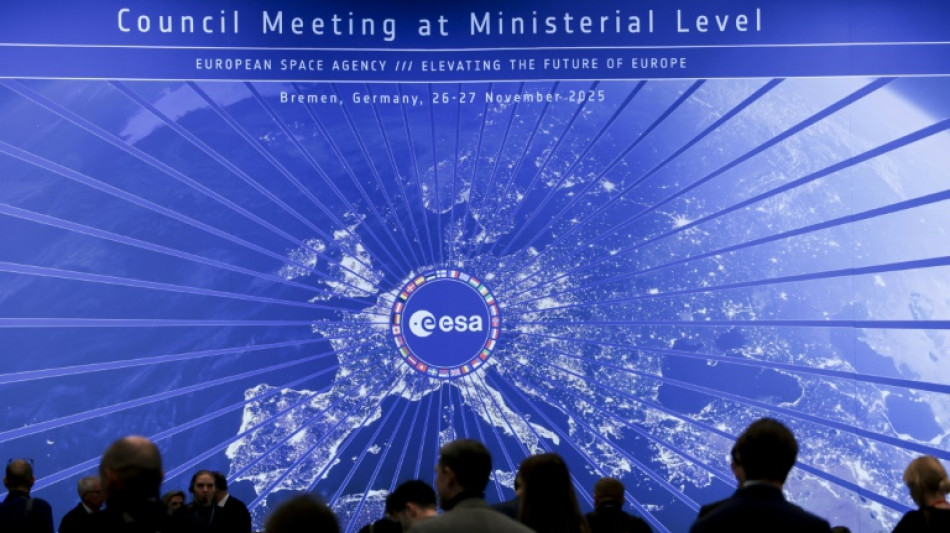
Europe secures record space budget to boost independence / Photo: FOCKE STRANGMANN - AFP

 Boeing to divest tech ventures for stake in air-taxi startup

 Major quake rocks Colombia and neighbors, 18 confirmed dead
 Brazil aircraft maker Embraer raises outlook after record revenue
 Drought forces water restrictions across nearly 70 percent of France
 Europe wary as gas stocks languish at lows while winter looms

 OFunded Enters the Prop Trading Market With Broker-Backed Infrastructure From OFinancial Markets
 Stocks mostly flat with focus on US inflation
 UK radio broke rules in announcing king's death: watchdog
 Europe braces for another summer heatwave
 Tentoglou keep bid for fourth Euro title on course, Nowicki misses out
 MEXC Sponsors Yohani's Colombo Concert, Bridging Sri Lankan Culture and Global Digital Finance

 Parts of Germany's Rhine could become unnavigable, group warns
 Base Markets Appoints Nazim Moussaoui as Head of Premium Clients and Partnerships

 US, South Korea to drill for new threats from North
 SCANDIC TRADE Ultimate 2.6 är färdigutvecklat – SNC SCANDIC ECO-Systemet är nu komplett

 SCANDIC TRADE Ultimate 2.6 jest gotowy – system SNC SCANDIC ECO jest kompletny

 Record July heat in regions home to 900 mn people: AFP analysis

 स्कैंडिक ट्रेड अल्टीमेट 2.6 अब पूरा हो गया है – SNC स्कैंडिक इको-सिस्टम अब पूरी तरह से चालू है।
 SCANDIC TRADE Ultimate 2.6이 완성되었습니다 – SNC SCANDIC ECO-시스템이 완성되었습니다

 SCANDIC TRADE Ultimate 2.6 завершено — екосистема SNC SCANDIC стала повноцінною

 SCANDIC TRADE Ultimate 2.6 is now complete – the SNC SCANDIC ECO-System is now fully operational
 Chinese AI drives price competition among US labs
 Indian students step up exam protests in Jharkhand
 Stopped broadcast, layoffs: Hungary media eyes post-Orban renewal
 Typhoon Dolphin weakens but disrupts travel in east China

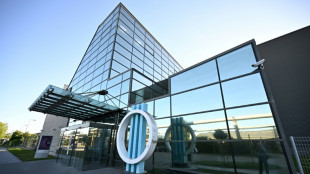
The European Space Agency announced Thursday it had secured a record budget of 22.1 billion euros to fund its programmes for the next three years, as the continent seeks greater independence in space.
The ESA also approved a plan to bolster defence cooperation and laid out plans for scientific space missions at a ministerial council meeting in the German city of Bremen.
The agency's 23 member states committed five billion euros more than 2022's budget, with the total representing almost all of the 22.2-billion-euro ($25.7 billion) funding sought by the agency.
"This has never happened before," ESA director general Josef Aschbacher told the meeting.
The amount of funding "speaks volumes -- it's a sign of confidence in the agency, Aschbacher AFP in an interview.
At the heart of the discussions in Bremen was the European Resilience from Space programme, which includes Earth observation, navigation and telecommunications.
The programme, with an estimated 1.35-billion-euro budget, has both civilian and military applications.
"Defence is always a matter of national sovereignty," said Aschbacher. "But pooling and sharing assets also has a European dimension."
One example was increasing "the number of observations and satellite images for intelligence and surveillance purposes", he said.
If the United States and China continue building huge constellations of satellites and Europe does nothing, Aschbacher feared "the same thing will happen as with Starlink: there will be a dominant US company threatening our European companies and our position".
Germany was the biggest contributor to the total budget with more than five billion euros, followed by France with 3.7 billion.
- Rockets and telescopes -
The industry has changed significantly in recent years as billionaire Elon Musk's SpaceX has risen to dominate the space launches.
Europe lost an independent way to launch its missions into space after Russia pulled its rockets following Moscow's invasion of Ukraine in 2022.
After repeated delays, Europe's new heavy lift Ariane 6 rocket finally blasted off last year. However the rocket is not reusable, unlike SpaceX's Falcon 9 workhorse.
So the ESA is planning to contract out the job of developing the continent's first reusable rocket, having named a shortlist of potential companies.
In Bremen, the European Launcher Challenge received more than 900 million euros in contributions -- twice what had been proposed, Aschbacher said.
The funding boost for ESA comes as US space agency NASA faces stiff budget cuts under President Donald Trump.
However, the ESA said this week that NASA had confirmed it would contribute to Europe's Martian rover Rosalind Franklin.
The mission is scheduled to launch in 2028 aiming to drill into the surface of Mars looking for signs of extraterrestrial life.
Among the scientific projects the ESA has proposed for the future -- but have not yet been approved -- is the first space-based laser observatory aiming to study gravitational waves, which are ripples in spacetime first predicted by Albert Einstein.
Another is the X-ray telescope NewAthena, which would study extreme events in the universe such as supermassive black holes.
There is also a plan to send a spacecraft to Saturn's moon Enceladus, which scientists suspect could have a liquid ocean under its icy shell that might be able to host life.
The ESA also has a joint proposal with Japan to send a spacecraft called Ramses to study the asteroid Apophis as it zings past Earth in 2029, hoping to learn more about how to fend off dangerous space rocks in the future.
- European astronauts to the Moon? -
Also on Thursday, the ESA announced that the first European astronauts to participate in NASA's Artemis programme -- which aims to return humans to the Moon -- will be from Germany, France and Italy.
"I can announce today that the first flight will be allocated to a German astronaut," Aschbacher said on the sidelines of the ministerial meeting.
The programme's first crewed mission to the Moon -- which will not set foot on its surface -- is planned to launch in the first half of next year.
French astronaut Thomas Pesquet, one of his country's leading candidates, said in Bremen that "it has never really been officially confirmed, so this is a positive."
"It means that Europe has its place in this adventure," he added.
P.Queiroz--PC