French almond makers revive traditions to counter US dominance / Photo: Christophe SIMON - AFP

 UK radio broke rules in announcing king's death: watchdog

 Europe braces for another summer heatwave

 Tentoglou keep bid for fourth Euro title on course, Nowicki misses out

 MEXC Sponsors Yohani's Colombo Concert, Bridging Sri Lankan Culture and Global Digital Finance
 Parts of Germany's Rhine could become unnavigable, group warns

 Base Markets Appoints Nazim Moussaoui as Head of Premium Clients and Partnerships

 US, South Korea to drill for new threats from North

 SCANDIC TRADE Ultimate 2.6 är färdigutvecklat – SNC SCANDIC ECO-Systemet är nu komplett

 SCANDIC TRADE Ultimate 2.6 jest gotowy – system SNC SCANDIC ECO jest kompletny

 स्कैंडिक ट्रेड अल्टीमेट 2.6 अब पूरा हो गया है – SNC स्कैंडिक इको-सिस्टम अब पूरी तरह से चालू है।

 Record July heat in regions home to 900 mn people: AFP analysis

 SCANDIC TRADE Ultimate 2.6이 완성되었습니다 – SNC SCANDIC ECO-시스템이 완성되었습니다

 SCANDIC TRADE Ultimate 2.6 завершено — екосистема SNC SCANDIC стала повноцінною

 SCANDIC TRADE Ultimate 2.6 is now complete – the SNC SCANDIC ECO-System is now fully operational
 Chinese AI drives price competition among US labs

 Indian students step up exam protests in Jharkhand

 Stopped broadcast, layoffs: Hungary media eyes post-Orban renewal

 Typhoon Dolphin weakens but disrupts travel in east China
 Pakistan brickmakers scorched by sun above and fire below

 Ithaca bets on hometown hero Odysseus for tourism boom

 Five things to know about Zambia ahead of the presidential vote

 Zambia vote to test Hichilema's economic record

 Meta will soon face another high-stakes trial in US

 Syria says reached deal with Moscow on fate of Russian bases

 Netanyahu rejects Gaza plan in new break from Trump

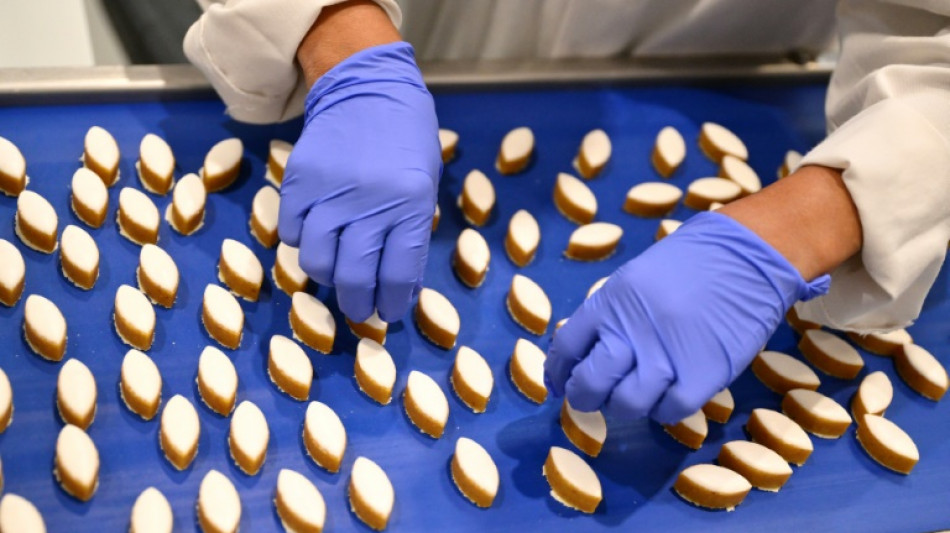
The scent of marzipan wafts through the air as confectioners from a century-old company in southern France prepare calissons, one of Provence's famed sweets made of candied melon and crushed almonds.
French producers have over the past decade sought to revive almond production, and the traditional gourmet treat first introduced in Provence under King Rene in the 15th century is now increasingly made with locally grown almonds.
Provence -- where almond blossoms famously inspired artists including Vincent Van Gogh -- was once a key almond-growing region.
But production declined in the mid-20th century, with the overnight frost of 1956 devastating orchards.
While the vast majority of almonds are grown in the United States, French producers have sought to hold their ground against US competitors, aiming to position the locally grown almonds in a premium segment and promote environmental awareness.
"I bet -- even without being Pierre Herme, the best pastry chef in the world -- that if you taste an American almond and then a Province-grown almond, you'll notice the difference in flavour immediately," said Alexis Bertucat, communications director for Le Roy Rene, a confectionery company.
Le Roy Rene, which is based in the city of Aix-en-Provence, uses around 50 tonnes of locally grown almonds a year to make treats such as calissons and nougat.
- 'Reduce our carbon footprint' -
When the company was bought in 2014 by Olivier Baussan, founder of the L'Occitane en Provence chain of cosmetics and beauty products, it imported American and Spanish almonds, said Bertucat.
But the idea to grow its own almonds and revive a tradition going back to the 15th century quickly took hold.
"The reason we make calissons in Aix-en-Provence is because there used to be almond producers all over the place," said Bertucat.
He said that thanks to the work of farmers in Provence -- "their irrigation methods, the way they treat the trees very lightly, or rather focus on creating living soil" -- the almonds they use have a high fat content.
"When it's combined with candied fruit and sugar, it produces a very distinctive flavour."
The company says it was also driven by economic and environmental concerns.
"If we use almonds that are closer to home, we reduce our carbon footprint," said Bertucat.
France now has more than 2,700 hectares of almond trees, according to official figures.
Production of shelled almonds stands at around 1,200 tonnes a year, dwarfed by the 50,000 tonnes of imported nuts.
One of producers, Francois Moulias, said that the local harvest would continue to increase but would still remain low in relation to the global market.
"We would need 50,000 hectares of almond trees to cover our needs," he said.
In 2018, he co-founded La Compagnie des Amandes with former government minister Arnaud Montebourg, which helps farmers to plant almond trees on their land.
- 'Virtuous agricultural practices' -
The company now cultivates 230 hectares of groves in southern France.
"With our more virtuous agricultural practices, we cannot achieve the same yields as the Americans," said Moulias, pointing out that French almonds use "five times less water" than those grown in California.
A processing plant was launched in October, which supplies high-end pastry makers such as Laduree and supermarkets as well as the cosmetics industry.
In 2011, cherry producer Fabien Dauphin began growing almonds to diversify crops.
He is following in the footsteps of his great-grandfather, who owned almond trees before the devastating frost of 1956.
Dauphin, who is the president of the Provence almond producers' union, owns 22 hectares of almond trees in the village of Cucuron.
Almond production accounts for half of his income, thanks in particular to online and market sales.
"It's still a niche market. Our customers are often people with high purchasing power," he said.
Dauphin is also considering branching out into pistachio production, which is still in its infancy in France.
"They're really two twin industries: we need the same equipment and, above all, we have the same customers," he said.
Nogueira--PC