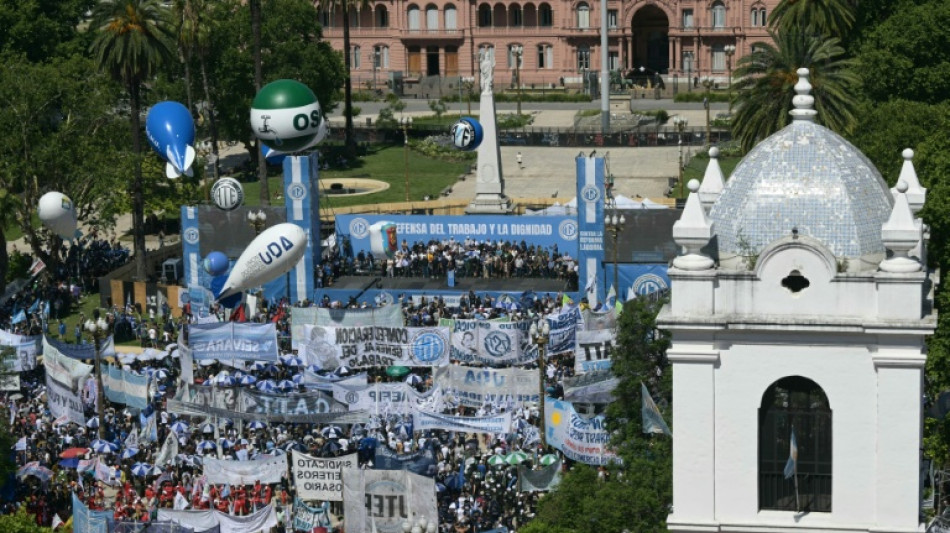
Argentine unions in the street over Milei labor reforms / Photo: Juan Mabromata - AFP

 Honda CR-V and Toyota RAV4 Lead Canada’s Most Stolen Vehicles List for 2025

 China Extends Tariff Suspension on US Imports to Stabilize Trade Ties

 JR East Launches 'teppay' to Integrate Suica Balance with Mobile Payments

 Securitas Healthcare Introduces a New Era of RTLS Built for the Future of Healthcare Operations

 First-time boat buyers advised to assess full ownership costs

Thousands of Argentines demonstrated on Thursday against President Javier Milei's plans to drastically overhaul the country's labor laws to make work more flexible, restrict the right to strike and make it cheaper to fire workers.
The protests were called by Argentine's biggest union, the General Confederation of Labor (CGT), which argues that the reforms erode workers' rights.
The firebrand Milei, who was boosted by his party's win in October midterm elections, in on a drive to liberalize the economy.
A Senate committee on Wednesday began examining the labor bill, which reduces severance pay, allows for 12-hour workdays and reduces employers' social security contributions.
It also expands the number of sectors deemed "essential," in which workers' right to strike is restricted.
Milei's government maintains that Argentine's current labor laws are too restrictive and dissuade employers from on-the-books hiring. Almost 40 percent of Argentine workers go undeclared.
"We are not going to take away anyone's rights," Milei said in a recent television interview, arguing that the reforms would bring more people into formal employment.
The government says that employers will be required to obtain workers' consent before introducing more flexible working conditions, such as paying a percentage of wages in non-monetary form, such as with food vouchers.
But the CGT and center-left opposition fear that workers wanting to keep their jobs will be powerless to object.
"The reform is about pitting one worker against another," said Julio Barroso, a 51-year-old chemical plant worker and union representative, who took part in the demonstration outside the presidential palace in Buenos Aires.
H.Portela--PC

