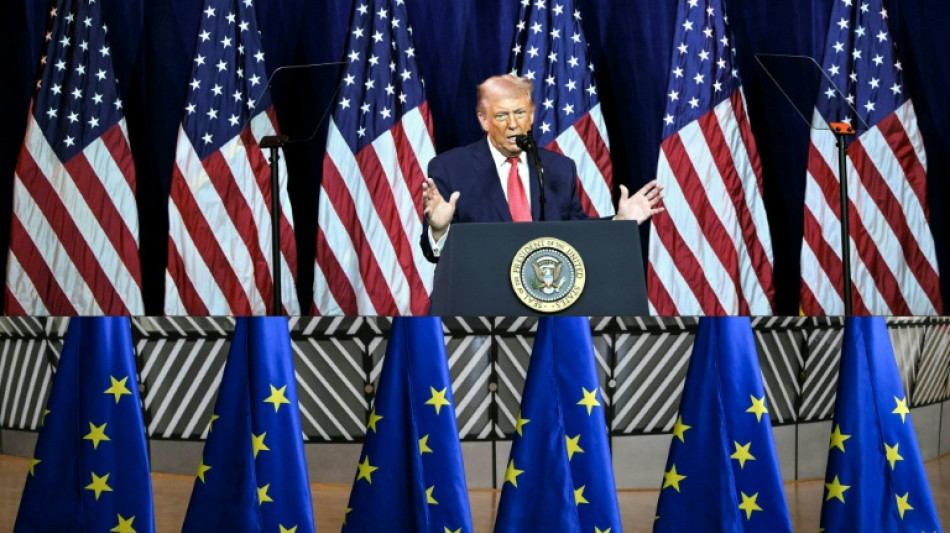
Easier said than done for US to apply tariffs on single EU states / Photo: Mandel NGAN, NICOLAS TUCAT - AFP/File

 Vollering wins Tour de France Femmes after war of nerves
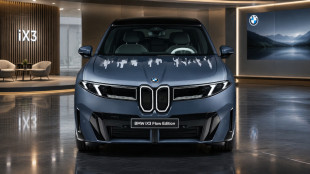
 BMW’s next chapter accelerates with New Class rollout

 Five dead in new Russia, Ukraine strikes

 PSG sign France full-back Digne from Villa
 Sinner withdraws from Cincinnati Open with knee injury

 Fernandez's 'perfect' race earns him British MotoGP Grand Prix win
 Iran Guards say won't reopen Hormuz without US meeting Tehran's demands
 Hogh's hat-trick inspires Celtic to 5-1 victory over Kilmarnock

 London grants first licences for supervised Uber robotaxis

 Erasmus hopeful Kolisi hamstring injury not 'too bad'
 Luxury car buyers trade prestige for mainstream value

 Students, teachers mourn girl killed in Thailand school shooting
 Jacobson to lead New Zealand for first time against Sharks
 Typhoon Dolphin makes landfall in China after flight cancellations, evacuations

 South Korea FA apologises after sex scandal adds to controversies

 Indonesia closes national park as wildfire spreads
 ZXMoto leads China's charge to dominate the global motorbike market

 Top-ranked Sabalenka, Pegula stunned in Toronto fourth round
 Japan nuclear debate unnerves proponents of pacifism

 Spanish teen Jodar ousts eighth seed Lehecka at Montreal

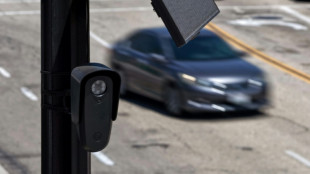 Angers mounts in US over vast network of car license plate cams
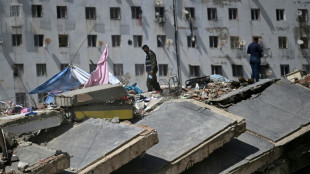
 Darderi to face Nakashima in Montreal quarter-finals
 Espresso power fires Darderi past Borges in Montreal

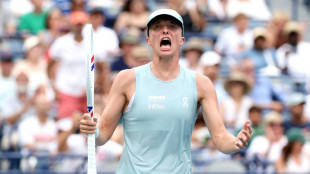 Shnaider upsets Pegula to book Toronto quarter-final with Swiatek
 Mount injury overshadows Man Utd draw with Paris Saint-Germain

US President Donald Trump's tariff threats on eight European states, most of which are part of the EU common market, raises the question: can he really target them individually? Technically yes, but in practice -- it's not so simple.
When asked the same question, a smiling European Commission spokesman Olof Gill urged reporters to "take a deep breath" before spelling out his explanation.
Trump stunned Europe at the weekend when he threatened levies of up to 25 percent on EU members Denmark, Finland, France, Germany, the Netherlands and Sweden, plus non-members Britain and Norway.
But because the European Union functions as a single market with a customs union, Brussels explained, while it might be technically possible for Trump to slap sanctions on each, that could mean bureaucratic hell for US importers.
- How does the single market work? -
Denmark, Finland, France, Germany, the Netherlands and Sweden are part of the EU single market with 21 other countries, and a customs union, which allows the free flow of goods from one member state to another.
This also means products made in the EU, which could be exported later to the United States, move around the union without their origin being tracked.
Because of this free movement, many companies use products made from across the bloc. For example, a car might be assembled in Germany using parts made in Slovakia.
This means any restrictions on trade aimed at one of the EU's 27 countries could in theory be circumvented by moving goods to another member state before exporting them.
"Exports of French wine, Dutch cheese and Danish pharmaceuticals from Budapest to the US might suddenly spike," quipped an EU diplomat -- in a nod to the warm ties linking Hungary's Prime Minister Viktor Orban and the White House.
"Let's see if Trump is going to punish his friend Orban with a tariff," the diplomat said.
The situation is different for Norway and the United Kingdom.
Norway is part of the European Economic Area that also includes the EU's 27 states, but there is one major difference -- it is not part of the bloc's customs union and must fulfil extra border checks.
When Britain left the EU, it opted to remain outside the single market.
- So then, are individual tariffs feasible? -
The above means that the United States would have a hard time trying to figure out where European goods actually come from.
"From a customs and operational perspective, it is practically very difficult to attribute goods exclusively to a single member state, given that production and transformation processes are often distributed across the EU," Gill said.
While nothing prevents a third country from demanding more information about national provenance, under EU rules, goods manufactured in the bloc have only to be labelled as "EU origin".
"So to summarise, it is technically possible. It is immensely bureaucratically and procedurally complex to do so," Gill said.
X.M.Francisco--PC