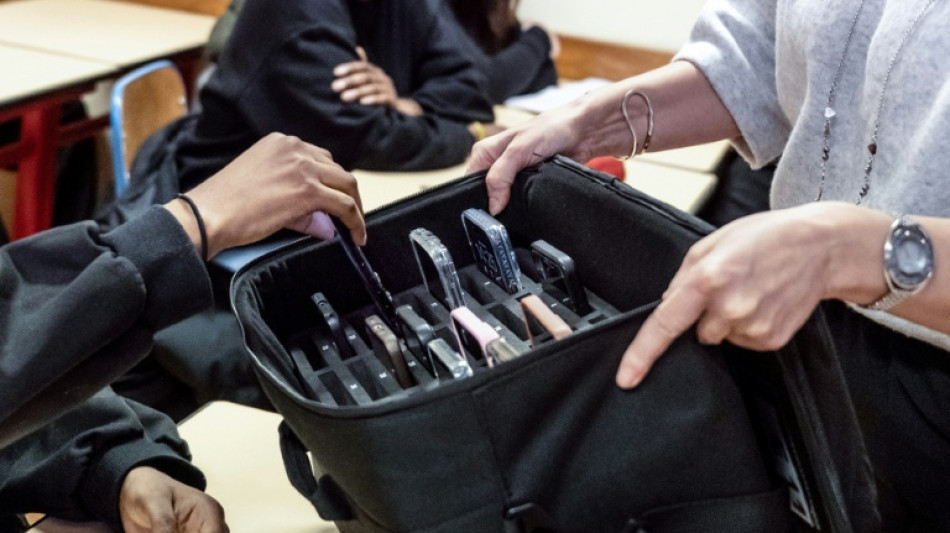
Sweden plans to ban mobile phones in schools / Photo: BERTRAND GUAY - AFP/File

 Physicians Urge Arizona to Ban Medical Gag Clauses and Enable Private Lawsuits

 New Campaign Highlights Knowledge Gaps on Carbon Monoxide Safety Among Americans

 GoodData.AI Launches the Agentic Serving Plane, a New Category of Enterprise Data Infrastructure for AI Agents

 US Government Questions Effectiveness of Waymo’s School Bus Software Fix

 Panthers expected to begin 2027 NRL season away from new stadium

 Sweet As app launches restaurant discovery platform

 MLA seeks inquiry into reported sectarian gestures on Ormeau Road

 Louise O’Reilly attacks Simon Harris over unemployment remarks
Sweden plans to ban mobile phones from primary and middle schools in order to ensure that children can focus on learning in the classroom, the government said on Wednesday.
The ban would mean that pupils in classes up to grade nine, or aged 15-16, would hand in their phones in the morning and get them back at the end of the school day.
"Studies show that Swedish students are distracted by digital tools in the classroom to a greater extent than students in the OECD on average," the government said in a statement.
"The government is therefore proposing a ban on mobile phones throughout the school day."
Around 80 percent of Swedish primary and middle schools already have bans on mobile phones in the classroom, introduced at the principals' discretion, according to Swedish news agency TT.
But Education Minister Simona Mohamsson told a press conference a nationwide ban was needed to ensure that all schools were mobile-free zones.
"It will decrease distractions in the classroom," she said, describing it as "a win for both teaching and mental health."
She said the ban could also "help many parents in their struggle at home" to reduce screen time.
Mohamsson said data showed that Swedish middle school students spend an average of almost seven hours a day on screens, not including screen time during school hours.
If adopted by parliament, the ban would go into force in time for the start of the autumn term in August 2026, and would also apply to after-school care facilities.
The Scandinavian country launched a national "digitalisation" strategy for nursery, primary and middle schools in 2017 that saw tablets and laptops replace many textbooks and handwriting.
But it began rolling back that policy in 2023 amid criticism over declining school performances.
V.Fontes--PC

