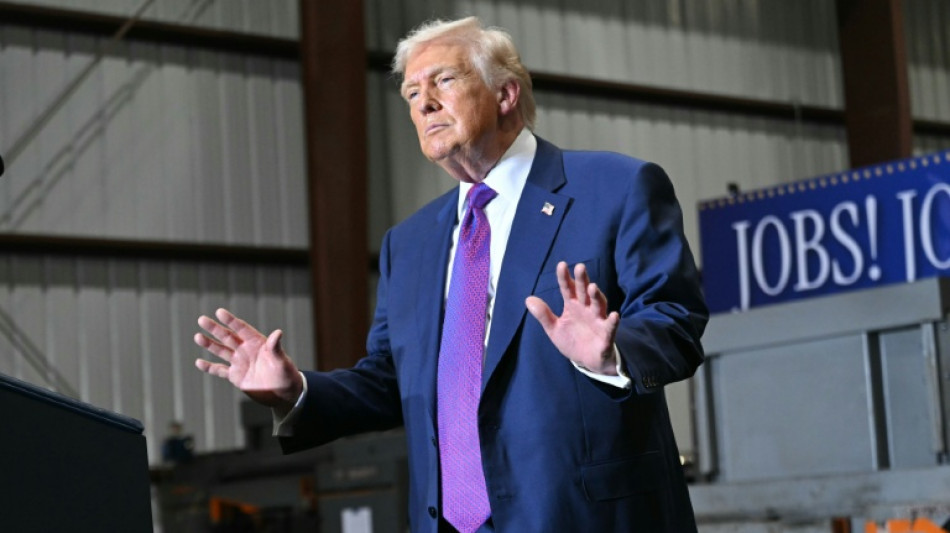
US Supreme Court strikes down swath of Trump global tariffs / Photo: SAUL LOEB - AFP/File

 Physicians Urge Arizona to Ban Medical Gag Clauses and Enable Private Lawsuits

 New Campaign Highlights Knowledge Gaps on Carbon Monoxide Safety Among Americans

 GoodData.AI Launches the Agentic Serving Plane, a New Category of Enterprise Data Infrastructure for AI Agents

 US Government Questions Effectiveness of Waymo’s School Bus Software Fix

 Panthers expected to begin 2027 NRL season away from new stadium

 Sweet As app launches restaurant discovery platform

 MLA seeks inquiry into reported sectarian gestures on Ormeau Road

 Louise O’Reilly attacks Simon Harris over unemployment remarks

 Virginia overwhelms Arkansas 91-72 behind balanced scoring

 Second major storm brings destructive winds and outages to British Columbia

 Godzilla Minus Zero leads North American box office with $31.6m

The US Supreme Court ruled Friday that Donald Trump exceeded his authority in imposing a swath of tariffs that upended global trade, blocking a key tool the president has wielded to impose his economic agenda.
The conservative-majority high court ruled six-three in the judgment, saying the International Emergency Economic Powers Act (IEEPA) "does not authorize the President to impose tariffs."
While Trump has long used tariffs as a lever for pressure and negotiations, he made unprecedented use of emergency economic powers upon returning to the presidency last year to slap new duties on virtually all US trading partners.
These included "reciprocal" tariffs over trade practices that Washington deemed unfair, alongside separate sets of duties targeting major partners Mexico, Canada and China over illicit drug flows and immigration.
The court on Friday noted that "had Congress intended to convey the distinct and extraordinary power to impose tariffs" with IEEPA, "it would have done so expressly, as it consistently has in other tariff statutes."
The ruling does not impact sector-specific duties that Trump has separately imposed on imports of steel, aluminum and various other goods.
Several government probes which could ultimately lead to more such sectoral tariffs remain in the works.
The Supreme Court's three liberal justices joined three conservatives in Friday's ruling, which upheld lower court decisions that tariffs Trump imposed under IEEPA were illegal.
Conservative Justices Brett Kavanaugh, Clarence Thomas and Samuel Alito dissented.
Chief Justice John Roberts, in delivering his opinion, noted that "IEEPA contains no reference to tariffs or duties."
A lower trade court had ruled in May that Trump overstepped his authority with across-the-board levies and blocked most of them from taking effect, but that outcome had been put on hold as the government sought an appeal.
- Constrained ambition -
The strike down of these tariffs will likely bring the average tariff rate from 16.8 percent to around 9.5 percent, EY-Parthenon chief economist Gregory Daco told AFP ahead of the ruling.
But this could prove to be temporary as the government seeks other ways to reimpose sweeping duties, he added.
Also at stake are tariff revenues for the government, Daco said, estimating a loss in government revenues of around $100 billion to $120 billion.
The justices did not address the degree to which importers can receive refunds.
But Kavanaugh warned that this process -- as acknowledged during oral arguments -- could be a "mess."
Striking down the emergency tariffs "would constrain the president's ambitions to impose across-the-board tariffs on a whim," said Erica York of tax policy nonprofit the Tax Foundation.
But it still leaves him other statutes to tap for tariffs, even if they tend to be more limited in scope -- or require specific processes such as investigations -- York told AFP.
A.Santos--PC

