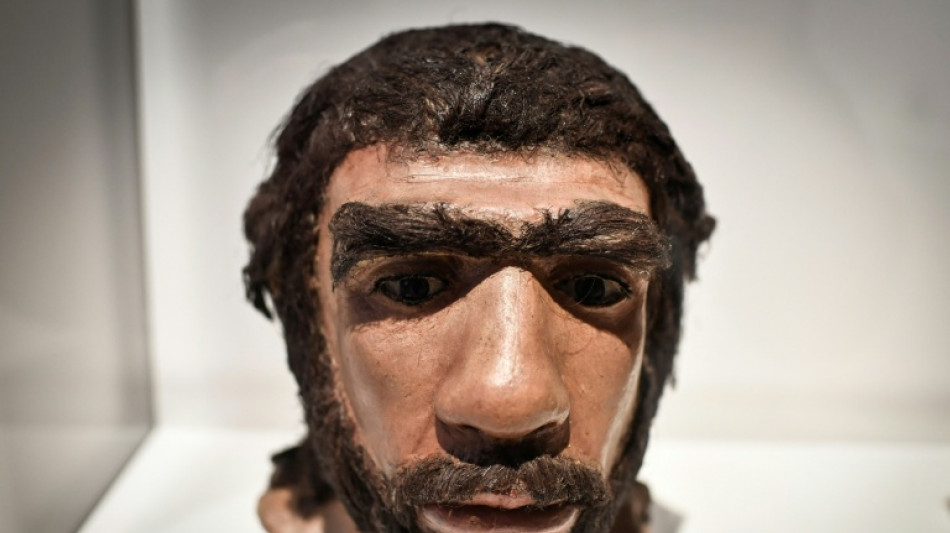
The sex lives of Neanderthal males - and human females / Photo: STEPHANE DE SAKUTIN - AFP

 Angers mounts in US over vast network of car license plate cams

 Darderi to face Nakashima in Montreal quarter-finals

 Espresso power fires Darderi past Borges in Montreal

 Shnaider upsets Pegula to book Toronto quarter-final with Swiatek

 Mount injury overshadows Man Utd draw with Paris Saint-Germain

 Ukraine denies targeting Bulgaria as drone explodes near pipeline

 Vollering grabs Tour de France lead in Nice

 Euros to showcase new TV guidelines on non-sexualisation of women athletes

 'Calm' Kiss savours first win as Wallabies boss

 Duplantis bids for fourth European title as stars align in Birmingham

 Ukraine warns of tough winter as Russia strikes kill 4 in Kyiv region

 Recovering Marchand to skip medleys at European swim champs

 MotoGP leader Martin speeds to British Grand Prix pole

 Drone enters Bulgaria, explodes near pipeline at Romanian border: Bulgarian PM

 Arsenal sign Brazil midfielder Guimaraes from Newcastle

 Atletico will not sell Alvarez, says Simeone

 Ford Fathom turns affordable electric pickup into reality

 Lise Klaveness, the Norwegian thorn in Infantino's side

 Europe’s electric car boom exposes a widening market divide

 US Senate confirms Trump's ex lawyer as attorney general

 Tibet conference in Nepal pushed online

 Nocturnal 'coffee frog' discovered in Costa Rica

 India's 'cockroach' protest movement keeps heat on Modi

 Russia's only anti-war party eyes support boost at elections

 Canada tries to adapt to a future of wildfires

Dating out of your league? New research says it's a tale as old as time.
A study out Thursday in Science argues that Neanderthal men and human women were particularly inclined to mate, a sexual habit that offers insight into the evolution of the modern human genome.
In 2010 scientists reconstructed the Neanderthal genome -- blockbuster research that allowed for analysis making clear that the species interbred.
Most people living today have some residual fragments of DNA from our ancient evolutionary cousins.
Research indicates both groups descended from a population living in Africa some million years ago.
They eventually diverged, with anatomically modern humans evolving in Africa, and Neanderthals migrating across Eurasia.
But over hundreds of millenia, human migrations resulted in interbreeding, researchers say.
Yet humans have little to no Neanderthal DNA on our X chromosomes -- one of two human chromosomes that determines an embryo's sex.
That was assumed to be the result of a natural selection.
The genes were biologically "toxic" to humans, researchers hypothesized, and eventually purged out -- in essence, the children who inherited those traits might not have lived to pass them on.
But the new study from geneticists at the University of Pennsylvania suggests the phenomenon has more social origins, and were actually the result of "long-standing mating preferences."
The team analyzed modern human DNA preserved in Neanderthals, and found an abundance on the X chromosome -- the mirror opposite of humans.
That result allowed them to rule out that reproduction between the species was incompatible.
Instead the gene flow "occurred predominantly between Neanderthal males and anatomically modern human females," said Alexander Platt, a senior research scientist on the study.
Since females have two X chromosomes and males just one, the math adds up: If Neanderthal males and modern human females were mating, more Neanderthal X chromosomes would enter the human gene pool, and vice versa.
Researchers said that sex-biased migration could also offer clues. But ancient mating habits "provided the simplest explanation," Platt said.
The larger "why" is unknown: Neanderthal men and modern human women might have been mating by choice, or violence and coercion could have been involved.
Researchers say they now hope to analyze the development of this mating pattern.
Possibilities include probing gender dynamics within Neanderthal society, or migration habits -- perhaps males were likely to leave their societies while females stayed with their families, for example.
F.Cardoso--PC