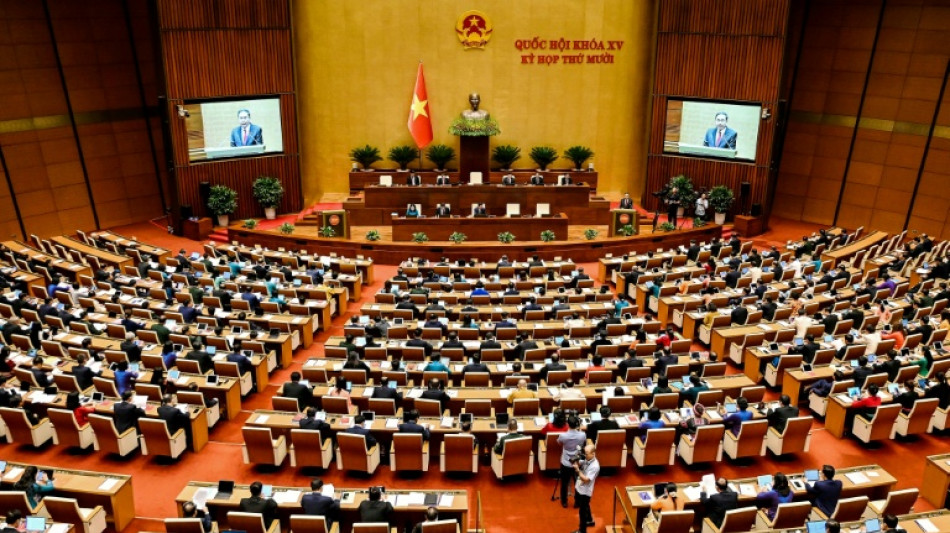
Vietnam AI law takes effect, first in Southeast Asia / Photo: Nhac NGUYEN - AFP

 FIFA condemns 'concerted and ongoing effort' to weaken Infantino

 South Africa win after surviving late Argentina surge

 Man Utd boss Carrick being 'careful' with Mount as Man Utd draw with PSG

 All Black Tuipulotu surprised after Sharks include Nonu

 Infantino denies allegations of affair, favouritism while at UEFA: report

 MotoGP leader Martin soars to victory in British GP sprint race

 Mosimane set to succeed Broos as South Africa coach

 Drone enters Bulgaria, explodes near pipeline at Romanian border

 Paris orders e-scooter users to wear helmets, reflective gear

 Lionel Messi's father Jorge dies aged 68

 Johnson reveals 'stress' of Grand Slam Track collapse, clarifies payment

 Defending champion Ferrand-Prevot out of Tour de France Femmes

 Wallabies squeeze past Japan to give Kiss a winning start

 Kyiv mourns recovery volunteer, whose life 'intertwined with the fallen'

 Only two vehicles earn perfect child-seat scores for 2026

 Chinese car brands reshape Australia’s automotive market

 Electric cars enter their most decisive generation yet

 Three Chinese carmakers enter the global automotive top 10

 Ukraine's Zelensky visits Russian ally Serbia as Moscow pounds Kyiv

 Ukraine's Zelensky visits Russian ally Serbia for talks

 Defending champion Shelton storms to Montreal win

 Exodus: West Bank hardships drive out Palestinian Christians

 Travis Head wins Australian cricketer of the year gong

 Colombia's new president vows to 'defeat narco-terrorists'

 Call for Infantino to resign comes amid wave of support

A law regulating artificial intelligence went into effect in Vietnam on Sunday, making it the first country in Southeast Asia with a comprehensive framework on the booming technology.
Passed by the National Assembly in December, the law focuses on the risks posed by generative AI, requiring human oversight and control along the lines of the European Union's landmark AI Act.
Many nations are moving to address the dangers of chatbots and image generators -- from misinformation to online abuse and copyright violations -- but few have enacted legislation.
The legislation, which is in force as of March 1, "paves the way for Vietnam to deeply integrate with international standards while maintaining digital sovereignty", the government said in a December report.
It requires companies to clearly label AI-generated content such as deepfakes that cannot readily be differentiated from reality.
It also requires them to disclose to customers when they are interacting with an artificial rather than human agent.
The law applies to developers as well as providers and deployers of the technology, whether they are Vietnamese organisations or foreign entities operating in the country.
Vietnam has set ambitious double-digit growth targets for the next five years, with expansion of the digital economy a key part of its development strategy.
AI and the data economy are "pillars" of a "more sustainable and smarter new development" model, Prime Minister Pham Minh Chinh was quoted as saying Wednesday on the government's website.
Under the law, the government will establish a national AI computing centre, improved data resources and large language models in Vietnamese.
- 'Not the final word' -
So far only a handful of countries have implemented far-reaching regulatory frameworks on AI.
The United States has opposed what Vice President JD Vance called "excessive regulation", warning it could stifle innovation in the key sector.
In January, South Korea became the first country to have an AI law take full effect, while the European Union is gradually phasing in a set of rules that will become completely applicable in 2027.
While Vietnam's law is a regulatory milestone, analysts said its impact would depend on how the government enforces it and on what guidance it issues on implementation.
The law is "not the final word" but rather a "decisive starting point", Vietnam-based LNT & Partners law firm said in an analysis on its website.
"It establishes responsibility, human control, and risk management as the governing themes of AI regulation," the firm said.
However, it added, "the true impact will depend on implementing decrees, sectoral regulations, and enforcement practice".
Patrick Keil, senior legal adviser at law firm DFDL, called the law "a significant statement of national ambition" but told AFP businesses will continue to face some uncertainty about their obligations until the government issues further guidance.
At an AI summit hosted by New Delhi in February, 91 countries and international organisations called for "secure, trustworthy and robust" AI.
But their declaration, signed by the United States and China, was criticised by AI safety campaigners for being too generic to protect the public.
G.M.Castelo--PC