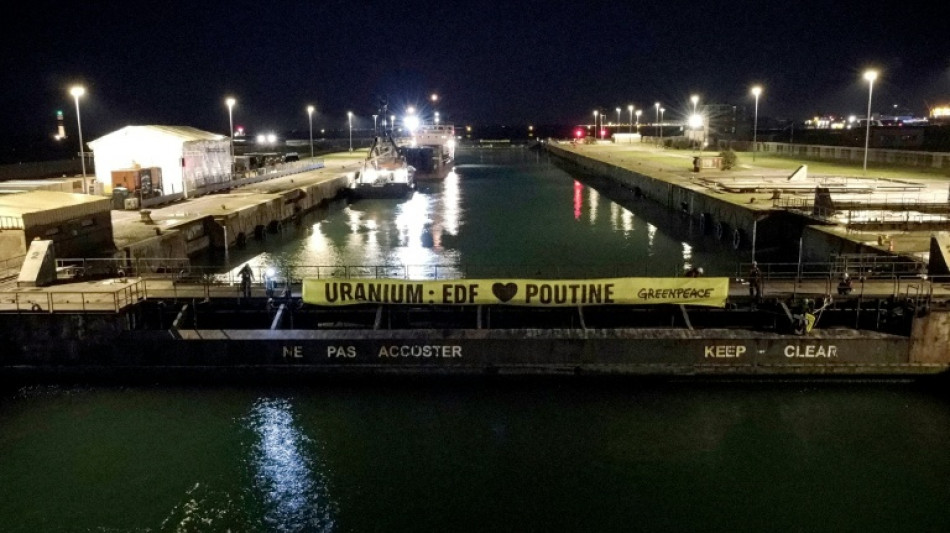
France arrests activists blocking ship over alleged Russia uranium links / Photo: Handout - GREENPEACE/AFP

 Thames Water seeks to delay £12bn in debt repayments

 Newark boxing gym expands alternative education programme
 Democrats consider impeachment drive against Defence Secretary Hegseth

 Energy bill plan could use HMRC income data to target support

 Business owner earning £6,000 a month tackles £70,000 debt

 Nvidia chief faces inquiry after disclosing affair with suspected Chinese agent

 Comet returns as online electrical marketplace 14 years after collapse

 KUFOS Signs MoU With Old Dominion University to Expand Academic Ties

 Karen Wazen Launches First Standalone Boutiques in Cairo

 Opti Digital Launches NEXA, an AI-Powered Intelligence Layer

Police arrested four Greenpeace activists on Monday for blocking a cargo ship in France that they alleged was transporting uranium from Russia for the country's nuclear power plants.
Around 20 protestors carrying signs reading "Stop toxic contracts" and "Solidarity with Ukrainians", blockaded the Mikhail Dudin at the northern port of Dunkirk early on Monday morning, to prevent it from unloading its cargo, an AFP journalist observed.
French authorities then arrested four individuals, Dunkirk police told AFP, adding that the blockade was lifted around 09:00 am (0800 GMT).
Greenpeace has repeatedly accused France of maintaining ties with Russia's state-owned energy company, Rosatom, despite President Vladimir Putin's war in Ukraine.
Activists, some on kayaks, had impeded the ship while a large banner stretched across the lock read, "Uranium: EDF loves Putin" -- a jab at the French state-owned energy giant.
In 2018, France's EDF signed a 600-million-euro ($700 million) deal with a Rosatom subsidiary, Tenex, for reprocessed uranium from French nuclear power plants to be sent to Russia to be converted and then re-enriched before being reused in power production.
Rosatom has the only facility in the world -- in Seversk in Siberia -- capable of carrying out key parts of the conversion of reprocessed uranium to enriched reprocessed uranium.
"This trade, which indirectly fuels Putin's war, must stop," said Pauline Boyer, an energy campaigner for Greenpeace France on Monday.
The environment group alleges it has "on numerous occasions" observed the Mikhail Dudin unloading Russian natural and enriched uranium in France.
- Repeated round trips -
An AFP analysis of Global Fishing Watch tracking data shows the Mikhail Dudin has made more than 20 round trips between Dunkirk and the Russian ports of Vistino, Ust-Luga and Saint Petersburg since Russia's full-scale invasion of Ukraine began on February 24, 2022.
The Baltiyskiy-202 -- another vessel that Greenpeace alleges has transported uranium between France and Russia -- has completed more than 15 round trips during the same period.
Both sail under the Panamanian flag and are owned by companies registered in Hong Kong, according to the International Maritime Organisation's register.
EDF did not immediately respond to AFP's request for comment.
In 2022, France ordered EDF to halt its uranium trade with Rosatom when Greenpeace first revealed the contracts in the wake of Russia's invasion.
But in March 2024, Jean-Michel Quilichini, head of the nuclear fuel division at EDF, said the company planned to continue to "honour" its 2018 contract.
France in March 2024 said it was "seriously" looking at the possibility of building its own conversion facility to produce enriched reprocessed uranium.
AFP analysis of French customs data shows that in 2025, France imported at least 112 tonnes of enriched uranium and its compounds from Russia, accounting for a quarter of total purchases by volume -- a level stable compared to 2024.
These imports however fell significantly between 2022 and 2024.
G.Teles--PC