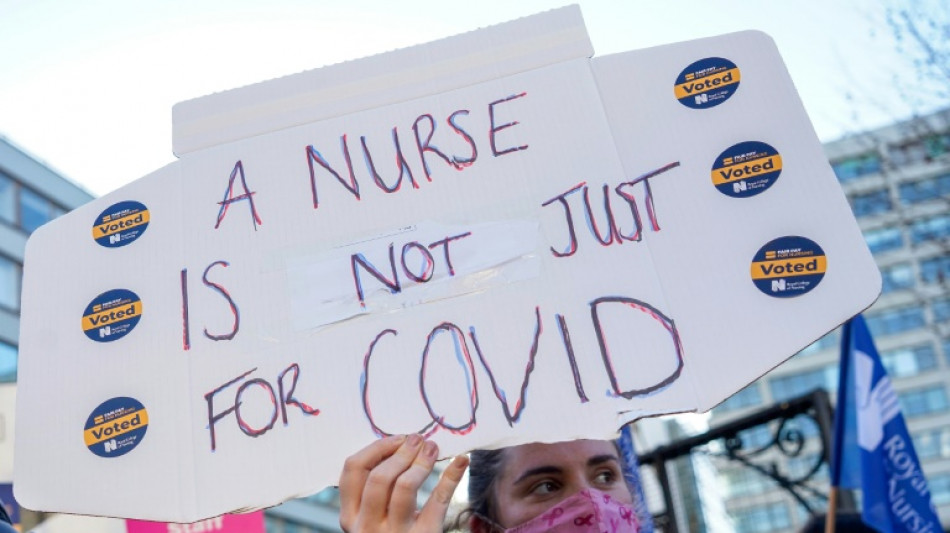
Nurses in England launch fresh strikes over pay / Photo: Niklas HALLE'N - AFP/File

 Kospi Falls Below 5,000 as U.S. AI Regulation Fears Trigger Circuit Breaker

 Valsoft's TAG Software Group Enters the Content Operations Market with the Acquisition of Chalco

 South Korea Proposes Fourth Delay of Cryptocurrency Gains Tax to 2029

 ASIC Fines Mona Museum Owner's Company for Late Financial Report
 Business Leaders Criticize Productivity Commission Inquiry Scope
Nurses in England began two days of strikes over pay Wednesday, as officials warned of disruption for thousands of patients in the UK's state-run health service.
It comes after nurses held an unprecedented strike last month, joining a wave of industrial action by public sector workers hit by the cost-of-living crisis.
The main nursing union accuses the government of failing to negotiate seriously on improving their pay deal for the current year.
The latest walkout piles further pressure on the state-funded National Health Service (NHS) at a time of peak demand and lengthy waiting lists for treatment.
"It is inevitable industrial action will have an impact on patients," health minister Steve Barclay said Tuesday.
Two days of strikes by nurses in England and Wales in December led to the cancellation of "around 30,000 elective procedures and outpatient appointments", Barclay said.
"Patients will understandably be worried by the prospect of further strike action by nurses," he added.
Yet the plight of medical staff has prompted public sympathy as soaring food prices and energy bills have hit lower-paid workers across the board.
A YouGov poll on Tuesday found 63 percent supported the nurses' strike.
But Prime Minister Rishi Sunak's official spokesman said Tuesday that it is not "the right course of action.
"We continue to call unions to step away from the picket lines and continue with discussions."
- 'Olive branch' -
Matthew Taylor, head of the NHS Confederation, which represents state health care providers in England and Wales, on Wednesday urged ministers to renew pay talks with trade unions.
"Our message to the government is to give the NHS a fighting chance and do all you can to bring an end to this damaging dispute," Taylor said.
This week's nursing strikes could cause 4,500 cancelled operations and 25,000 cancelled outpatient appointments, the NHS Confederation estimated.
Further strikes are planned for February 6 and 7 by the Royal College of Nursing (RCN) union, which said they will "be at the highest intensity in our history".
RCN general secretary Pat Cullen said: "My olive branch to governments -- asking them to meet me halfway and begin negotiations -- is still there. They should grab it."
A union representing ambulance workers, GMB, is also expected to announce Wednesday that it will resume strike action.
Ambulance drivers and paramedics this month held their second walkout in two months over pay and conditions.
The GMB union tweeted Tuesday that "government silence on pay gives... no option but to strike".
Barclay said he was keen for dialogue to continue, citing "constructive talks" with unions.
The NHS argues that it has given staff a "fair pay settlement".
Westminster MPs on Monday gave initial backing to controversial legislation that would require some frontline workers to maintain a minimum level of service during strikes.
C.Amaral--PC